Union Minister of State for Cooperation Krishan Pal Gurjar announced a stronger push for transparent and fair elections in Multi-State Cooperative Societies, stating that the government is implementing key reforms to strengthen democratic governance and accountability in the cooperative sector.
Speaking at a national seminar on “Transparency and Purity in Elections of Multi-State Cooperative Societies” held at Vigyan Bhavan, New Delhi, Gurjar said the initiative would prove to be a milestone for India’s cooperative movement. The seminar was organised by the Cooperative Election Authority under the Ministry of Cooperation.
The event brought together chairpersons, chief executive officers, board members of multi-state cooperative societies, returning officers, district magistrates, heads of state cooperative election authorities, experts from the cooperative sector and senior officials from both central and state governments.
Minister of State for Cooperation Krishna Pal Gurjar addressing the seminar.
Addressing the gathering, Gurjar noted that for the first time representatives of multi-state cooperative societies from across the country had come together on a single platform to discuss ways to enhance transparency and integrity in cooperative elections. He said the reforms are aligned with the vision of Prime Minister Narendra Modi of “Sahkar se Samriddhi” and are being carried forward under the leadership of Union Home and Cooperation Minister Amit Shah.
The minister highlighted that major reforms have been introduced through the Multi-State Cooperative Societies (Amendment) Act, 2023 to make cooperative institutions more transparent, accountable and democratic. One of the most significant changes was the establishment of an independent Cooperative Election Authority, formally notified on March 11, 2024, to ensure free, fair and transparent elections in multi-state cooperative societies.
Another key reform relates to fixing the tenure of boards of directors of multi-state cooperative societies and removing provisions that allowed boards to continue indefinitely until elections were conducted. Gurjar said this step would bring greater discipline in governance and prevent delays in holding elections.
According to the minister, the Cooperative Election Authority has already conducted around 240 elections, while about 70 elections are currently underway, and around 130 additional elections are expected in the coming financial year.
Gurjar also highlighted provisions in the amended law to promote inclusiveness in cooperative governance. The Act mandates reservation of two seats for women and one seat each for Scheduled Castes and Scheduled Tribes on the boards of multi-state cooperative societies. However, he noted that six seats reserved for women and thirteen seats for SC/ST categories remain vacant in elections held so far, and the ministry is taking steps to fill these positions.
He further pointed out that the Banking Regulation (Amendment) Act, 2025 has aligned the tenure of boards of cooperative banks, including multi-state cooperative banks, with constitutional provisions to strengthen democratic governance in the cooperative banking sector.
The minister also said the amended law requires cooperative banks to appoint auditors from a panel approved by the Central Registrar of Cooperative Societies, thereby enhancing transparency and accountability. Additionally, amendments to the Banking Regulation Act, 1949 stipulate that directors of multi-state cooperative banks cannot hold office for more than ten consecutive years, creating opportunities for younger leadership within cooperative institutions.
Gurjar stressed that cooperative societies operate on core cooperative principles that ensure equitable participation and democratic control by members. To build public trust in the cooperative system, he said institutions must adopt transparent administrative structures and merit-based systems for recruitment and procurement.
He also informed that following amendments to the Multi-State Cooperative Societies Act, 2002, the government appointed a Cooperative Ombudsman through a gazette notification on March 5, 2024 to protect the interests of cooperative members. The ombudsman reviews complaints filed by members and also serves as an appellate authority against orders of cooperative information officers.
More than 38,000 complaints have been received so far, and a significant number of these grievances have already been resolved through orders issued by the Cooperative Ombudsman.
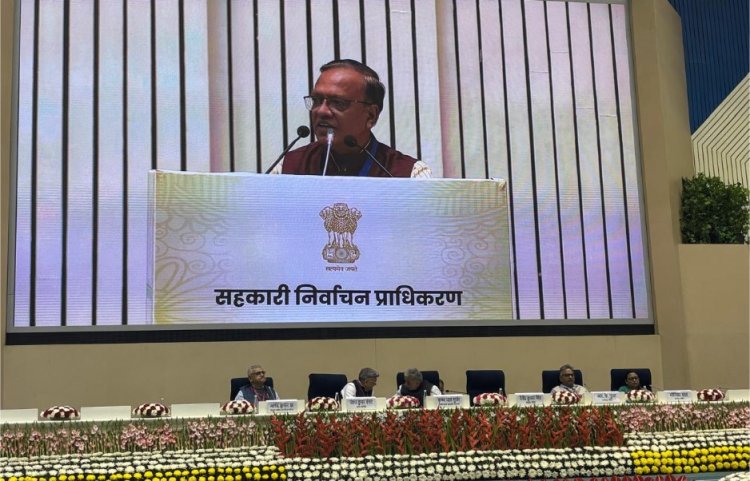
Chairperson of the Cooperative Election Authority Devendra Kumar Singh speaking at the seminar.
Speaking at the seminar, Chairperson of the Cooperative Election Authority Devendra Kumar Singh said the authority is now entering its third year of functioning and has gained valuable experience in conducting elections across various cooperative institutions.
He emphasised that cooperative societies operate on the principle of democratic member control, making it essential that the electoral process remains transparent, participatory and credible. Singh also stressed the importance of clearly defined bye-laws in cooperative societies, particularly regarding voting rights, active membership and eligibility criteria for contesting elections, to avoid disputes during elections.
He added that large multi-state cooperative societies operating across several states and districts should ensure that board representation reflects the diversity of their membership.
Two technical sessions were organised on the themes “Promoting Transparency through Elections” and “Strengthening Purity and Integrity in Electoral Processes.” Stakeholders held detailed discussions on improving cooperative election management and strengthening democratic participation in the sector.
The seminar concluded with a collective commitment to enhance transparency, fairness and democratic participation in cooperative elections, reinforcing the cooperative movement as a key pillar of India’s socio-economic development and advancing the government’s vision of a Viksit Bharat by 2047.