In Rajasthan’s Shekhawati region, water is no longer just a natural resource - for farmers, it has become a struggle for survival against rising debt and uncertainty. In the Nawalgarh area of Jhunjhunu district, the relentless decline in groundwater levels has dramatically transformed the rural landscape. Fields that once stayed green through the year now lie dry and barren. Families like that of farmer Bhagirath Choudhary, who until a decade ago cultivated crops across all three farming seasons, are today grappling with failed borewells, drying tubewells, and mounting financial distress. Despite spending lakhs of rupees in search of water, their fields continue to thirst.
The crisis extends far beyond agriculture. Livestock rearing, rural employment, and everyday social life are all under severe strain. Across villages in Shekhawati, the falling groundwater table has evolved from an environmental challenge into a deepening economic and humanitarian crisis. A report…
Bhagirath Chaudhary is a resident of the Nawalgarh region in Rajasthan’s Jhunjhunu district. Until a decade ago, he cultivated crops on his 22-bigha farm during all three agricultural seasons - rabi, kharif, and zaid. Irrigation for the entire farm was managed through a single tubewell connected to 22-25 sprinklers. However, due to the depletion of groundwater, he is now able to sow crops on only 8 to 10 bighas of land, while the rest of the farmland is entirely dependent on rainfall. Groundwater is the only source of water in the region, and as a result, the area under rabi cultivation has been steadily shrinking.
Describing his struggles, he says, “Earlier, my main occupation was camel rearing, but suddenly my camels started dying one after another. I then shifted to farming. Until 2010-12, groundwater availability was good, but after that the water level kept declining. I got six new borewells drilled in different parts of my farm and also tried to revive two old tubewells, but no water was found. Even where water was available, the quantity was too little for irrigation. Repeated drilling increased my debt burden. Farming no longer generates enough income to repay the loans.”
Farmer Bhagirath Choudhary standing near his tubewell, looking at his barren fields. (All photos: Mahesh Bhadana)
If a tubewell drilling attempt fails, a farmer suffers a loss of around Rs 1.25 lakh to Rs 1.40 lakh. This is only the initial cost of drilling a borewell. It includes the cost of using a dola machine for digging through soft soil and a separate machine for cutting through rock formations once stone layers are encountered. Borewell contractors charge on a per-foot basis. Soil excavation costs around Rs 100-120 per foot, while rock-cutting costs Rs 250-280 per foot. If water is eventually found, farmers must additionally bear the expenses of motors, cables, pipes, and sprinklers.
Due to the falling groundwater levels, Bhagirath has also been forced to reduce the area under cultivation. In recent years, he has taken up sheep rearing alongside farming. “Farming has become a loss-making activity,” he says, “which is why I had to turn to sheep rearing as an additional source of income.”
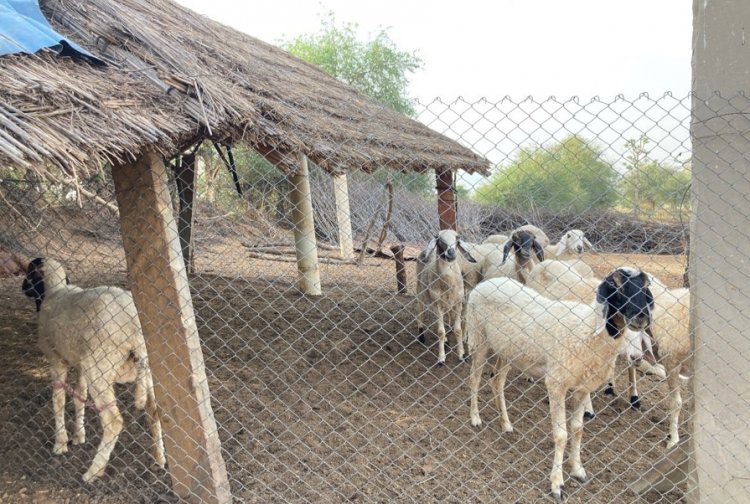
Shelter for farmer Bhagirath Choudhary’s sheep.
This story is not just about farmer Bhagirath Chaudhary; it reflects the plight of many farmers in the region. A large number of cultivators have now been reduced to tenant farmers and agricultural labourers. Until 2012-13, more than 600 bighas of land in the area were cultivated not only during the kharif season but also in the rabi and zaid seasons, with water available at depths of 150 to 200 feet. Today, however, rabi cultivation is limited to barely 90 to 115 bighas, while groundwater is found only at depths of 500 to 700 feet. The number of farmers cultivating crops during the zaid season has become negligible.
Bhagirath Chaudhary’s neighbouring farmer, Dhudram Gurjar, along with his extended family, used to irrigate around 90 bighas of land. When water levels in their tube well declined, they drilled borewells at four different locations, but none yielded water. At present, only three sprinklers function, and even those run for just two to three hours before the motor stops drawing water. As a result, this year they were able to sow crops on only 12 out of their total 90 bighas during the rabi season. Even that was done in the hope that rainfall in November or December would help the crop survive.
The tubewell jointly owned by farmer Dhudram Gurjar and his brothers.
“Earlier, the fields remained green throughout the year. Now the land lies barren and abandoned,” says Dhudram.
Livestock Rearing Also Hit by Groundwater Depletion
Woman farmer Santosh Gurjar from Chaingarh village, while milking her buffalo, says, “I was 16 years old when I got married and came to this village. At that time, there was no shortage of water, and there was so much work in the fields that we hardly had any free time. Abundant water availability also meant people kept a large number of livestock. Along with farming, families reared cows, buffaloes, and goats. But as water scarcity increased over the years, the area under cultivation kept shrinking, and the number of livestock also gradually declined.”
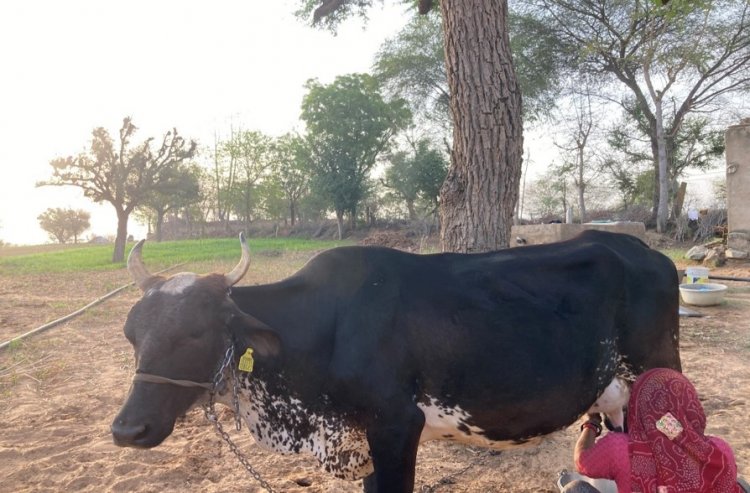
Woman farmer Santosh Gurjar milking her buffalo.
Santosh Gurjar’s neighbour, Sajna Devi, while cutting green fodder for her cattle in the field, says that the shortage of water has also led to a decline in fodder availability. As a result, the family has had to reduce the number of livestock they own. At present, they have only three animals, which are just enough to meet the household’s basic needs. Earlier, Sajna Devi used to cultivate green fodder on 3-4 bighas of land, but now fodder is grown on barely half a bigha. Even that crop is withering due to water scarcity and extreme heat.
Woman farmer Sajna Devi cutting green fodder for cattle in her fields.
How the crisis escalated
Several research papers and government reports indicate a sharp decline in groundwater levels in the Nawalgarh region of Rajasthan’s Jhunjhunu district. A study on groundwater levels and quality in Jhunjhunu district by Dr. P.S. Chauhan, Principal of Shri Tagore College, Kuchaman City, was published in July 2025 in the “International Journal of Innovation and Research Analysis.” The study found that both groundwater availability and water quality in the Nawalgarh and Mandawa tehsils are in a poor state. Water samples from the region showed excessive levels of fluoride, nitrate, and chloride, posing serious risks to public health as well as agriculture. Similar concerns were highlighted in the Central Ground Water Board’s (CGWB) reports - “Hydrological Atlas of Rajasthan-2013” and “Ground Water Year Book 2020-21” - published under the Union Ministry of Jal Shakti. These reports also pointed to deteriorating groundwater quality and alarming concentrations of fluoride, nitrate, and chloride.
One of the primary reasons behind the rapid depletion of groundwater in Nawalgarh is the excessive extraction of water for agriculture. Farmers in the region also face repeated borewell failures due to rocky underground formations. Ironically, these very rock deposits have encouraged the growth of cement factories in the area. Currently, three cement plants are operational in the region, while land acquisition for new projects is underway. Local villagers claim that groundwater levels in nearby villages have dropped drastically due to these factories, causing fertile farmland to turn barren. However, no scientific study has yet established a direct link between the cement plants and declining groundwater levels.
The water crisis in the Shekhawati region is steadily worsening for both farmers and residents, as groundwater remains the only major source of water. To address the issue, the state Agriculture Department has introduced a rainwater harvesting initiative called the “Farm Pond” scheme, under which farmers receive a 60-70 percent subsidy from the state government.
Speaking to Rural Voice, Nawalgarh agriculture officer Subhash Seegar said that around 200 farmers had applied for the scheme over the past two years, of whom 93 received benefits. This year, officials expect more than 500 farmers to apply under the programme.