The War in West Asia is disrupting global fertilizer and gas supplies, leading to a sharp increase in fertilizer prices in India for the Kharif 2026 season. The surge is expected to raise input costs for farmers, particularly due to steep hikes in the prices of complex fertilizers such as NPK.
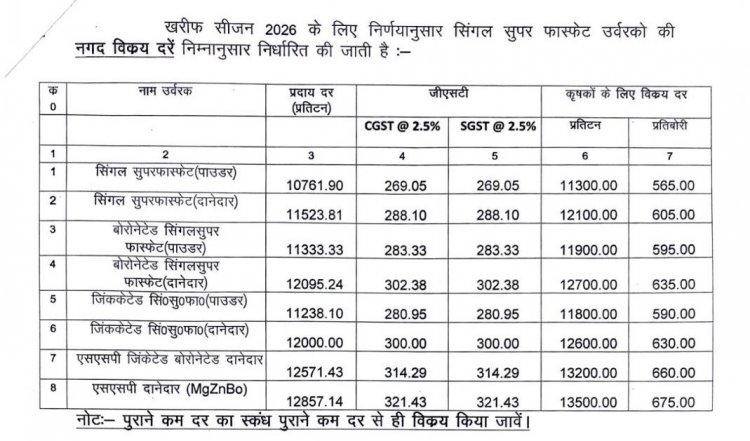
The Madhya Pradesh State Cooperative Marketing Federation has announced revised retail prices for chemical fertilizers for the Kharif 2026 season. Under the new rates, a 50 kg bag of NPK (12:32:16) and NPK 10:26:26 will now cost Rs 2,450, compared to Rs 1,720 during the previous Kharif season, marking a substantial increase.
The fertilizer rates have been finalized by the cooperative marketing federations of Madhya Pradesh and Chhattisgarh based on tenders received from fertilizer companies. Farmers across the season will be supplied fertilizers at these revised prices. Urea has been excluded from the revision because its price is regulated by the central government and remains unchanged.
Similarly, the price of decontrolled fertilizer Diammonium Phosphate (DAP) has been kept stable at Rs 1,350 per 50 kg bag. The government is providing additional subsidies to maintain DAP prices. Total fertilizer subsidy burden this year is estimated to cross Rs 3 lakh crore.
Industry sources said the ongoing Iran conflict and broader West Asia crisis have disrupted imports of fertilizers and natural gas, affecting fertilizer production globally. As a result, fertilizer companies have started increasing prices of complex fertilizers. Reports in recent weeks indicated that NPK fertilizer prices had already climbed to nearly Rs 2,450 per bag despite having lower nutrient content than DAP.
According to the revised rates, NPK (16:16:16) has been priced at Rs 2,050 per bag, up from Rs 1,475 last year. Ammonium Sulphate will now cost Rs 1,400 per bag compared to Rs 950 earlier. The price of MOP (Potash) has increased to Rs 1,975 per 50 kg bag from Rs 1,535 last year. Similarly, granular Single Super Phosphate (SSP) has been fixed at Rs 605 per bag, up from Rs 505 in the previous Kharif season.
The sharp rise in fertilizer prices is expected to significantly impact farm input costs and farmer incomes during the ongoing Kharif season.
The federation is yet to finalize the price of NPK (20:20:0:13). Sources said fertilizer companies have quoted around Rs 2,100 per bag for this variant, although efforts are being made to negotiate lower prices. Sources indicated that fertilizer prices in most other states are also expected to remain at similar levels.
Industry officials also pointed to shortages of ammonia, sulphur and sulphuric acid, which are affecting production of complex fertilizers. India annually consumes nearly 400 lakh tonnes of urea, about 100 lakh tonnes of DAP and around 140 lakh tonnes of complex fertilizers. At present, the government is prioritising the availability of urea and DAP through imports of LNG and finished fertilizers.
Fertilizer production relies heavily on natural gas, a significant portion of which is imported from the Middle East and used in the manufacture of ammonia, a crucial raw material. Reduced LNG availability following the effective closure of the Strait of Hormuz forced fertilizer companies to suspend plant operations, leading to lower production.
Meanwhile, the government is simultaneously attempting to reduce fertilizer consumption. Prime Minister Narendra Modi recently emphasised reducing the use of chemical fertilizers and promoting natural farming practices. A policy roadmap aimed at lowering dependence on chemical fertilizers may soon be finalised.
However, with the Kharif season already underway, experts warn that any delay in fertilizer availability could adversely affect crop production and agricultural output this year.