Union Minister for Agriculture & Farmers Welfare and Rural Development Shivraj Singh Chouhan announced that a dedicated team will be set up within the Indian Council of Agricultural Research (ICAR) for sugarcane research in the country. This team will also work on the sugarcane policy. The Minister made this announcement while addressing a National Consultation on the Sugarcane Economy, organized by Rural Voice and National Federation of Cooperative Sugar Factories (NFCSF) in collaboration with the Indian Council for Agriculture Research (ICAR).
Shivraj Singh Chouhan highlighted that sugarcane variety 238 has shown good sugar content but is vulnerable to red rot disease. He emphasised the need to work simultaneously on developing alternatives. Controlling diseases, he said, is a critical challenge since new varieties often bring new disease risks.
"We are aware of the challenges," Chouhan said. "We must focus on increasing production and mechanization, reducing costs, and improving sugar recovery. Water use is a serious concern. Under the principle of ‘per drop, more crop,’ we need strategies to reduce water requirements. At the same time, we must consider the financial burden on farmers, since drip irrigation involves significant costs."
Chouhan acknowledged the issues around the sugar value chain, stating that farmers’ grievances about delayed payments are genuine. While sugar mills face their own difficulties, he said, farmers remain at a disadvantage when payments are delayed. He further highlighted the shortage of agricultural labour and suggested training and capacity building, along with innovations in mechanization, to make sugarcane harvesting less labour-intensive.
Agriculture Minister said, "I urge ICAR to form a separate team for sugarcane research, focusing on practical issues. Research must benefit both farmers and industry. Research that does not serve farmers is meaningless."
He said, "Our goal is to make sugarcane a significant factor in India's agricultural economy and to remove all obstacles to this end. Today's discussion could form the basis of our roadmap for sugarcane production. The Agriculture Department is planning for the next five years. This discussion is crucial before that."
ICAR head highlights four areas of focus
At the same conference, ICAR Director General and DARE Secretary Dr. M.L. Jat outlined four key research focuses: first, what to focus on; second, what developmental issues are needed to advance research; third, what are the industry-related issues; and fourth, what policy steps should be taken.
Dr Jat stated that sugarcane uses a lot of water, fertilizer, and labour. Monocropping poses pest and disease problems, along with industry and market-related issues.
Significant research has been conducted and is underway to address the water problem. Micro-irrigation of sugarcane in other areas, like in Maharashtra, will save water. The current fertilizer use is not appropriate. Increasing fertilizer efficiency is essential. It is also crucial to address sugarcane stubble.
He stated that diversification is essential to address monocropping. Pulses and oilseeds can be used in intercropping with sugarcane. Efforts are underway to increase the production of pulses and oilseeds in the country. Intercropping will increase farmers' income and promote sustainability. The same amount of fertilizer and water used for sugarcane can be used to grow peanuts. This will benefit sugarcane through nitrogen fixation.
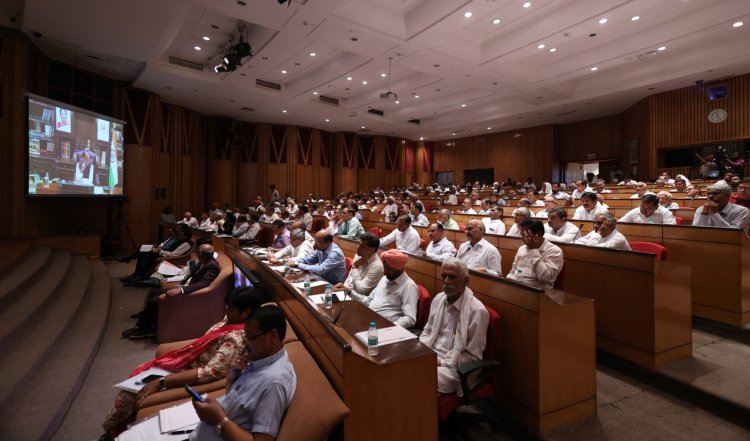
Farmers and sugar industry representatives raise their concerns
During the discussion, progressive sugarcane farmers from several states shared their problems and issues. The most pressing concern was the lack of a suitable alternative to the disease-prone sugarcane variety 0238. Farmers also raised issues related to sugarcane price and the shortage of labour.
On this occasion, senior scientists from ICAR (Indian Council of Agricultural Research) briefed the participants about their ongoing efforts to develop improved sugarcane varieties. Senior scientists, including Dr Devendra Kumar Yadava, Deputy Director General (Crop Science), Dr Rajbir Singh, Deputy Director General (Agricultural Extension), Dr P. Govindaraj, Director of the Sugarcane Breeding Institute, Coimbatore, and Dr Dinesh Singh, Director of the Indian Institute of Sugarcane Research, Lucknow, discussed the technical and scientific aspects of sugarcane cultivation.
Deepak Ballani, Director General of ISMA, Roshan Lal Tamak, CEO and Executive Director (Sugar Business) of DCM Shriram Limited, and Atul Chaturvedi, Executive Chairman of Renuka Sugars Limited, shared their concerns related to sugar and ethanol production.
Ketan Kumar Patel, Vice President, and Prakash Naiknavare, Director General of the National Federation of Cooperative Sugar Factories (NFCSF), spoke about the role of cooperative sugar mills and the issues they face.
Concluding the program, Harvir Singh, Editor-in-Chief of Rural Voice, emphasized the importance of dialogue and coordinated efforts to address the challenges in the sugarcane economy and improve farmers' incomes.