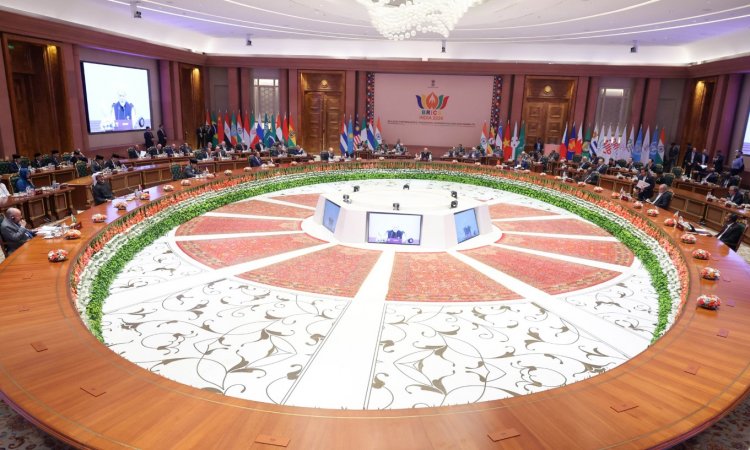
BRICS, marking two decades since its formation, entered a new phase at the New Delhi Summit as member countries adopted the 2026 New Delhi Declaration and India called for a more action-oriented agenda for the next 20 years. Prime Minister Narendra Modi described the grouping as having reached a “coming of age” moment and urged members to translate consensus into measurable outcomes, while seeking a stronger voice for the Global South in global economic and political governance.
The unanimous adoption of the declaration was significant after differences among members had prevented a joint statement at the BRICS foreign ministers’ meeting in May. India undertook extensive consultations to bridge disagreements, including on sensitive geopolitical issues.
Strong stand on trade barriers
Trade emerged as a major economic priority in the declaration. BRICS members expressed serious concern over the growing use of unilateral tariffs and non-tariff measures that distort international trade and are inconsistent with World Trade Organization rules. The grouping also opposed unilateral coercive measures that it said run contrary to international law.
The declaration called for continued efforts to develop practical solutions for cross-border payments among BRICS members. The initiative is part of a wider effort to strengthen trade and financial cooperation and reduce vulnerabilities arising from external economic pressures.
India has been seeking greater trade integration within BRICS, lower barriers and more business opportunities among member countries, while also advocating a larger role for emerging economies in shaping global economic rules.
Modi calls for governance reform
Opening the summit, Modi argued that the Global South continues to bear a disproportionate share of the impact of global crises while having limited influence over international decision-making. He called for a shift from “privilege to partnership” and from being a “rule taker” to a “rule shaper”.
He proposed that BRICS prepare a roadmap for global governance reform by the next summit, based on representation, responsiveness and rule-making. Reform of the United Nations Security Council, including greater representation for India and other emerging economies, was highlighted as an urgent priority.
Modi also stressed that BRICS must focus on implementation rather than merely reaching consensus. He proposed a secure digital repository to monitor the bloc’s initiatives, responsible agencies, timelines and progress.
Technology and crisis response
Technology is expected to become an increasingly important part of the BRICS agenda. Modi identified artificial intelligence, cyberspace, outer space and biotechnology among the critical technologies likely to influence future global rules. He suggested that BRICS could help companies from developing countries strengthen their negotiating, legal and technical capabilities.
The Prime Minister also proposed a BRICS emergency-response mechanism for seafarers, including distress alerts, medical assistance and systems to keep families informed during emergencies. The proposal reflects the bloc’s attempt to connect global cooperation with practical support for people involved in international trade.
Geopolitical tensions test consensus
The declaration was adopted against a difficult geopolitical backdrop, with continuing conflicts and heightened tensions in the Middle East. BRICS leaders expressed concern over the risks associated with conflict and nuclear threats, while stressing the importance of maintaining nuclear safety, security and safeguards even during armed conflicts.
The summit brought together leaders including Russian President Vladimir Putin, Chinese President Xi Jinping, Iranian President Masoud Pezeshkian, South African President Cyril Ramaphosa and Abu Dhabi Crown Prince Sheikh Khaled bin Mohamed bin Zayed Al Nahyan.
India’s chairmanship comes as BRICS expands its role and membership. The grouping now includes Brazil, Russia, India, China, South Africa, Egypt, Ethiopia, Indonesia, Iran and the UAE. India has used its fourth BRICS chairship to promote resilience, innovation, cooperation and sustainability, organising more than 350 meetings and high-level engagements across nearly 30 cities.