India should aim to increase maize production to 75 million tonnes over the next decade, alongside a 1.5-fold increase in productivity, Dr M. L. Jat, Secretary, Department of Agricultural Research and Education (DARE) and Director General, ICAR, said this at the inaugural 1st International Maize Conference 2026 in Hyderabad on Monday. Padma Bhushan Dr R. S. Paroda, former Secretary, DARE, and Director General, ICAR, called for aligning research priorities with the evolving needs of agriculture and allied sectors, while Dr H. S. Jat, President of the Maize Technologists Association of India (MTAI), emphasised stronger collaboration among research institutions, agricultural universities, policymakers and industry.
Addressing the conference, Dr M. L. Jat said India's maize production had reached approximately 55 million tonnes, supported by substantial productivity gains over the past decade. He emphasised technological innovation, improved crop management and efficient resource utilisation to achieve the next phase of growth.
The conference, themed “Maize Revolution for Food, Feed, Fodder, Fuel and Sustainability in the Changing World”, is being held from November 2 to 4 at the JD Convention Centre, Hyderabad.
Dr M. L. Jat advocated expanding the traditional 4F vision of maize - food, feed, fodder and fuel - to a 5F approach by placing farmers at the centre. He stressed that research and extension must translate into higher farm profitability and improved livelihoods.
He called for a systems-science approach to bridge yield gaps, particularly those arising from crop management, and strategically expand maize cultivation across seasons and agroecological zones without compromising oilseeds and pulses. Affordable, quality seeds, particularly public-sector hybrids, and a robust seed system were identified as key priorities.
Dr D. K. Yadav, Deputy Director General (Crop Science), ICAR, highlighted the development of 329 maize hybrids over the past five years and called for strengthening the All India Coordinated Research Project on Maize. He emphasised breeding for higher yields, improved nutritional quality and resistance to biotic and abiotic stresses, alongside mechanisation, input-use efficiency and stronger public-sector hybrid seed production.
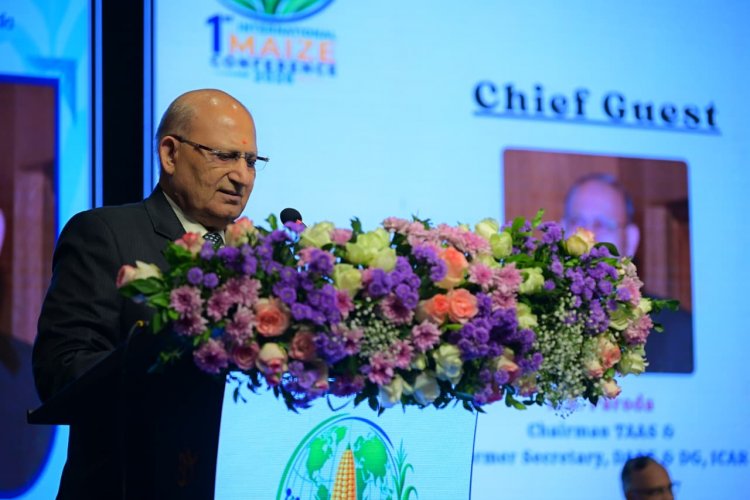
Padma Bhushan Dr R. S. Paroda, former Secretary, DARE, and Director General, ICAR.
Dr R. S. Paroda stressed the need for advanced breeding techniques, systematic germplasm conservation and utilisation, stronger maize value chains and effective aflatoxin management to ensure food and feed safety.
Padma Shri Dr S. Vasal, eminent maize scientist associated with CIMMYT, advocated simple and cost-effective breeding approaches to develop improved varieties and hybrids suited to farmers' needs.
The conference brings together scientists, policymakers, agricultural institutions and industry stakeholders to strengthen collaborative research, improve seed access and develop sustainable maize value chains, including for ethanol production. Several scientific publications were released and awards presented to scientists and researchers for their contributions to maize research and development.