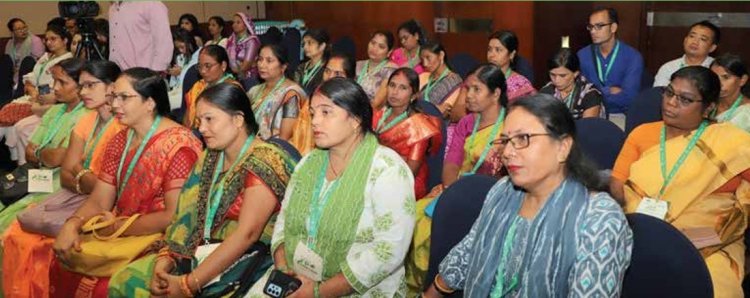
The 5th Farmer Producer Organisation (FPO) Conclave 2025, jointly organised by NABARD and Samunnati, unveiled a series of landmark initiatives aimed at strengthening farmer collectives and transforming them into enterprise-ready, resilient institutions. Held recently in New Delhi, the event brought together over 2,500 delegates, including more than 1,000 FPO leaders, policymakers, agri-tech innovators, and financial institutions, all united by the theme “Partnerships for Sustainability towards a Future-Ready FPO Ecosystem.”
The conclave showcased India’s evolving agricultural ecosystem—where collaboration, innovation, and inclusivity are converging to redefine the role of farmers as entrepreneurs and key stakeholders in national growth.
A Platform for Collective Vision
The inaugural plenary opened with Anil Kumar SG, Founder and CEO of Samunnati, calling for stronger multi-stakeholder partnerships to unlock the trillion-dollar potential of Indian agriculture. In a video message, Union Agriculture Minister Shivraj Singh Chouhan reaffirmed the government’s commitment to empowering FPOs as “engines of rural prosperity.”
Prof. Ramesh Chand, Member of NITI Aayog, who was Chief guest for the event, outlined the strategic vision for transforming Indian agriculture through enabling and scaling Farmer Producer Organizations. His remarks illuminated the evolving landscape of rural markets, the need for climate-resilient farming, and the centrality of farmer collectives in policy frameworks
.
Pravesh Sharma, Chairman at Samunnati Foundation, delivered the theme introduction, emphasizing the powerful momentum of the FPO ecosystem, which integrates grassroots transformation with strategic partnerships. Sharma invited delegates to envision a future where collective enterprise, innovation, and market linkages uplift millions of smallholder farmers across the country. NABARD’s Deputy Managing Director A.K. Sood highlighted the importance of policy-backed financial instruments and digital governance to make FPOs sustainable.
Major Launches and Reports
One of the event’s biggest highlights was the release of the State of the Sector Report – FPOs 2025 by NAFPO, which mapped more than 44,000 registered Farmer Producer Companies (FPCs) across the country. The report introduced the first Ease of Doing Business for FPOs (EODBF) Index, providing comparative insights into how various states enable institutional growth and sustainability.
Another milestone came with the launch of the Closure Report on “Building an Enabling Ecosystem for Indian FPOs,” a multi-year initiative by Samunnati and the Bill & Melinda Gates Foundation (BMGF). The report demonstrated how integrated access to finance, markets, technology, and advisory services can transform FPOs into resilient, investor-ready entities—effectively creating a new asset class in Indian agriculture.
Further energizing the sector, Samunnati announced FPO ScaleX, an ambitious programme to nurture 300 FPOs into ₹100 crore enterprises—the so-called “Unicorn FPOs.” The initiative seeks to position FPOs as anchors of scale, sustainability, and market leadership within the agricultural value chain.
Financial Security and Inclusion for Farmers
A landmark session at the conclave explored expanding the National Pension System (NPS) to farmers. Suparna Tandon, CEO of NPS Trust, described pensions as a “second harvest,” ensuring long-term income stability and dignity for rural households. Experts from NABARD, State Bank of India, and Madhya Bharat Consortium of FPOs shared strategies to simplify enrollment and build pension literacy through FPO networks, framing NPS as both a financial and social safety net.
Women Farmers Lead the Way
Women’s leadership took centre stage through the session “The Future She Grows”, which showcased inspiring examples of women driving climate-smart agriculture and local food system innovations. Speakers from NAFPO, Frontier Markets, and CInI highlighted how empowering women with access to knowledge, finance, and digital tools strengthens community resilience.
A highlight was the launch of two new rural brands—Nari and Tribo—by Corteva Agriscience and Samunnati Foundation. Nari celebrates women farmers’ entrepreneurship, while Tribo promotes tribal produce like Mahua Ladoo under the “Tribo” initiative, symbolizing cultural heritage and sustainable livelihoods.
Driving Climate-Smart and Digital Innovation
The conclave’s sessions underscored the centrality of technology in modernizing agriculture. TERI’s session on Agrivoltaics presented a dual-use model combining solar power generation with crop cultivation, positioning renewable energy as a “third crop” that enhances income and resource efficiency.
Similarly, discussions led by Digital Green, Grameen Foundation, and Ray One Consulting showcased AI-driven precision farming, satellite monitoring, and weather-based advisories that boost productivity while reducing input costs.
The introduction of the Unified Krishi Interface (UKI), developed by Aarti Industries in collaboration with Samunnati, was another technological milestone. Based on open digital architecture, UKI enables farmers to access multiple agri-services—inputs, credit, advisory, and logistics—on a single interoperable platform.
Insurance, Finance, and Value Chain Innovations
Risk management was another key focus area. The session on Parametric Insurance, co-hosted by SBI General and ET Insights, showcased scalable models offering quick and transparent payouts to farmers affected by weather or market shocks. Examples included Nagaland’s monsoon insurance and SEWA’s heat cover for women farmers, demonstrating how index-based insurance can safeguard livelihoods.
Panels on horticulture finance, resilient value chains, and biodiversity conservation highlighted the importance of blended capital, digital integration, and ecosystem partnerships to ensure inclusivity and scalability. Industry leaders such as Coromandel International, ITC, and Srinivasa Farms shared how collaborations with FPOs are driving efficiency, sustainability, and innovation across agri-value chains.
Grassroots and Global Voices
Grassroots success stories from leaders like Yogesh Dwivedi of Madhya Bharat Consortium and Puneet Singh Thind of Northern Farmer Mega FPO illustrated how strong governance, market linkages, and digital adoption are empowering smallholders. Their experiences echoed the Conclave’s core belief—that farmer-led institutions are key to equitable agricultural growth.
The presence of a Cambodian delegation and insights from the Gates Foundation added a global perspective, underscoring India’s growing role as a model for collective, sustainable agriculture in the Global South.
A Vision for the Future
Concluding the event, Samunnati and NABARD reaffirmed their commitment to building a future-ready FPO ecosystem through continuous innovation, capacity building, and policy advocacy. The FPO Pavilion, showcasing products and innovations from across states, reflected the vitality of farmer entrepreneurship and the spirit of collaboration driving rural India.
As India moves toward a more sustainable, inclusive agricultural future, the 5th FPO Conclave 2025 stands as a defining moment—where partnerships turned into possibilities, and farmers became architects of their own prosperity.