The Union Modi government has projected the ethanol blending programme as a significant achievement and a farmer-friendly initiative. However, the farmers’ protest against the proposed ethanol factory in Rathikheda village of Tibbi tehsil in Rajasthan’s Hanumangarh district has raised serious questions. After the agitation turned violent on December 10, construction work at the factory site was temporarily halted. Despite this, protesting farmers remain firm in their demand for the complete removal of the factory.
Although tensions appeared to ease after an agreement was reached on Friday through administrative mediation, the political atmosphere around the issue continues to be charged. In solidarity with the Tibbi farmers, several farmer organisations have called a mahapanchayat in Hanumangarh on December 17. Prominent farmer leaders, including Rakesh Tikait, Gurnam Singh Chaduni and Joginder Singh Ugrahan, are expected to participate.
Sriganganagar MP Kuldeep Indora and Nagaur MP Hanuman Beniwal have raised the issue in the Lok Sabha. Political confrontation has intensified, with the Congress criticising the state government over the lathicharge on farmers, while BJP ministers accuse Congress leaders of provoking the agitation. Amid these accusations and counter-accusations, one fact stands out: the Tibbi agitation did not emerge suddenly but has its roots in the Zira movement in Punjab.
Farmers protesting against the ethanol factory and smoke rising. Photo: Social media
The Zira movement set a precedent
Hanumangarh’s proximity to Punjab and Haryana has ensured close coordination among farmer organisations in border districts. The prolonged agitation by farmers in Mansoorwal village of Zira tehsil in Punjab’s Ferozepur district against the Malbros International Ethanol Distillery showed Tibbi farmers a path of resistance. Similar to Zira, the protest in Tibbi has continued for the past sixteen months.
In Zira, farmers from 44 villages began their agitation on July 24, 2022, which lasted 177 days. Under sustained public pressure and environmental concerns, the Punjab government ordered the closure of the ethanol factory in January 2023. Subsequently, on November 2, 2025, the Punjab government acknowledged before the National Green Tribunal that the distillery had caused serious environmental damage and should be permanently shut.
This decision became a major reference point for farmers in Hanumangarh. Members of the Factory Hatao Kshetra Bachao Sangharsh Samiti, including Madan Durgesar, Mahnga Singh Sidhu and Jagjit Singh Jaggi, visited Zira and interacted with protesting farmers. Madan Durgesar says, “After hearing the conditions described by the Zira farmers, the ground slipped from under our feet. We realised that if we did not stop it in time, Tibbi would suffer the same fate.”
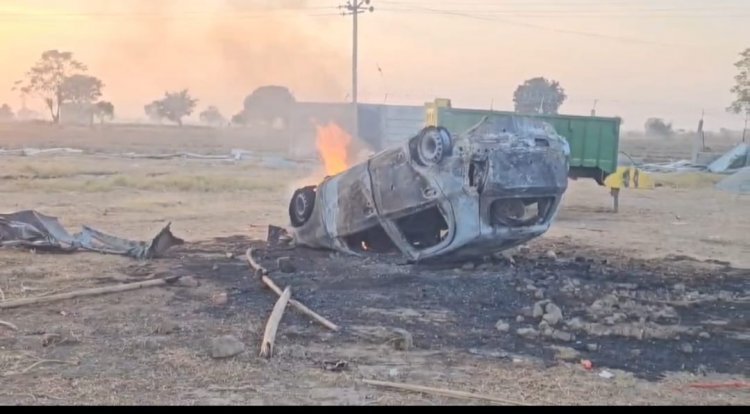
Vehicles set on fire at the factory site | Photo: Amarpal Singh Verma
Concerns over water scarcity and pollution
According to Madan Durgesar, industrial waste and foul odour from the ethanol factory established in Zira in 2006 severely affected farmland, groundwater and the surrounding environment. Polluted water entering fields reduced soil fertility, damaged crops and degraded drinking water quality. Reports of increased health problems among residents also surfaced.
The closure of the Zira factory after a prolonged protest served as both a warning and a model for Tibbi farmers. Both agitations share similarities, including long-duration protests, village-level mobilisation, extensive use of social media and a strong focus on environmental damage.
A protest spanning nearly two years
Unrest in the Tibbi region began two years ago when farmers learned that Chandigarh-based Dune Ethanol Private Limited planned to establish a 1,320 KLPD grain-based ethanol plant along with a 24.5 MW power plant on about 45 acres of land in Rathikheda village, with an investment of ₹450 crore. Farmers submitted memorandums to the district administration opposing the project.
Agriculture in Tibbi largely depends on tube wells, and concerns over excessive groundwater extraction and pollution intensified opposition to the factory. When the company began constructing a boundary wall in July 2024, protests escalated. On August 12, 2024, large numbers of farmers staged a sit-in at the site, which continued until November 19, 2025, when the administration, with police support, removed the protesters and resumed construction.
Meeting between the administration and farmers in Hanumangarh on Friday night | Photo: Amarpal Singh Verma
Events of December 10
On December 10, farmers from dozens of villages gathered for a mahapanchayat outside the SDM office in Tibbi. After the meeting, thousands marched towards the factory site on tractors. As farmers pushed against the boundary wall, tensions flared. Following arson and vandalism, police used tear gas, lathicharge and plastic bullets. Dozens of people on both sides were injured.
Internet services were suspended and heavy police deployment followed. Several people, including Congress MLA Abhimanyu Poonia, were injured. More than 16 vehicles were burnt and several others damaged. FIRs were registered against 107 people, and multiple arrests were made.
After three days of tension, an agreement between the administration and police led to a halt in construction. However, farmers remain on strike. Sangharsh Samiti member Jagjit Singh Jaggi maintains that the agitation will continue until the project is completely cancelled.
Credibility of company claims questioned
Dune Ethanol Private Limited has claimed the plant will use modern technology, pollution-control equipment and a zero liquid discharge system, while offering better crop prices and employment opportunities. Farmers, however, remain unconvinced.
Former district head Shabnam Godara says, “This is not a question of trust, but of the future. We will not allow anything in the name of development that threatens future generations.” Farmer Vinod Nehra argues that ethanol projects elsewhere have damaged water, land and air, questioning why Tibbi would be different.
At present, construction remains suspended. The administration has promised further action after consultations and inquiry, but farmers continue their protest, demanding complete revocation of the project’s approval. Madan Durgesar reiterates, “Until the decision is reversed, agitation is the only way.”