Kharif sowing in India is moving towards its final stages, but the overall cropped area remains marginally below last year’s level. According to the latest data from the Ministry of Agriculture and Farmers Welfare, kharif crops had been sown across 1,056.70 lakh hectares as of 21 August 2026, compared with 1,072.77 lakh hectares during the same period last year.
The total area under kharif crops is therefore lower by 16.07 lakh hectares, or 1.50%, from a year ago. While the gap has narrowed significantly from the early weeks of the monsoon season, lower acreage under rice, maize and ragi has kept overall sowing below last year’s level.
Rice Sowing Down 3.15%
Rice, India’s largest kharif crop, was planted across 405.10 lakh hectares as of 21 August, compared with 418.29 lakh hectares during the corresponding period last year. This represents a decline of 13.19 lakh hectares, or 3.15%.
However, the current rice acreage is approaching the normal area of 412 lakh hectares, according to the Department of Agriculture and Farmers Welfare.
Pulses Area Rises 1.33%
Pulses have recorded a better performance, with the total area rising to 113.63 lakh hectares from 112.14 lakh hectares a year earlier. This marks an increase of 1.49 lakh hectares, or 1.33%.
Tur was sown across 43.86 lakh hectares, urad across 24.38 lakh hectares and moong across 32.68 lakh hectares. Urad acreage rose sharply by 12.22% from last year, while tur registered a marginal increase of 0.97%. Moong, however, saw its area decline by 3.67%.
Maize and Ragi Decline, Bajra and Jowar Gain
The total area under Shri Anna and coarse cereals stood at 176.36 lakh hectares, down 1.92% from 179.81 lakh hectares last year.
Maize acreage fell to 89.51 lakh hectares from 93.30 lakh hectares, a decline of 4.06%. Ragi recorded the sharpest fall among the major crops, with its area dropping to 4.81 lakh hectares from 6.60 lakh hectares, a decline of 27.14%.
In contrast, jowar acreage increased by 6.41%, while bajra recorded a 2.13% rise.
Oilseeds Remain Almost Unchanged
The total area under oilseeds stood at 188.37 lakh hectares, marginally lower than 188.69 lakh hectares last year, representing a decline of just 0.17%.
Groundnut acreage rose by 1.18%, while sesamum recorded a significant increase of 15.16%. Sunflower acreage surged by 80.98% and nigerseed by 48.94%, although both crops account for relatively smaller areas.
Soybean acreage declined by 1.15%, while castorseed recorded a sharper fall of 20.80%.
Marginal Decline in Sugarcane and Cotton
Sugarcane acreage stood at 58.44 lakh hectares, compared with 58.87 lakh hectares during the same period last year, a decline of 0.72%.
Cotton was sown across 108.45 lakh hectares, marginally lower than 108.73 lakh hectares a year ago. The combined area under jute and mesta, however, increased by 1.68% to 6.34 lakh hectares.
Overall, India’s kharif sowing remained only 1.50% behind last year’s level as of 21 August. Higher acreage under pulses and broadly stable oilseed coverage have helped limit the overall decline, although lower sowing under rice, maize and ragi has kept total coverage below last year’s level.
Monsoon Rainfall 13% Below Normal
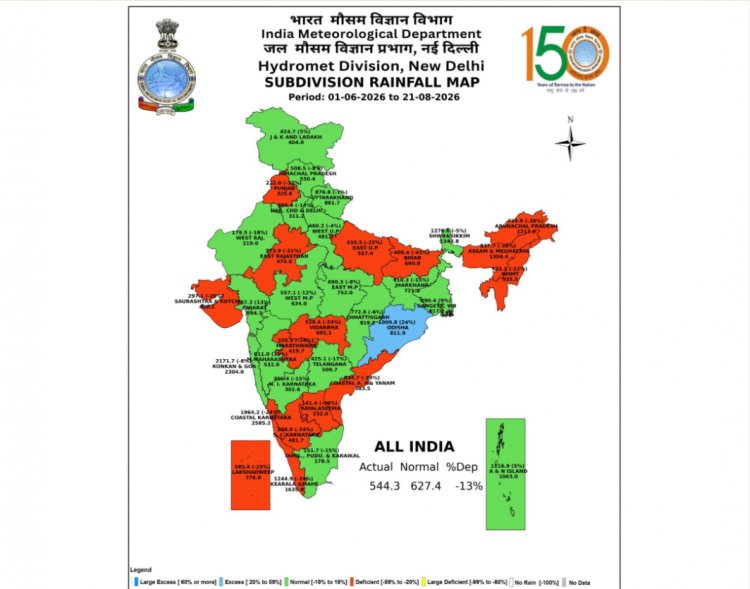
The progress of the kharif season has also been influenced by the El Niño event and the uneven distribution of monsoon rainfall. According to the India Meteorological Department, cumulative rainfall across the country between 1 June and 21 August 2026 was 13% below the long-period average.
Central India remained close to normal, with rainfall just 2% below average. However, East and Northeast India recorded a 26% rainfall deficit, while South Peninsular India was 23% below normal and Northwest India reported an 11% shortfall.
The uneven distribution of rainfall has affected sowing progress across different states and crops. However, the advance of the monsoon and improved rainfall in several areas during the later part of the season have helped narrow the gap in kharif sowing significantly compared with the early weeks of the monsoon.