The recently released Basic Animal Husbandry Statistics (BAHS) 2025 by the Department of Animal Husbandry and Dairying underlines strong across-the-board growth in India’s livestock output, reinforcing the sector’s expanding role in the rural economy.
India continues to maintain its global leadership in milk production and ranks second in egg production and fourth in meat output. This rapid growth has enabled livestock sector to become a dominant pillar of agricultural income, contributing 31% to the total Agricultural GVA in 2023-24.
The annual publication was released by Prof. S.P. Singh Baghel, Minister of State for Fisheries, Animal Husbandry & Dairying, in the presence of Minister of State George Kurian and Naresh Pal Gangwar, Secretary of the Department on the occasion of National Milk Day.
Milk Production: India Retains Global Leadership
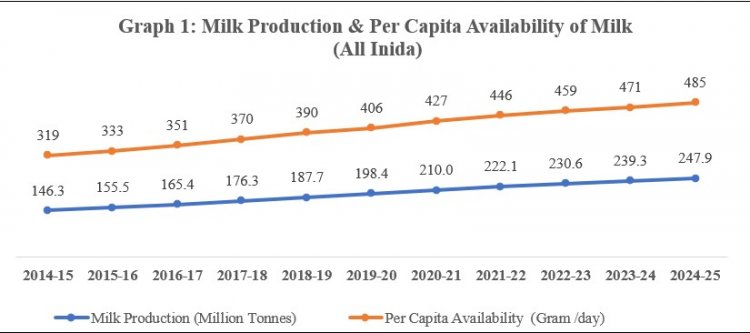
India remains the world’s largest milk producer, with output touching 247.87 million tonnes in 2024-25, up from 239.30 million tonnes in 2023-24—a growth of 3.58%.
Per capita milk availability rose to 485 grams/day in 2024-25, up from 319 grams/day in 2014-15, reflecting sustained improvement in dairy access.
The top five milk-producing states contributed over half of the country’s output:
- Uttar Pradesh – 15.66%
- Rajasthan – 14.82%
- Madhya Pradesh – 9.12%
- Gujarat – 7.78%
- Maharashtra – 6.71%
Milk production from exotic/crossbred cattle increased 4.97%, indigenous cattle by 3.51%, and buffaloes by 2.45% over the previous year.
Egg Production: Strong Growth
The total Egg production in the country is estimated as 149.11 billion during 2024-25 and registered a growth of 4.44 % the production has increased annually by 3.18% during 2023-24. Per capita egg availability has steadily climbed from 62 eggs per year in 2014-15 to 106 eggs per year in 2024-25.
The poultry-dominant states accounted for a major share of production:
- Andhra Pradesh – 18.37%
- Tamil Nadu – 15.63%
- Telangana – 12.98%
- West Bengal – 10.72%
- Karnataka – 6.67%
Out of the total eggs produced, commercial poultry contributed 125.98 billion eggs, accounting for 84.49% of the national output. Backyard poultry, on the other hand, produced 23.13 billion eggs, representing 15.51% of the total production.
Meat Production: India Ranks Fourth Globally
Total meat production in 2024-25 is estimated at 10.50 million tonnes, showing a modest growth of 2.46% over 2023-24. The meat production from poultry is 5.18 million tonnes, contributing about half of total meat production. The meat production has increased by 2.46% as compared to previous year (2023-24).
Top meat-producing states include:
- West Bengal – 12.46%
- Uttar Pradesh – 12.20%
- Maharashtra – 11.57%
- Andhra Pradesh – 10.84%
- Telangana – 10.49%
Together, these states contribute 57.55% of national meat production.
Wool Production: Moderate Recovery Seen
India’s wool output stood at 34.57 million kg in 2024-25, recording a 2.63% increase over the previous year. Rajasthan continues to dominate the wool sector with 47.85% of national production, followed by:
- Jammu & Kashmir – 22.88%
- Gujarat – 6.22%
- Maharashtra – 4.75%
- Himachal Pradesh – 4.30%
These five states collectively account for 85.98% of India’s wool output.
Livestock Sector Shows Strong Economic Contribution
The livestock sector accounts for 5.5% of the national GVA at current prices, acting as a crucial buffer during economic fluctuations. The sector has also seen a steady rise in exports, with the total value of livestock products reaching Rs 66,249 crore in 2024–25, driven largely by the strong performance of the meat industry.
The importance of livestock is further reflected in its role within the overall agricultural economy. Agriculture, Forestry and Fishing contributed 17.8% to the national GVA in 2023–24, with livestock forming a significant share of this value and supplying nearly one-third of the output from agriculture and allied activities.
Over the last decade, the Indian livestock sector has shown remarkable growth. Its Gross Value Added (GVA) increased by nearly 195% between 2014–15 and 2023–24, far outpacing the growth of the crop sector.
Strengthening Data for Policy and Growth
Releasing the report, Minister Baghel highlighted that reliable data is the backbone of policy reforms aimed at improving farmer income, productivity and sustainability in the livestock sector. Basic Animal Husbandry Statistics (BAHS) 2025, is an important publication document that provides comprehensive data on the livestock and dairy sector trends. The BAHS 2025 is based on the outcomes of the Integrated Sample Survey conducted for the period from 1st March 2024 to 29th February 2025. This survey generates crucial data on the production estimates of Major Livestock Products (MLPs) such as Milk, Eggs, Meat, and Wool, which plays a pivotal role in research and policy formulation in the livestock sector.