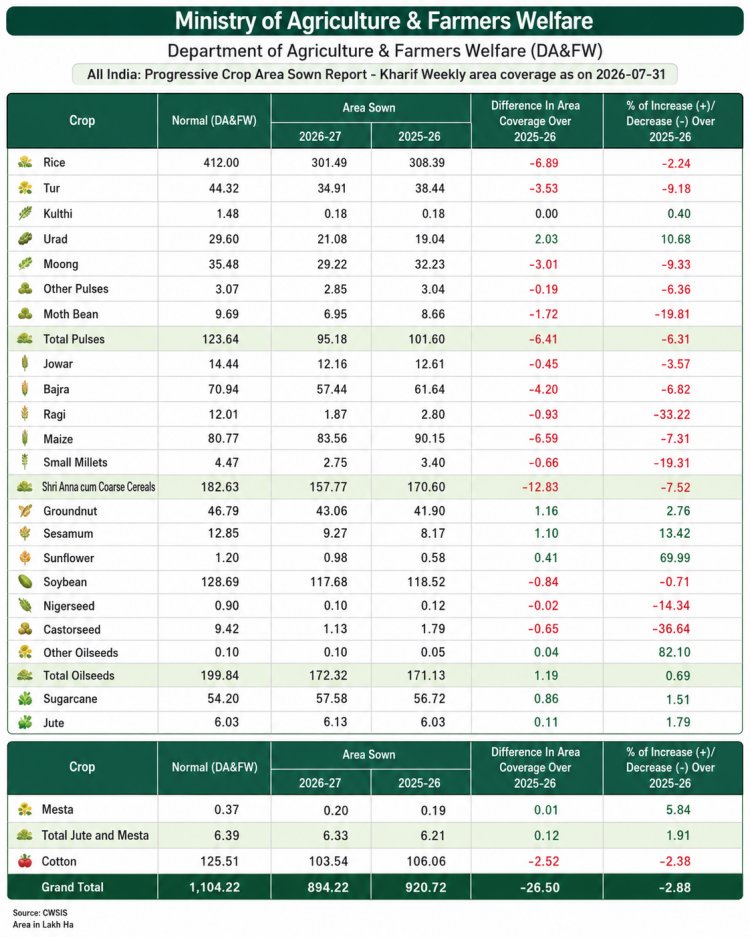
Half of India's southwest monsoon season has passed, with July bringing a strong revival after a weak start in June, significantly improving kharif sowing and easing concerns over crop acreage. However, despite the recovery, the country continues to face a 13 per cent rainfall deficit, while the overall kharif sown area remains 2.88 per cent lower than last year. At the same time, reservoir storage across the country is still below both last year's level and the long-term average, raising concerns for the upcoming rabi season.
July Revival Narrows Rainfall Deficit
India received 389.8 mm of rainfall between June 1 and July 31, against the normal 445.8 mm, leaving the country with a 13 per cent deficit. The improvement marks a sharp recovery from the end of June, when cumulative rainfall was nearly 40 per cent below normal.
After a sluggish onset, the southwest monsoon gained momentum during the first week of July before entering a brief break phase. It became active again during the last week of the month, bringing widespread rainfall across central India, where precipitation stood 4 per cent above normal for the season. This helped reduce the national rainfall deficit substantially.
The regional distribution of rainfall, however, remained uneven. East and Northeast India recorded a 30 per cent deficit, Northwest India remained 12 per cent below normal, while South Peninsular India received 23 per cent less rainfall than the long-period average. In contrast, Central India registered 4 per cent above-normal rainfall, reflecting the uneven spread of the monsoon.
Kharif Sowing Gap Shrinks Significantly
The improved rainfall had a direct impact on kharif sowing. According to the Ministry of Agriculture, the total kharif sown area reached 894.22 lakh hectares as on July 31, compared with 920.72 lakh hectares during the same period last year. The gap has narrowed to 26.50 lakh hectares, or 2.88 per cent, from more than 20 per cent a month ago, indicating that farmers were able to make up much of the initial delay as rainfall improved.
Despite the sharp recovery in acreage, concerns remain over crop prospects because of the delayed onset and uneven distribution of rainfall. Crop growth during the critical vegetative stage will depend heavily on rainfall during August.
Pulses Still Lag, Oilseeds Hold Ground
Pulse sowing has improved considerably over the past month but continues to trail last year's level. Total pulse acreage stood at 95.18 lakh hectares, down 6.31 per cent from a year earlier. Among major pulses, tur (pigeon pea) acreage declined 9.18 per cent, moong was down 9.33 per cent, while total pulse sowing remained below normal. If rainfall remains normal or above normal during August, the gap could narrow further, reducing concerns over pulse production.
Oilseed sowing has shown better resilience. Total oilseed acreage reached 172.32 lakh hectares, marginally higher than 171.13 lakh hectares recorded a year ago. Groundnut, sesame and sunflower registered increases, helping offset lower soybean acreage.
Rice, Maize and Cotton Acreage Remain Lower
In contrast, the area under Shri Anna and other coarse cereals declined to 157.77 lakh hectares from 170.60 lakh hectares last year, a fall of 7.52 per cent. Maize acreage dropped to 83.56 lakh hectares, down 7.31 per cent, raising concerns not only for feed availability but also for India's grain-based ethanol production programme, which has become increasingly dependent on maize.
Rice, the country's largest kharif crop, was sown over 301.49 lakh hectares, compared with 308.39 lakh hectares last year, reflecting a 2.24 per cent decline. Cotton acreage also remained lower at 103.54 lakh hectares, down 2.38 per cent year-on-year. Sugarcane was among the few major crops to record an increase, with acreage rising to 57.58 lakh hectares, up 1.51 per cent from last year.
Reservoir Storage Below Last Year and Normal
While rainfall has improved, reservoir levels remain a key concern. According to the Central Water Commission (CWC), live storage in 166 major reservoirs stood at 81.479 billion cubic metres (BCM) as on 30 July, equivalent to 44.39 per cent of their total live storage capacity. Reservoir storage was 34.63 per cent lower than the 124.634 BCM recorded during the corresponding period last year and about 7 per cent below the normal storage level of 87.624 BCM.
The lower reservoir storage could put pressure on irrigation supplies for the rabi season if rainfall during August and September fails to improve significantly. It may also affect drinking water availability in some regions. However, heavy rainfall received across several states during the final week of July is expected to improve reservoir levels in the coming weeks.