India's rural economy is showing early signs of slowing, with income growth among rural households falling to its lowest level since the National Bank for Agriculture and Rural Development (NABARD) began tracking rural economic conditions in September 2024. NABARD's latest Rural Economic Conditions and Sentiments Survey (RECSS) – Round 12 (July 2026) indicates weakening income momentum, slower consumption growth, lower savings, and increasing reliance on informal sources of credit.
According to the survey, only 27.7% of rural households reported an increase in income compared with a year ago. This is the lowest level recorded since the survey was launched. Meanwhile, 52.6% of households said their income remained unchanged, the highest share on record, while 19.8% reported a decline. Together, 72.4% of rural households saw no increase in income over the past year.
The bi-monthly survey covers 20,000 rural households across 29 states and Union Territories.
The findings also show that the proportion of households reporting higher incomes has been steadily declining since November 2025, suggesting that rural income growth has been losing momentum.
Moderation in Consumption
Reflecting moderation in consumption, the proportion of respondents reporting an increase in consumption expenditure declined to 74.1 per cent. This marks only the second time since the survey began that the share has fallen below the 75 per cent threshold
Despite weaker income growth, rural consumption has remained relatively resilient, although signs of moderation are emerging.
The share of respondents reporting an increase in consumption expenditure fell to 74.1%, marking only the second time since the survey began that the figure has dropped below 75%. The proportion stood at 77.2% in May 2026 and 76.6% in July 2025.
Even so, rural households continue to spend a significant share of their earnings on consumption. On average, 66.5% of monthly household income is spent on consumption, while another 12.5% goes towards debt repayment, underscoring the pressure on household finances.
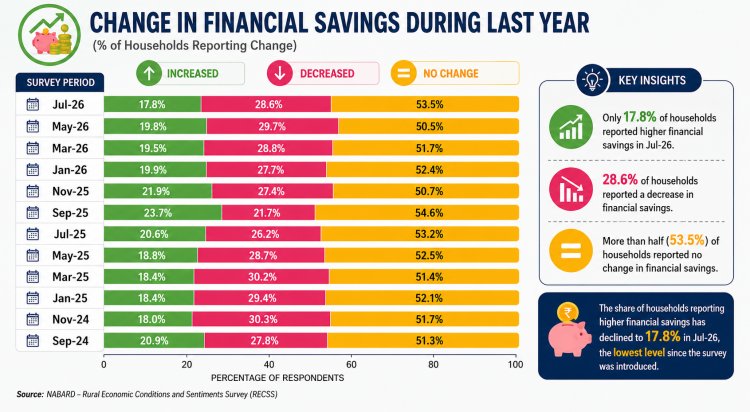
The survey also found that the share of households reporting higher financial savings declined to 17.8%, the lowest level since the survey was introduced.
Dependence on Informal Credit
One of the survey's most notable findings is the growing dependence of rural households on informal credit sources.
The proportion of households relying exclusively on formal lenders—including banks, NBFCs and microfinance institutions—declined to 51% in July 2026 from 58.3% in November 2025.
In contrast, the share of households borrowing exclusively from informal sources rose to 23.6%, the highest level recorded in the survey. Among them, 16.2% borrowed only from friends and relatives, 6% relied solely on moneylenders, and 1.4% borrowed from both.
In addition, 25.3% of rural households reported borrowing from both formal and informal sources.
The survey found that the average interest rate on informal loans was 17.77%. However, nearly 20% of respondents reported paying no interest, suggesting that these loans were largely obtained from friends and relatives.
The growing reliance on informal borrowing points to increasing liquidity pressures or limited access to formal finance among rural households.
Weak Monsoon and Inflation
The weakening rural outlook comes at a time when inflation remains elevated, and the monsoon has been below normal.
India's retail inflation accelerated to 4.38% in June, the highest level in 17 months. At the same time, delayed and deficient monsoon rainfall amid concerns over El Niño has raised uncertainty over agricultural production and farm incomes.
The survey also points to a deterioration in rural expectations.
The proportion of households expecting better income and employment opportunities over the next three months fell to its lowest level since the survey began. Likewise, the share of respondents expecting higher income over the next year declined to 66.8%, the weakest reading on record.
According to NABARD, uncertainty surrounding the monsoon and broader economic conditions has weighed on rural sentiment, reinforcing concerns that the rural economy may face greater headwinds in the coming months.