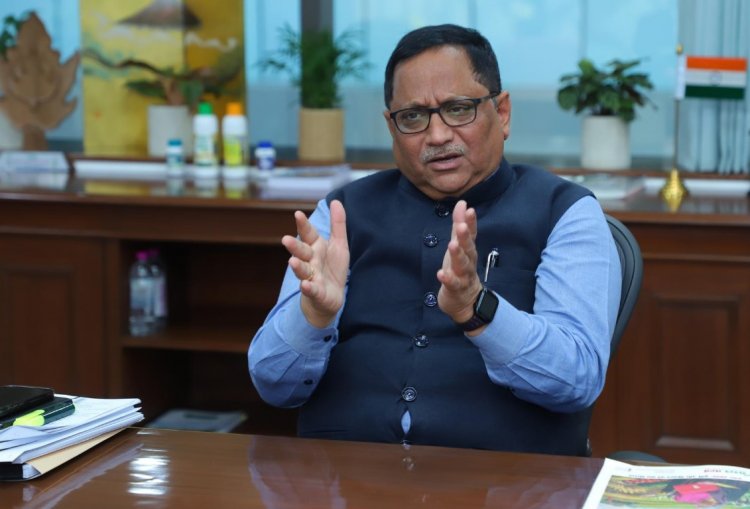
With an annual turnover exceeding Rs 41,000 crore, Indian Farmers Fertiliser Cooperative Limited (IFFCO) stands as the world’s largest cooperative fertilizer organisation. From supporting India through phases of food insecurity to enabling its rise as a major agricultural exporter, IFFCO has played a central role in strengthening farmers and rural economies. Amid geopolitical uncertainties, India now faces new challenges, including rising dependence on fertilizer imports, excessive use of chemical fertilizers, and the urgent need to promote sustainable farming. In an exclusive interaction, IFFCO Managing Director K. J. Patel spoke with Rural World (print publication of Rural Voice) Editor-in-Chief Harvir Singh and Executive Editor Ajeet Singh on IFFCO’s evolving role and the future trajectory of the fertilizer sector. Excerpts:
IFFCO is about to complete 60 years since its establishment. The circumstances have changed significantly, and new challenges have emerged. Under your leadership, how do you see IFFCO’s role and the agricultural sector?
When IFFCO was established in 1967, the country faced extremely difficult conditions in terms of fertilizer availability and food security. It was registered as a cooperative society in November 1967, founded on the principles of cooperation, owned by farmers, and committed to serving the farming community. That remains our core objective even today.
At the time of its establishment, India urgently needed fertilizers. Large-scale plants like those we see today were difficult to operate. Initially, small plants were set up at Kalol and Kandla, one for urea and the other for phosphatic fertilizers. We began functioning as a fertilizer producer in January 1975. The early goal was to produce fertilizers with government support and cooperative funds.
Now, nearly six decades later, the situation has transformed. Today, we have more than 35,600 cooperative societies and are connected with over 45 million farmers across the country. Back then, food security was a concern; today, India has achieved it. We are no longer importers of food grains but exporters.
However, when it comes to fertilizers, IFFCO continues to play a crucial role. India is still not self-reliant in fertilizer production. Global trade dynamics significantly affect cooperatives like IFFCO. Despite this, we are moving forward with new technologies, innovation, and farmer participation.
Farmers have immense trust in IFFCO. Does this relationship make a difference compared to private companies?
Absolutely. When I visit fields and interact with farmers, they often say, “If IFFCO fertilizer has arrived, we will buy it first. Others can wait.” Why? Because this is a farmers’ institution. The profits generated from the business ultimately benefit farmers. Since we began fertilizer production in 1975, farmers’ trust in IFFCO has consistently grown due to the quality of fertilizers and services we provide.
There is a challenge of providing quality fertilizers at affordable prices while ensuring balanced usage. How do you see this?
Urea is the most widely used fertilizer in India. For a long time, the government has been providing urea at Rs 266 per bag to farmers, which has increased the subsidy burden. Government policy now focuses on efficiency and energy optimization, how effectively you use resources determines whether you profit or incur losses.
It is essential to provide high-quality fertilizers to farmers. Subsidies help keep prices low, but they come at a high cost to the government. Here, the industry’s role becomes critical. Organizations like IFFCO must help reduce this burden.
Our aim is not just to continue producing what we have always produced. If that were the case, we would not have introduced nano fertilizers, biostimulants, or biofertilizers. We have been producing biofertilizers for years and are working toward reducing dependence on chemical fertilizers. To move away from subsidies, we must reduce production costs and develop innovative fertilizers. To achieve this, we established IFFCO Nanoventions Pvt. Ltd. where 30-35 PhD scholars and agricultural experts are working.
We also have IFFCO - Nano Biotechnology Research Centre (NBRC) at the Kalol unit. We have recently set up an innovation hub there. We are identifying new products that can protect farmers from the harmful effects of chemical fertilizers. Sustainable agriculture will depend heavily on such innovations. Promoting natural and organic farming, along with speciality fertilizers, can reduce both import dependence and subsidy burden.
India consumes about 40 million tonnes of urea annually, with nearly 10 million tonnes imported. Are there plans to set up new plants to reduce import dependence?
The government has already increased production capacity through new plants under HURL. With a growing population and increasing life expectancy, demand for agricultural products will continue to rise.
However, relying solely on urea is not a sustainable solution. Urea is a chemical fertilizer with several drawbacks. With the introduction of nano urea and nano DAP, we have begun working with farmers to explore alternatives.
We must consider whether we can shift from chemical fertilizers to more specialized products. When ammoniacal nitrogen from urea enters the soil, it can convert into nitrous oxide, degrading soil quality. Organic carbon in soil is declining.
We are not in favour of setting up new urea plants simply to increase production because India is also dependent on imported natural gas. Even if we build new plants, we will remain dependent on foreign gas supplies. Our focus is to ensure gas is available at viable prices.
If economics permit, we may consider setting up plants abroad where resources are cheaper. Countries like those in the Gulf, Indonesia, and Morocco prefer value addition within their borders. They want investments that convert gas into ammonia and urea locally.
IFFCO has never focused solely on profit. For example, in 2021, when there was a shortage of DAP, our board decided to produce it even at a loss. Other companies followed suit. Eventually, the government assured compensation. Today, IFFCO contributes 71% of India’s DAP production.
India relies heavily on fertilizer imports. Given the volatile geopolitical situation, how can availability be ensured?
First, we need to move away from the excessive use of chemical fertilizers and build confidence among farmers that agriculture can succeed without them. Farming is essentially a technology, and farmers must adopt better practices.
We must change the mindset. Chemical fertilizers such as urea, DAP, NPK, and potash may not remain sustainable in the long run. We must guide farmers toward alternatives without compromising on yields. Agricultural land is shrinking, and we cannot keep increasing the supply of chemical fertilizers indefinitely. However, mindset change will take time, and the transition must be gradual and carefully managed.
How is organic or natural farming being promoted among farmers?
Prime Minister Narendra Modi has called upon every farmer to adopt organic farming on at least one acre. If all farmers start organic farming even on a small portion of their land, it can bring about a big change.
Organic farming does not mean zero fertilizer use. There are many organic fertilizers available, and farmers can use them. We are focusing on ensuring the availability of organic fertilizers, along with speciality fertilizers, growth promoters, and biostimulants.
We are building systems to manufacture, distribute, and train farmers effectively. We want to ensure that farmers’ money is not wasted. At the same time, we are creating awareness about the harmful effects of chemical fertilizers and promoting natural farming.
We have built a network of 750–800 progressive farmers across the country who act as ambassadors, spreading awareness about organic and chemical-free farming at the village level.
IFFCO is promoting nano fertilizer. What has the response been like from farmers?
The response has been very encouraging. The future of nano fertilizers is very promising. They are developed using nanotechnology and have undergone extensive research and field trials across ICAR labs and agricultural universities.
IFFCO and NBRC have made significant efforts as initiators and innovators for nano fertilizers. We have demonstrated that what we are making is effective in the fields.
Nano fertilizers are fundamentally different from conventional fertilizers and require proper knowledge of their usage. Unlike traditional fertilizers that are broadcast in fields, nano fertilizers can be used in seed treatment and foliar sprays. Farmers must understand the correct concentration, timing, and nutrient requirements.
The standard operating procedure (SOP) for using nano fertilizers must be explained to every farmer. The use of nano fertilizers depends on which nutrient is deficient in the soil and which nutrient the crop needs. If farmers understand these things and use nano, they will get better results. Farmers across the country are using nano fertilizers. Some farmers using nano fertilizers are also on our board. We take inputs from them as well. Everyone says it is good. In every awareness programme on nano, we get good feedback.
IFFCO has also pioneered the use of drones for spraying nano-fertilizers. How has this experiment been?
Nano fertilizers are liquid, unlike granular traditional fertilizers and need to be sprayed. Farmers initially faced difficulties in spraying. So, we invested over Rs 225 crore to procure more than 1,800 drones. We also provided 300 drones under the “Drone Didi” program.
We aim to make drone technology useful for fertilizer spraying. We are also providing nano sprayers to farmers so that they can adopt nano fertilizers easily. Once farmers begin using them, adoption will increase through peer learning.
Importantly, our focus is not just on selling nano fertilizers but on training farmers. IFFCO has deployed 700–800 additional field representatives who are agriculture graduates. They educate farmers not only about nano fertilizers but also about organic farming, the harmful effects of chemical fertilizers, and products like Sagarika.
After nano urea and nano DAP, what kind of products or innovations are being introduced next?
We are exploring alternatives for farmers who face difficulties in spraying nano products. We have developed Nano-NPK in granular form, which has already received approval under the Fertilizer Control Order (FCO). This will provide farmers the convenience of a familiar application method while retaining the benefits of nanotechnology.
Additionally, under the Nano Mission, we have developed a new product called “DharAmrut,” using banana extract and seaweed. These innovations aim to expand alternatives for farmers while promoting sustainable nutrient management.
The issue of unbalanced fertilizer use has long been debated. Should there be a government policy on this?
A recent meeting, attended by Minister of State for Chemicals and Fertilizers Anupriya Patel, senior officials from the Department of Fertilizers, ICAR, agricultural universities, and industry representatives, focused on this very concern.
India spends heavily on fertilizer subsidies, around Rs 1.5 to 2 lakh crore annually. However, the subsidy does not directly reach farmers or even the industry. A large portion goes to the countries from which we import raw materials.
If new technologies help reduce the use of conventional fertilizers by even 25 percent, we could save nearly Rs 50,000 crore. This money could instead be used to enhance farmers’ incomes and improve services like education and healthcare.
I often recall my visit to Atlanta, the home of Coca-Cola. In its first year, Coca-Cola sold just nine bottles a day. Today, it sells nearly two billion bottles worldwide every day.
Similarly, we introduced nano fertilizers in 2021. In less than five years, annual sales have already reached around 40 million bottles. Now, we are not pushing sales aggressively. We have strictly prohibited forced tagging by dealers and made it clear that any violation will lead to the cancellation of the dealership. Our approach is to encourage voluntary adoption.
We have invested around Rs 1,900 crore in production capacity, with an installed capacity of nearly 290 million bottles annually. It is a matter of satisfaction for us that so many farmers in the country are adopting nano fertilizers.
Do you think India needs to develop new fertilizer molecules using locally available resources?
We should not limit ourselves to developing new molecules alone. We must also focus on making the entire fertilizer industry more commercially viable and self-reliant. If we talk about Atmanirbhar Bharat and Swadeshi, we must develop fertilizers that utilize locally available resources.
We have already taken steps in this direction. We are also exploring how rock phosphate available in India can be used for plant nutrition. Rajasthan has phosphate reserves, but their quality is not good enough for large-scale phosphoric acid production. We are working on technologies that can make effective use of these resources. If successful, this could significantly reduce our dependence on imports.
IFFCO has evolved into a diversified conglomerate. What are your priorities for growth in the coming year?
Our primary goal is to ensure that all IFFCO subsidiaries and ventures operate at full potential. We want to maximise the capacity and value of every investment we have made.
One of our projects in Punjab was stalled due to the pandemic. Now we are talking with our Spanish partners to restart it. The plan is to process agricultural produce, such as potatoes and tomatoes, near Ludhiana into frozen food products for domestic and export markets. This will directly enhance farmers’ incomes.
We are also expanding into the energy space. Fertilizer production is highly energy-intensive, so increasing the share of renewable energy is a priority. We are currently sourcing solar power externally, but the long-term plan is to develop our own captive solar and wind energy capacities.
On the global front, we are setting up a nano-fertilizer plant in Brazil. During our interactions with Brazilian farmers, there was strong demand for customised nano products tailored to local soil and crops. We discussed it with our scientists. They said it is technically possible.
The Brazil facility, expected to be operational by mid-year, involves an investment of under Rs 50 crore and will have an initial capacity of about 1.5 million litres, with scope for expansion as demand grows. This reflects our broader vision - combining innovation, global outreach, and farmer-centric solutions. The plant in Brazil is expected to be operational by June–July.
The government is actively promoting the cooperative sector, with a new policy in place. How do you see this development?
The formation of a dedicated Ministry of Cooperation has provided unprecedented support to cooperative institutions. Cooperatives are built on trust and partnership and have immense economic and social significance. At IFFCO, we are exploring ways to strengthen this model further.
For instance, every year we purchase bags worth Rs 400–500 crore for fertilizer packaging from external suppliers. Now we are thinking why not set up a multi-state cooperative society to produce bags? This will not only meet our requirements but also supply bags to other industries.
With rising geopolitical tensions, how are you ensuring fertilizer availability and self-reliance?
Ensuring a stable supply of raw materials is critical. Our Kandla plant requires around 8-8.5 lakh tonnes of phosphoric acid annually, much of which is currently imported. We closely monitoring supply chains across all source countries and continuously assess potential risks. If any disruption appears likely, we proactively explore partnerships with alternative suppliers.
We are already in discussions with several countries. Apart from Jordan and the UAE, countries like Morocco and Senegal have substantial reserves of high-quality phosphate. Strengthening such partnerships is essential to securing long-term supply and reducing vulnerability to global disruptions.
Where do you see IFFCO in the next 10 years?
Over the next decade, I would like to see the use of chemical fertilizers reduced by up to 50 percent. We are already moving towards a new generation of fertilizers and modern technologies. With supportive government policies, industry initiatives, and increasing farmer awareness, agriculture will undergo a major transformation in the coming years.
The shift is no longer limited to nano fertilizers; many companies are now working on speciality and high-value products. At the same time, digital technologies are playing a transformative role. Our e-marketplace platform is one such example of how agriculture is becoming more technology-driven.
There is a perception that the younger generation is moving away from farming. What is your view?
I think it is very important to make agriculture a part of the education system. A large section of the country’s population depends on farming. Therefore, farming-related subjects should be introduced from the school level through to higher education. I would request the state education boards to take this seriously. Such steps can significantly change how society perceives farming.
Farmers are often perceived as less educated, but when given the right knowledge and opportunities, they quickly adopt new technologies. The weakest link today is the agricultural extension system, which needs strengthening. While we talk about AI and advanced technologies, unless farmers are properly trained, these innovations will not reach their full potential.