A panel discussion on the implications of Union Budget 2026–27 for Indian agriculture highlighted a shift in emphasis from staple crop production toward diversification, allied sectors, high-value agriculture, and technology-enabled advisory services. A central policy question, however, is whether these measures amount to genuine structural transformation or represent an incremental continuation of existing policy trajectories.
The discussion was organized on February 3, 2026, at the ICAR–National Institute of Agricultural Economics and Policy Research (NIAP), New Delhi, in collaboration with the Division of Agricultural Economics, ICAR–Indian Agricultural Research Institute (IARI), Pusa, Agricultural Economics Research Association (AERA) and the International Food Policy Research Institute (IFPRI), South Asia Regional Office.
The session brought together policymakers, researchers, media representatives, faculty members, and students. The discussion was chaired by Dr P. K. Joshi, President of the Agricultural Economics Research Association (AERA), New Delhi. The panel included Dr Vijay Pal Sharma, Chairman of the Commission for Agricultural Costs and Prices (CACP); Dr Shahidur Rashid, Director, IFPRI South Asia; Unupom Kausik, Managing Director of National Cooperative Exports Limited; Harvir Singh, Editor-in-Chief of Rural Voice; and Dr Smita Sirohi, ICAR National Professor and Tushar Pandey, Expert Consultant and Advisor, Public Policy, Social Equity and Agriculture. The theme and policy context were introduced by Dr Anjani Kumar, Secretary, AERA. Dr Jaya Jumrani and Dr S. Pavithra presented the salient budgetary provisions relevant to agriculture and the food system.
Panelists noted that while the overall allocation for agriculture and allied sectors has increased, concerns remain regarding its adequacy relative to the sector’s contribution to GDP and employment. The reduction in allocation for agricultural research and education (ICAR) emerged as a major concern. Panelists highlighted that, in real terms, the decline would be even more pronounced, which is difficult to justify given the high and well-documented returns on agricultural research investment.
Dr Shahidur Rashid, Director, IFPRI South Asia, said, “Investments in agri R&D are vital, particularly to advance seed innovation and productivity growth. Strengthening public investment in these areas would reinforce India’s aspiration to lead agricultural transformation in the Global South.”
Dr Vijay Pal Sharma, Chairman, CACP, emphasized that Union Budgets should be viewed as part of a continuous policy process, with several initiatives announced in earlier budgets now progressing toward implementation. At the same time, the absence of major new schemes suggests policy continuity rather than a sharp break from the past.
Structural issues such as high establishment costs and underutilization of funds were also flagged, with calls for improved efficiency and exploration of public–private partnerships.
Harvir Singh, Editor-in-Chief of Rural Voice, said agriculture must be viewed across the entire agri-value chain, from production to markets. He expressed concern over the reduction in the ICAR budget, noting that farmers need high-yielding seeds amid the challenges of climate change. While the focus on livestock and fisheries is welcome, food crops have been ignored in the Budget. He also pointed out that several missions announced in the previous Budget received zero allocation this year, raising serious questions about implementation.
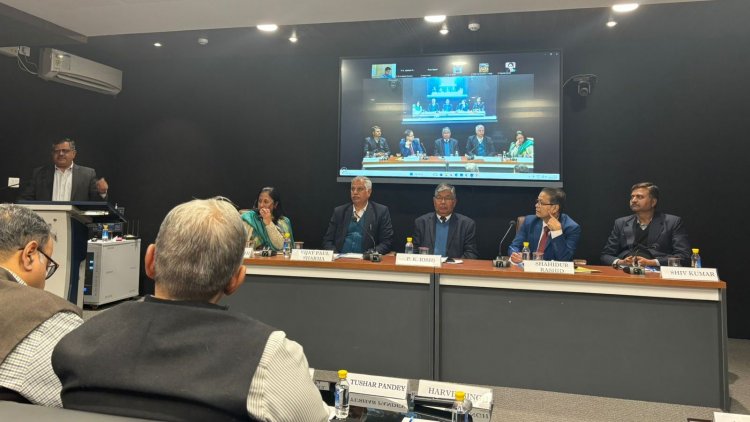
Dr Anjani Kumar, Secretary AERA, said the Union Budget is not just a fiscal statement but a policy signal. “With agriculture at a critical juncture, amid structural gaps and rising climate risks, the question is whether Budget 2026–27 offers transformational change or incremental reform,” he said.
Diversification and High-Value Agriculture
The Budget’s emphasis on high-value and plantation crops was widely welcomed as a step toward diversification and income enhancement. However, concerns were raised regarding long gestation periods, the availability of quality planting material, and the risks faced by smallholders during the transition phase.
Livestock and Fisheries
The substantial increase in allocations for livestock and fisheries was seen as recognition of their growing contribution to agricultural output and rural incomes. Panelists pointed out that allied sectors account for nearly 40 percent of the value of agricultural output but continue to receive a disproportionately smaller share of research and institutional support. Greater alignment between economic importance, public investment, and research priorities was emphasized.
Digital Agriculture
The announcement of Bharat-VISTAAR, an AI-enabled digital advisory platform, generated mixed responses. While digital tools were seen as having the potential to improve targeting and integration of advisory services, panelists cautioned that technology alone cannot address the chronic weaknesses of agricultural extension. Farmers’ needs for timely market information and institutional support were highlighted as being as important as production advice.
Cooperatives
The discussion underscored the potential role of cooperatives and other organizational models as a “middle path” between fragmented smallholder farming and large-scale industrial agriculture. International experiences were discussed, with panelists cautioning against direct replication of models without adapting them to India’s diverse agrarian context. Professional management, political support, and institutional capacity were identified as critical success factors.
Unupom Kausik, MD of NCEL, emphasized that the budget should be seen as a starting point for a larger transformation, including the rise of Cooperatives 2.0—farmer enterprises rooted in cooperative structures, backed by professional management and political commitment.”
Fertilizer Subsidies
The panel debated the role of fertilizer subsidies in the context of rising cultivation costs. While recognizing the continued importance of fertilizers, panelists emphasized the need for better targeting and rationalization. Evidence was cited suggesting declining marginal returns to fertilizer subsidies over time. A more holistic approach to reducing cultivation costs through better seeds, mechanization, labour efficiency, and resource-use efficiency was advocated.