Mushrooms, once dismissed as mere fungi, have now become a staple on plates across Delhi-NCR. This growing acceptance explains why, in just a single room using 15–16 tonnes of compost, farmers are producing between 3,000 and 3,500 tonnes of mushrooms within 45–60 days. This output is not the result of mechanised factory production, but a compelling example of modern agricultural enterprise.
While traditional farming offers limited yields per acre, mushroom cultivation delivers high productivity within a small space and short time frame, provided conditions remain favourable. Mushroom farming is expanding rapidly not only in the capital region but across the country. However, farmers engaged in mushroom cultivation in North India are facing a distinct set of challenges, with the impact of rising pollution worsening year after year.
According to a report by market research firm IMARC Group, India’s mushroom market was valued at approximately $276 million in 2024. Between 2025 and 2033, the market is projected to grow at an average annual rate of about 6.5%, reaching nearly $487 million by 2033. North India accounted for the largest share of the market in 2024, at 39.8%.
The report attributes this dominance to favourable climatic conditions, government support, and existing infrastructure. States such as Himachal Pradesh and Haryana offer ideal temperature and humidity for mushroom cultivation. Government schemes provide training and subsidies, while research institutes support improvements in farming techniques. However, beyond these projections, practical challenges such as pollution are emerging as major obstacles to achieving these targets.
Compost stored for mushroom cultivation inside Shivam Sharma's farm.
Shivam Gopal Sharma, who operates ARS Mushroom Farms in the Karala area of outer Delhi, has been engaged in this work for two years. He describes mushroom cultivation as less of a traditional farming activity and more of a modern agribusiness. He notes that while consumption of various mushroom varieties has increased in India, many people still avoid them, perceiving mushrooms as fungi or non-vegetarian food.
He explains that air pollution is increasingly damaging crops. When harmful elements are present in the air, they directly affect mushroom growth. As pollution rises every year, farmers are left with little control. At the final stage, when the crop requires ample oxygen, polluted air introduces harmful particles that prevent proper pin formation. As a result, mushrooms fail to develop fully.
Shivam currently grows mushrooms in one room using 16 tonnes of compost and reports yields of 3,000–3,500 tonnes per crop cycle. Each cultivation cycle typically lasts 45–50 days.
Two cultivation models, farmers betting on both
Mushroom cultivation follows two main models. One uses AC units to maintain precise temperatures, while the other, known as the jhuggi model, depends on winter conditions and functions like seasonal farming. Both systems are practised in and around Delhi, though young farmers increasingly prefer the modern AC-based model, likely due to training opportunities available at government centres such as Pusa, KVK and HAIC.
Pawan Kumar established his farm in Ujua in 2016 after training at a Krishi Vigyan Kendra, which also assisted with the initial setup. He later received industrial training from the HAIC training centre in Murthal and the Directorate of Mushroom Research. After starting with a single room and six tonnes of compost that yielded 1,200 kg of mushrooms, he now operates with 70 tonnes of compost and also trains young farmers.
Based in Hasanpur village in Najafgarh, Pawan Kumar has been cultivating mushrooms for over a decade. He says AC units eliminate temperature-related risks and allow better pollution management compared to the jhuggi model. With AC units, mushrooms can be grown year-round, making production independent of seasonal conditions.
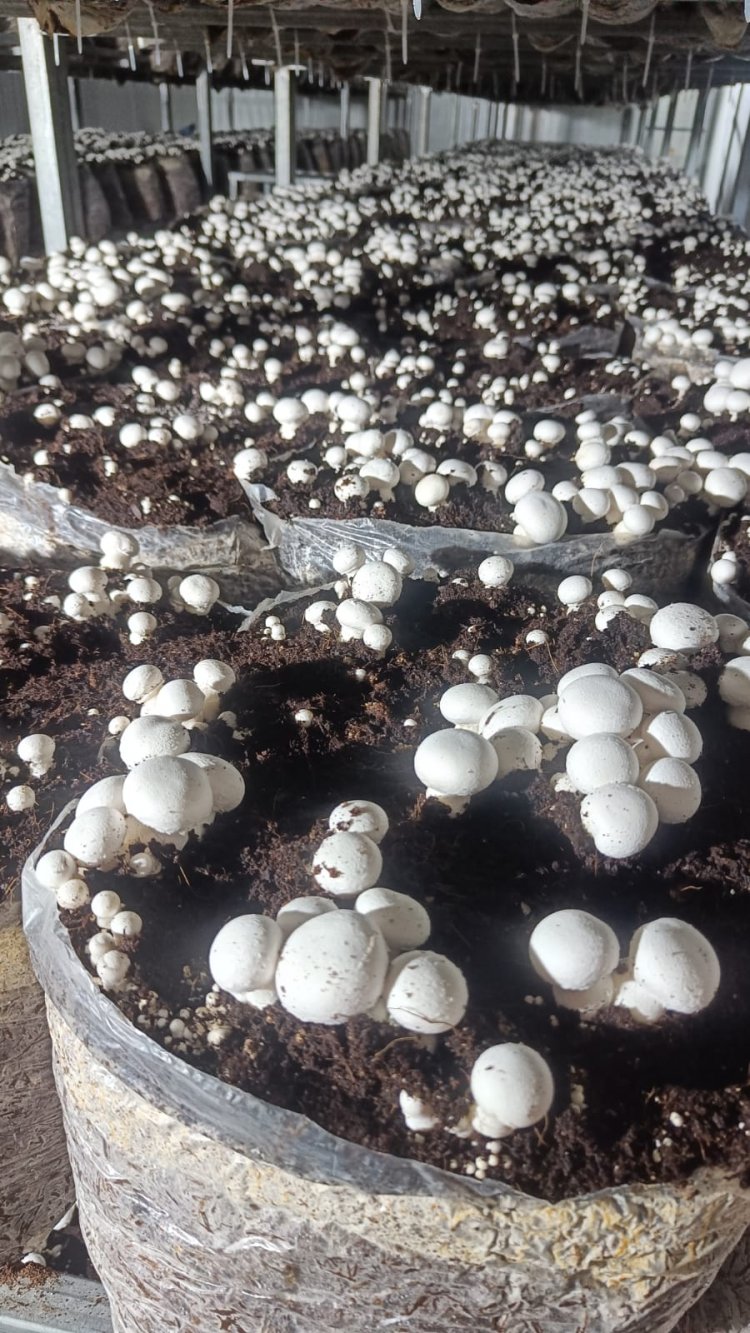
Mushrooms ready for harvesting at ARS Farm.
Button mushrooms dominate consumption
Among various varieties, button mushrooms remain the most widely consumed in Delhi-NCR. Shiitake and Portobello mushrooms also have demand, but their higher prices limit both consumption and production. As a result, larger varieties such as Portobello have a limited presence in markets.
Pawan Kumar highlights another challenge: farmers in Delhi lack permission to produce compost locally due to urban land classification, despite owning cultivable land. As a result, compost must be sourced from Haryana.
Challenges of the jhuggi system
For farmers using the jhuggi model, cultivation is viable only between October and February. Sowing must be timed so that the final stage coincides with January. If pollution remains high or temperatures fail to drop, yields are severely affected.
Temperature management at every stage
Mushroom cultivation requires precise temperature control at each stage. Sowing requires 22–25°C, casing needs 22–24°C, cooling requires 14–18°C, pin formation needs 12–16°C, and harvesting occurs at 14–18°C. Even minor deviations can lead to failed pinning, small yields or rot. Oxygen and carbon dioxide levels must also be managed carefully throughout the process.
Compost quality risks
Proper compost is critical. Compost may appear suitable but still contain ammonia or be poorly pasteurised, leading to crop failure. Farmers typically lack scientific tools to test compost and rely on experience to assess quality.
Packets of mushrooms prepared at ARS Farm.
Seed availability and handling
Mushroom spawn is available from government centres such as Pusa and Sonipat, though farmers must ensure freshness and absence of contamination. While button mushroom spawn is readily available, other varieties require advance orders.
Careful handling is essential, as even slight discoloration or damage can reduce market acceptance. Improper handling during packing or transport can render produce unfit for consumption. If compost spoils or processing errors occur, crops can be lost entirely. Mushrooms must be harvested, cleaned, packed and delivered to market immediately upon maturity, often on a daily basis.
Demand and supply pressures
Mushroom prices follow demand and supply dynamics. Farmers typically sell through mandis and commission agents, often after taking advances that limit price negotiations. During winter, oversupply can depress prices. Unlike other crops, mushrooms cannot be stored.
Introduced to India in the 1990s, mushroom cultivation has gained strong traction among young farmers by 2025. Addressing pollution, regulatory hurdles and market challenges is now crucial to sustaining the growth of this rapidly emerging sector.