India has strengthened food security through sustained cereal production, large-scale food distribution programmes and expanding agricultural output, yet ensuring that every household can afford a nutritious and diverse diet remains one of the country's biggest policy challenges, according to The State of Food Security and Nutrition in the World (SOFI) 2026 report released jointly by the Food and Agriculture Organization (FAO), IFAD, UNICEF, WFP and WHO.
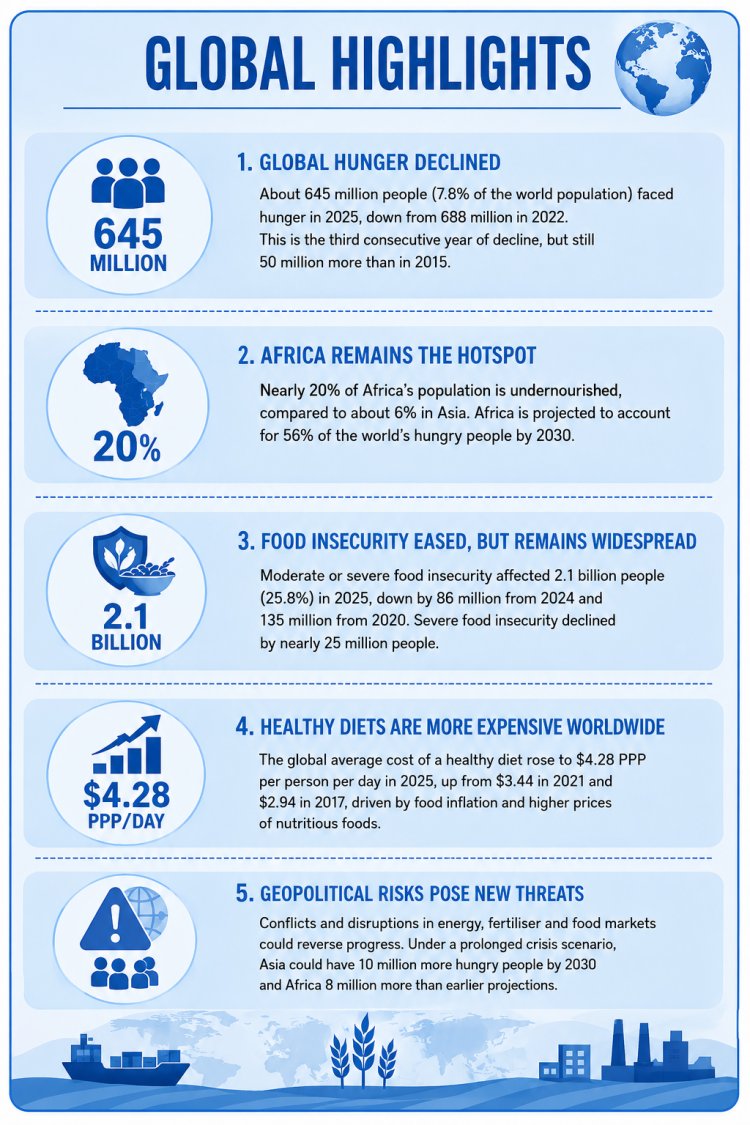
The report comes at a time when global food security is gradually improving after the disruptions caused by the COVID-19 pandemic, although progress remains uneven across regions. Worldwide hunger declined for the third consecutive year in 2025, with an estimated 645 million people or 7.8% of the global population remaining undernourished, down from 688 million in 2022. Yet the figure is still about 50 million higher than when the Sustainable Development Goals (SDGs) were adopted in 2015, highlighting how difficult it will be to achieve Zero Hunger by 2030.
The contrast across regions is striking. While only 6% of Asia's population faced hunger in 2025 and Latin America and the Caribbean continued to register steady improvements, one in every five Africans remained undernourished. Africa now accounts for the largest share of the world's hungry population, overtaking Asia, and is projected to account for 56% of all hungry people by 2030.
The report warns that recent geopolitical developments, including the conflict in the Middle East, could slow this progress by pushing up energy, fertiliser and food prices. FAO projects that under a prolonged crisis scenario, Asia could have around 10 million more hungry people by 2030, while Africa could see an additional 8 million, compared with earlier projections.
For India, the report's central message extends beyond hunger. The country has made remarkable gains in ensuring food availability through record foodgrain production, improved procurement systems and one of the world's largest food subsidy programmes. However, nutritional security increasingly depends not only on cereals but also on access to fruits, vegetables, pulses, dairy products and other nutrient-rich foods whose prices have risen much faster than staple grains.
The SOFI report notes that food inflation continued to increase the global cost of a healthy diet during 2025. It estimates that the average global cost of a healthy diet has risen to 4.28 purchasing power parity (PPP) dollars per person per day, compared with 3.44 PPP dollars in 2021 and 2.94 PPP dollars in 2017. The increase reflects persistent inflation and higher prices for nutritious foods across much of the world. For India, the cost is 4.11 PPP dollars.
For India, this has important implications. Although foodgrain availability has improved substantially, many households continue to struggle with the affordability of balanced diets. The report refers to research on India showing that measuring the cost of a healthy diet requires going beyond conventional food price indices because nutrient-rich foods have often become costlier than staple cereals.
Another important finding is that the biggest opportunity for lowering food prices lies beyond the farm. According to the report, 70-75% of what consumers pay for food comes from post-farmgate activities, while up to 40% of value-chain costs are incurred during processing, transport, storage and wholesale operations. Reducing these costs through better infrastructure, cold chains, logistics and more efficient supply chains could significantly improve the affordability of nutritious foods.
The report argues that agricultural policy should also evolve. Future productivity gains should increasingly focus on fruits, vegetables and legumes rather than concentrating primarily on staple cereals. Investments in research and development, irrigation, quality seeds, extension services and climate-resilient farming would help increase supplies of nutrient-rich foods while reducing prices over time.
For India, this recommendation aligns closely with ongoing efforts to diversify agriculture, promote horticulture, pulses and oilseeds, and strengthen farmer producer organisations and value chains. Experts say such diversification will become increasingly important as consumer demand shifts toward healthier diets and as the country seeks to tackle the dual burden of undernutrition and rising obesity.
Globally, the report also records encouraging progress in food insecurity. The proportion of people experiencing moderate or severe food insecurity fell to 25.8% of the world's population in 2025, equivalent to 2.1 billion people, compared with 27.1% in 2024. Nearly 86 million fewer people experienced moderate or severe food insecurity than a year earlier, while the number facing severe food insecurity declined by almost 25 million. Nevertheless, global food security has not yet returned to pre-pandemic levels.
The report concludes that achieving SDG-2 will require far more than increasing food production. Governments need integrated investments across the entire agrifood system - from research, irrigation and improved seeds to storage, logistics, trade facilitation and nutrition-sensitive policies. Without structural reforms that make healthy diets affordable, the world may continue producing enough food while millions remain unable to access the nutrition needed for healthy lives.