On almost every headline indicator, Indian formal agricultural credit has never looked better. Yet the same evidence that documents this expansion at the macro level, highlights some gaps and challenges at the micro- and even the meso-level. We explore the journey in this article.
The Journey
In 1951, close to 11 percent of the loans taken by Indian farmers came from a bank or a cooperative and the remaining about 89 percent was supplied by the moneylenders, landlords and traders (AIDIS, various rounds). Seven decades on, that ratio has inverted. Institutional lenders like banks and coops now account for nearly 86 percent of borrowing by Indian agricultural households (NAFIS 2021-22) . In FY 2024-25, the annual flow of Ground Level Credit (GLC) to Indian agriculture crossed Rs. 28.7 lakh crore, more than double its level just five years earlier (Figure 1). Relative to agricultural gross value added (GVA), annual credit disbursement reached 53 percent, compared with 22 percent in 2004-05, indicating that credit intensity has increased by around 2.4 times over the past two decades (NABARD 2025; DAFW 2026).
Behind these numbers is a policy thrust that is backed by an architecture that has been decades in the making. The Kisan Credit Card (KCC) scheme, the Modified Interest Subvention Scheme (MISS), priority sector lending (PSL) norms, NABARD's refinance pipeline and, more recently, the Kisan Rin Portal (KRP) together facilitate channelling concessional credit to millions of Indian farmers each year (DAFW 2026). The FY26 Union Budget pushed the framework further when they raised the KCC-MISS eligible loan ceiling from Rs. 3 lakhs to Rs. 5 lakhs. Even the Reserve Bank of India (RBI) lifted its collateral-free agricultural lending limit from Rs. 1.6 lakhs to Rs. 2 lakhs (NABARD 2025; RBI 2026).
India’s small and marginal farmers (SMF) were not left far behind. More than half of the GLC or the agri-credit was provided to these SMF (the share climbed from 41 percent a decade ago to 52 percent today) (DAFW 2026). Scheduled commercial banks’ (SCB) priority-sector lending stood at 45 percent of Adjusted Net Bank Credit (ANBC) in March 2026, comfortably above the 40 percent regulatory floor (RBI 2026).
Yet some gaps persist.
Gap in coverage. Institutional agricultural credit has expanded more rapidly in value than in reach. According to NAFIS 2021-22, only about 45 percent of agricultural households reported borrowing. Among borrowing households, 75.5 percent relied exclusively on institutional sources, implying that nearly one in four continued to depend, at least partly, on non-institutional credit. Such sources, including family and friends, relatives, input dealers and moneylenders, accounted for about 14 percent of the average amount borrowed by agricultural households.
Kisan Credit Card coverage remains similarly incomplete. Only 44.1 percent of agricultural households held a valid KCC, leaving nearly 56 percent outside the scheme (NAFIS 2021-22).
Tenant farmers are still largely excluded. Without land title, tenants cannot access institutional loans, take crop insurance on leased land, or qualify for PM-Kisan and most state schemes. Joint Liability Groups (JLG) reach only a small share of these households. The Haque Committee had recommended enactment of a model tenancy law so that tenants could be formally recorded without ownership risk to landowners. Such reform would extend the reach of institutional credit to a category of farmer the current framework misses.
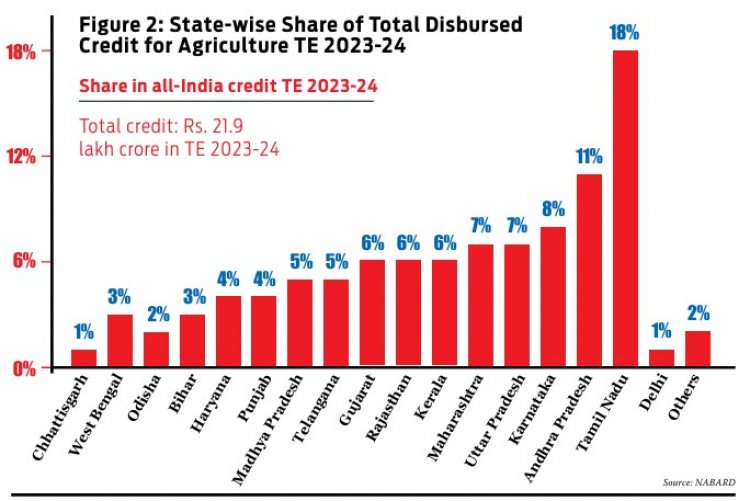
Regional concentration is stark and durable. Over a third of national institutional agri-lending is concentrated in just three southern states of Tamil Nadu, Andhra Pradesh and Karnataka (NABARD 2025) and these states are home to less than 20 percent of Indian farmers (Agri Census 2015). Figure 2. Additionally, NABARD's own refinance data shows that the southern region accounted for 46 percent of short-term refinance disbursement and 42 percent of long-term refinance disbursement in FY 2024-25; the North-East accounted for less than 2 percent of long-term refinance (NABARD 2025). Agricultural credit is not, in practice, reaching where most of India's agricultural households live.
Diversion of subsidized agri-credit to non-agri uses. RBI's Internal Working Group on Agricultural Credit (2019) found that outstanding short-term credit in several major agricultural states now substantially exceeds the total input requirement of the state's cultivation: Kerala at 326 percent, Andhra Pradesh at 254 percent, Punjab at 231 percent, a pattern the RBI itself interprets as plausible diversion of subsidised agri-credit to non-agricultural uses. The rising credit intensity metric is doing at least two things at once: some genuine capital deepening, and some subsidy arbitrage that never converts to agricultural GVA at all. To address this concern about diversion, the RBI's Internal Working Group on Agricultural Credit recommended that interest-subvention-eligible crop loans be routed exclusively through KCC, precisely to curb such misuse (RBI 2019).
Farm-loan waivers erode the credit culture without reducing long term distress. Between 2012 and 2026, sixteen state governments implemented farm-loan waiver schemes, several of them more than once. Since 2022 alone, three major states waived loans: Telangana rolled out a Rs. 31,000 crore waivers of loans up to Rs. 2 lakhs from July 2024, benefitting approximately 70 lakh farmers; Maharashtra's Punyashlok Ahilyadevi Holkar Farmer Debt Relief Scheme, approved in 2025-26, waives crop loans up to Rs. 2 lakhs with an estimated fiscal outgo of around Rs. 36,585 crores; and Tamil Nadu, months before its April-May 2026 state elections, waived cooperative crop loans up to Rs. 75,000 for 14.43 lakh farmers at a cost of Rs. 5,932 crores (Government of Telangana 2024; Government of Maharashtra 2025; Government of Tamil Nadu 2026). Many of these waivers are times around elections (NABARD 2022).
Farm loan waivers may provide temporary relief to indebted borrowers, but they can weaken the wider agricultural credit system. Saini et al. (2021) find that waiver may provide temporary relief to indebted borrowers, but weaken the wider agricultural credit system. Expectations of future waivers erodes repayment discipline, increases default risk by even the honest borrowers and reduce banks’ willingness to extend fresh loans. Waivers also imposed substantial opportunity costs on state budgets by diverting resources from productivity-enhancing expenditure, including irrigation, soil and water conservation, agricultural research and education, and capital formation.
In 2024, RBI issued a Model Operating Procedure for Government Debt Relief Schemes (DRS)- its first structured framework on the subject noting that "frequent DRS announcements risk eroding credit discipline, encourage repayment delays, and disrupt credit supply" and directing that debt relief schemes "should be considered only as a measure of last resort when other measures to alleviate financial stress have failed," with broad-based relief better addressed through Direct Benefit Transfer than through waivers (RBI 2024).
The application process itself is a barrier for those the system most needs to reach. A farmer applying for a crop loan typically requires between six and eight documents including KYC, land records, girdawari, tax receipts, title deeds, no-dues certificates, which are often communicated in banking language that small and marginal farmers cannot easily navigate (NABARD 2022). Middlemen have emerged in some states to bridge this gap, who took a percentage of the sanctioned loan (Saini et al 2021). Since then, the Government has attempted to compress this friction through the Kisan Rin Portal, launched in September 2023, which integrates 1.8 lakh bank branches across 30 SCBs, 43 RRBs, 20 State Cooperative Banks and 356 DCCBs, and validates KCC applications against 54 pre-identified data fields drawn from AgriStack, PMFBY, UIDAI and the electronic Scale of Finance (DAFW 2026). Whether these digital rails have narrowed the gap for the small, illiterate borrower or have merely made the eligible farmer's journey faster, remains an open question.
Yet, overall, one assesses that India has largely solved the problem of mobilising institutional agricultural credit, now the issue is about solving for equitable access, appropriate use, productive additionality, and repayment discipline. We make few suggestions below,
Policy Recommendations
1) Move Beyond Credit Targets Towards Investment-Led Agricultural Finance: India's agricultural credit policy has largely been evaluated through annual disbursement, which have grown from less than Rs. 1 lakh crore in the early 2000s to nearly Rs. 29 lakh crores in 2024-25 (Figure 1). While this expansion represents a significant policy achievement but increasing credit volumes alone is not the solution. Future policy should place greater emphasis on the quality and purpose of agricultural lending. A larger share of institutional finance should support long-term productive investments such as irrigation, mechanisation, post-harvest infrastructure, protected cultivation, livestock, fisheries and renewable energy, complemented by extension services, insurance and market access to improve repayment capacity and long-term farm productivity.
2) Adopt Region-Specific Agricultural Credit Planning: The analysis highlights a growing spatial imbalance in institutional credit, with lending concentrated in a relatively small number of agriculturally advanced states while other regions continue to exhibit lower institutional penetration. Uniform national lending targets cannot adequately address these differences. Agricultural credit planning should therefore incorporate state-specific cropping systems, agro-climatic conditions, irrigation intensity, banking infrastructure and regional investment needs. Such an approach would enable underserved regions to expand access to formal finance while allowing high-credit states to increasingly prioritise investment-led and climate-resilient agricultural development.
3) Integrate Agricultural Credit Within A Broader Rural Financial Ecosystem: Access to credit alone cannot address rural financial vulnerability. Agricultural finance should therefore be viewed as one component of a broader rural financial ecosystem that integrates crop insurance, digital financial services, savings, Farmer Producer Organisations (FPOs), extension services and market linkages. Equally important, policy evaluation should move beyond measuring disbursement volumes and instead assess whether institutional credit improves farm productivity, household income, repayment performance and resilience to shocks. Such outcome-oriented monitoring would provide a more meaningful assessment of the effectiveness of agricultural credit policy.
4) Non-Institutional Credit Continues To Stay Important For Ahh: Informal lenders often remain the quickest source of credit for tenant farmers, smallholders and households facing urgent consumption or medical expenses. The policy objective should therefore be regulation rather than elimination. A model framework should require professional lenders to register, disclose interest rates and charges, maintain written or digital loan records, issue repayment receipts and follow defined recovery practices. It should prohibit usurious interest, coercive recovery, blank loan documents and the unauthorised seizure of productive assets. District-level grievance mechanisms and a clear distinction between commercial moneylending and occasional loans from family or friends would help retain the accessibility of informal credit while reducing opacity and exploitation.
5) Shift from Reactive Loan Waivers to Preventive Distress Management: Rural indebtedness is real and is mostly caused by commodity price cycles and weather and monsoon vulnerabilities. The discussion on recurring farm loan waivers illustrates that governments continue to respond to agrarian distress after financial stress has already accumulated. While waivers may provide temporary relief, they do little to address the underlying drivers of indebtedness. A more sustainable approach would integrate the Farmer Distress Index (FDI), developed by the Ministry of Agriculture and Farmers Welfare, into agricultural credit planning. By identifying regions facing elevated distress before repayment capacity deteriorates, the FDI can enable financial institutions to deploy concessional credit, temporary restructuring, insurance support and targeted livelihood interventions proactively rather than relying on repeated loan waivers. This would improve both the efficiency of institutional credit and the resilience of vulnerable farming households.
The next phase of agricultural credit reform should move beyond simply expanding the volume of credit and instead focus on improving its quality. Future policy should prioritise equitable access for underserved farmers, ensure that credit is allocated where it is most needed, encourage productive investments that enhance farm incomes and resilience, and strengthen repayment capacity through complementary interventions such as market access, insurance, extension services and risk management. In other words, the success of agricultural credit policy should increasingly be measured not by how much credit is disbursed, but by how effectively it contributes to sustainable agricultural development.
(Shweta Saini is an Agricultural economist, Founder and CEO at Arcus Policy Research. Shreshtha Jeniffer Peter is Research Associate, Strategic Advisory, at Arcus Policy Research.)