Abhash Anand & Prinsu
Consumers may have welcomed the fall in potato and onion prices in recent months, but for farmers cultivating these staple crops, the price crash has turned into a deepening crisis. Growers across major producing states say the steep decline in market rates has made it increasingly difficult even to recover cultivation costs.
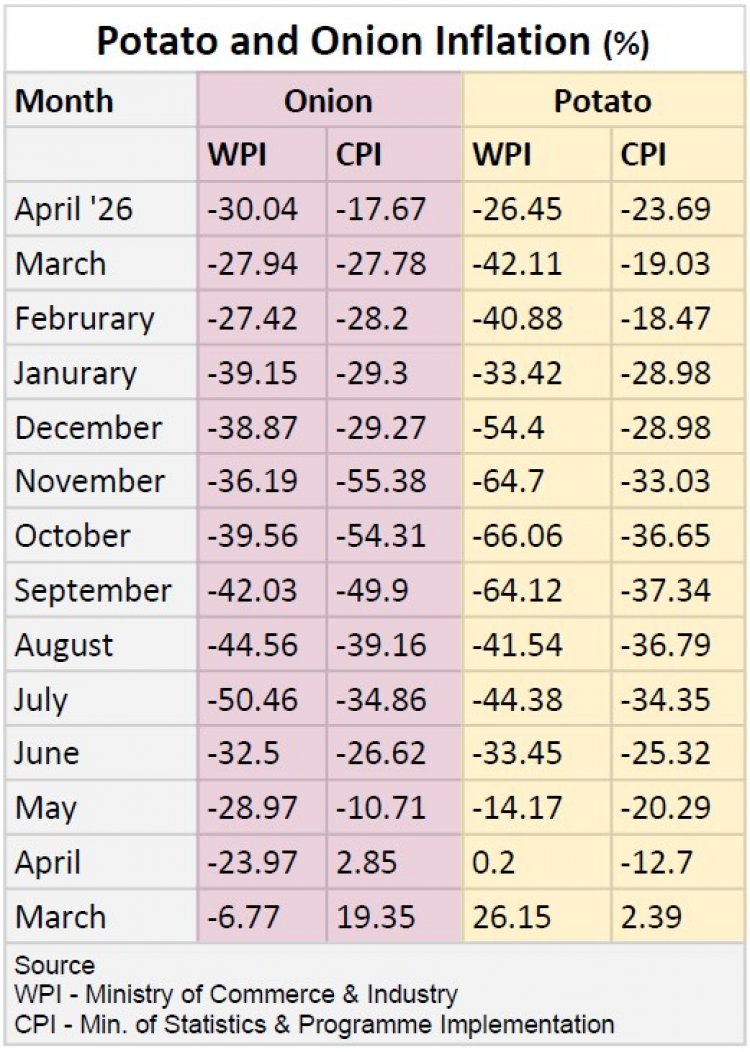
Government data show that wholesale and retail inflation for both potatoes and onions has remained in negative territory for nearly a year. Month-wise figures reveal that wholesale onion prices have dropped by as much as 50 percent during this period, while retail prices have fallen by up to 55 percent. Potatoes have witnessed a similar downturn, with wholesale prices declining by as much as 66 percent and retail prices by up to 37 percent.
Farmers say this prolonged slump has sharply eroded their earnings. Many growers complain that the returns from the market are insufficient to cover rising expenses on seeds, fertilisers, labour, irrigation and transportation.
Amid mounting concern among farmers, Union Agriculture and Farmers Welfare Minister Shivraj Singh Chouhan last week announced in Maharashtra that the government would procure onions at Rs 12.35 per kilogram. However, farmers argue that the procurement price offers little meaningful support at a time when cultivation costs have risen substantially. Political leaders are demanding that the government raise the procurement price to at least Rs 25 per kilogram to provide adequate relief to onion growers.
Negative inflation since March 2025
As per the government data, onion wholesale price inflation (WPI) has been continuously in negative territory since March 2025, and the CPI since May 2025. As far as potatoes are concerned, their WPI has been negative since May 2025 and CPI since April 2025. The following table tells the truth:
For onion farmers like Nivrutti Nyaharkar from Nashik, these numbers are not just economic figures; they are directly connected to survival. “We spend around Rs 20 to grow one kilogram of onion, but we are forced to sell it for only Rs 5 or Rs 8. Sometimes prices even fall to Rs 1 or 50 paise,” he said to Rural Voice.
Nyaharkar said onion farming on one acre of land may cost almost Rs 1 lakh because seeds, fertilizers, labour, and irrigation have become expensive. But after months of hard work, many farmers are not even able to recover half of their investment.
He also blamed sudden government export restrictions for making the situation worse. According to him, whenever onion prices start increasing, export controls are imposed, and rates suddenly crash in mandis.
On May 15, Union Agriculture Minister Shivraj Singh Chouhan announced, “As onion exports have been affected due to the West Asian crisis, prices have fallen. Starting today, NAFED will begin purchasing onions at Rs 12.35 per kg to provide immediate support to farmers. We will procure the entire stock and support onion growers.”
NAFED and the National Cooperative Consumers’ Federation of India (NCCF) have each set a procurement target of one lakh tonnes of onions for the current fiscal year. Agencies had procured 3 lakh tonnes and 4.7 lakh tonnes in 2025-26 and 2024-25, respectively.
However, according to Narendra Wadawne, secretary of the Lasalgaon APMC, the rate for ‘A’ grade onion is Rs 16 per kilogram, while the average rate of onion overall is Rs 11 per kilogram. This means the announcement does not provide any major relief or special benefit to farmers.
Meanwhile, Maharashtra NCP (SP) MLA Rohit Pawar, on Monday, demanded that the government procure onions at Rs 25 per kg and provide compensation to farmers who had sold their produce at distress prices. Pawar, along with other party leaders, joined onion growers in a tractor rally and sit-in protest at Lasalgaon Agricultural Produce Market Committee (APMC).
Wadawne also pointed out that farmers lose opportunities in international markets because of sudden export restrictions imposed by the government whenever domestic prices rise. According to him, these policies may temporarily help control prices for urban consumers, but they also push global buyers towards countries like Pakistan, Egypt, and Turkey. By the time restrictions are removed, Indian farmers are left with excess supply and falling prices in local markets.
Crisis of potato farmers
The situation is equally serious for potato farmers in the largest producer state, Uttar Pradesh. UP accounts for roughly 30% to 33% of the country's total output, producing over 190 lakh tonnes annually. This year, huge production and oversupply in the market caused wholesale potato prices to collapse badly. In many mandis of the state, prices have fallen to just Rs 350 to Rs 400 per quintal. The situation was the same in West Bengal, the second largest potato producing state.
Ram Kumar, a farmer-turned-labourer from Malihabad, told Rural Voice, “The cost of growing potatoes has become higher than the selling price. After adding expenses such as seeds, diesel for water pumps, and fertilizers, the production cost reaches between Rs 500 and Rs 1,000 per quintal. After that come labour charges. Potatoes need to be dug out manually, packed into sacks, and transported to mandis.”
In potato-growing areas like Kannauj, farmers say cultivation costs have crossed Rs 1,000 per quintal, while mandi prices are still around Rs 800 per quintal. Transport and storage expenses also add to the cost. This is why, in some villages, farmers have taken extreme steps. Some have reportedly run tractors over standing crops, while others dumped potato sacks on roadsides because taking them to the mandi guaranteed losses.
The crisis becomes worse because potatoes cannot survive the summer heat without cold storage facilities. Anand Kumar Mishra, a potato dealer from Dalmau, Raebareli, said that cold storage charges are around Rs 340 to Rs 380 per quintal. Supply disruptions in West Asia have reportedly affected ammonia supplies used for industrial refrigeration, increasing operating expenses for cold storage owners, who eventually pass these costs to farmers.
For farmers across states, the math simply does not work anymore. The combined cost of growing and storing the crop has become much more than what they get in the market. Unless procurement systems are expanded, export policies become more predictable, and storage and processing infrastructure improve, farmers fear they will continue to bear the burden of volatile markets.