The crushing of sugarcane during the ongoing sugar season 2025–26 is almost complete. With this, the picture of sugarcane and sugar production in the country has become clear. Maharashtra is leading the country with sugar production of 9.93 million tonnes, while sugar mills in Uttar Pradesh, struggling with cane shortages, have produced only 8.92 million tonnes of sugar.
According to the Indian Sugar and Bio-energy Manufacturers Association (ISMA), by April 15, crushing had closed in 520 out of 539 sugar mills across the country. Currently, only 19 mills are operational. The country’s sugar production (excluding diversion into ethanol) has reached 27.48 million tonnes, about 8% higher than the 25.49 million tonnes produced during the same period last year. However, last year, sugar production declined by around 18% due to disease and adverse weather affecting sugarcane crops.
Source: ISMA (sugar production after diversion into ethanol)
Lower Sugarcane Supply to UP Mills
This season, sugar mills in Uttar Pradesh crushed about 6.3 million tonnes less sugarcane. This shortage forced most mills in the state to announce an early end to their crushing operations, signalling a major crisis for the state’s sugarcane economy.
According to the latest report by the National Federation of Cooperative Sugar Factories Limited (NFCSF), sugar mills in UP crushed 87.45 million tonnes of cane by April 15, compared to 93.76 million tonnes during the same period last year—a decline of about 6.7%. This comes despite claims of increasing acreage and production of sugarcane in the state over recent years.
Lower Crushing, Higher Recovery
Despite the drop in cane supply, sugar production in UP reached 8.92 million tonnes, slightly lower than 9.11 million tonnes last year. A silver lining is the improvement in sugar recovery, which rose from 9.70% to 10.20%. In simple terms, more sugar was produced from less cane.
While this higher recovery partially offset losses for sugar mills, farmers bore the brunt of the crisis. It is estimated that farmers in UP suffered losses of around Rs 2,500 crore due to the 6.3 million tonne shortfall in cane supply to mills, based on the SAP of Rs 400 per quintal for the current crushing season.
Sugar mills, meanwhile, faced losses due to inadequate cane supply and the short duration of crushing. Most mills operated at lower capacity, which may lead to increased financial stress.
Crisis in the Sugarcane Economy
An official from a major sugar mill group in western UP told Rural Voice that despite better prices this year, mills struggled to procure sugarcane. The shortage has created a worrying situation. Many mills received 2–3 lakh tonnes less cane compared to last year, affecting both production and operations.
Rakesh Tikait, national spokesperson of the Bharatiya Kisan Union (BKU), said that sugarcane farmers in Uttar Pradesh are facing a serious crisis. Yields have declined due to crop diseases, while the cost of cultivation continues to rise. He added that the government and sugar mills have failed to provide farmers with disease-resistant varieties. Tikait said that if sugarcane farming is to be saved in the state, the government and sugar mills will have to support the farmers.
Data vs Ground Reality
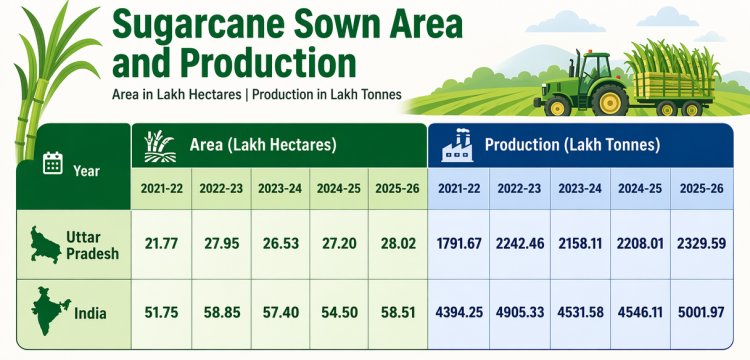
A significant gap exists between official production estimates and ground reality. According to the Union Ministry of Agriculture and Farmers Welfare, sugarcane acreage in UP is estimated to increase from 2.17 million hectares in 2021–22 to 2.80 million hectares in 2025–26. Over the same period, production is projected to rise from 179.16 million tonnes to 232.95 million tonnes.
The Big Question: if UP produced 232.95 million tonnes of sugarcane, why did mills receive only 87.45 million tonnes (just 38%)? Where did the remaining 62% go? This gap raises serious concerns about the reliability of sowing and production data.
Source: https://www.upag.gov.in
National-Level Discrepancies
A similar discrepancy exists at the national level. According to Union Agriculture Ministry estimates, sugarcane production is expected to exceed 500 million tonnes in 2025–26. Despite this record production, sugar mills across the country crushed only 286.5 million tonnes of cane (about 58%), leaving a gap of roughly 213.6 million tonnes (around 42%).
Although a portion of sugarcane is used for seeds, jaggery, and khandsari units, their share typically remains around 25–35%.
NFCSF has also expressed concern over the widening gap between total sugarcane production and its utilisation for sugar. Typically, 65–75% of total cane output is used for sugar production, but this year it is estimated at only 59.5%, the lowest in a decade.
This trend is a matter of concern as it indicates changing dynamics in cane utilisation and raises questions about crop area and production estimates.
Reasons for Lower Cane Supply
Several factors are behind the reduced cane supply in UP. The dominant variety Co-0238 has been affected by diseases such as red rot, leading to lower yields. Farmers have been struggling with this issue for years.
Nitin Deshwal, a farmer from Bijnor district, said farmers often have to travel long distances to get quality sugarcane seeds, and no effective alternative to Co-0238 has emerged. Additionally, labour shortages and rising input costs, including fertilisers and pesticides, are discouraging farmers from continuing sugarcane cultivation. As a result, many are shifting to horticulture, agroforestry, or crops such as maize and potato.
Weather Impact in Maharashtra
In Maharashtra, the country’s largest sugar producer, a bumper crop was expected this season. However, adverse weather in October caused significant damage. Excessive rainfall led to waterlogging, while prolonged cloud cover reduced sunlight, affecting photosynthesis and ultimately crop yields.
Better Prices from Jaggery, Khandsari Units
In UP this year, many jaggery and khandsari units offered better prices than sugar mills, which also contributed to reduced cane supply to mills.
Overall, sugarcane yields in the state have been adversely affected, and the sector is facing multiple challenges. This poses a serious concern not only for farmers but also for the sugar industry and policymakers. Without timely and effective intervention, the crisis could deepen in both Uttar Pradesh and across the country.