Betel cultivation, once the lifeline of several villages nestled in the foothills of the Aravalli Range, is steadily disappearing as climate change devastates a centuries-old farming tradition.
Villages such as Kharairi, Bagrain and Khankheda in Bayana tehsil of Bharatpur district, Rajasthan, were historically known for their thriving betel leaf cultivation. For generations, the Tamboli community depended almost entirely on this crop, which formed the economic and cultural backbone of the region. Over the last 15 years, however, erratic weather patterns have crippled production and pushed farmers out of agriculture.
Unseasonal cold waves, rising temperatures and unpredictable rainfall have proven disastrous for betel vines, which are highly sensitive to climatic changes. Farmers say winters are now harsher, summers unusually intense and rainfall increasingly erratic. A slight dip in temperature below 20°C causes leaf burn, while excess or delayed rain leads to root rot. Since betel vines do not bear fruit or flowers, any damage to leaves results in complete crop loss.
Farmer Vijendra Tamboli stands in a betel field in Kharairi village, Bayana tehsil, Bharatpur district. Photo: Amarpal Singh Verma
Kharairi village reflects this collapse vividly. Once nearly 500 residents were directly engaged in betel cultivation; today, fewer than 100 remain. Economic activity has dried up alongside farming. A branch of the Alwar-Bharatpur Rural Regional Bank, once a symbol of prosperity, shut down as trade declined. Families that once employed labourers and extended credit are now struggling for survival.
Farmers report a sharp fall in productivity. Earlier, a vine would grow up to 15 feet and yield more than 100 leaves; today, growth is limited to seven or eight feet, producing barely 70–80 leaves. At the same time, input costs for bamboo, plastic sheets and protective shade structures have increased, squeezing already shrinking incomes. Many cultivators, unable to sustain losses, have abandoned farming altogether.
Policy gaps have further deepened the crisis. Betel cultivation is not covered under the crop insurance scheme in Rajasthan, leaving farmers without compensation during climate-related losses. Despite repeated demands, growers say they have received no insurance protection, subsidies or technical support from the state.
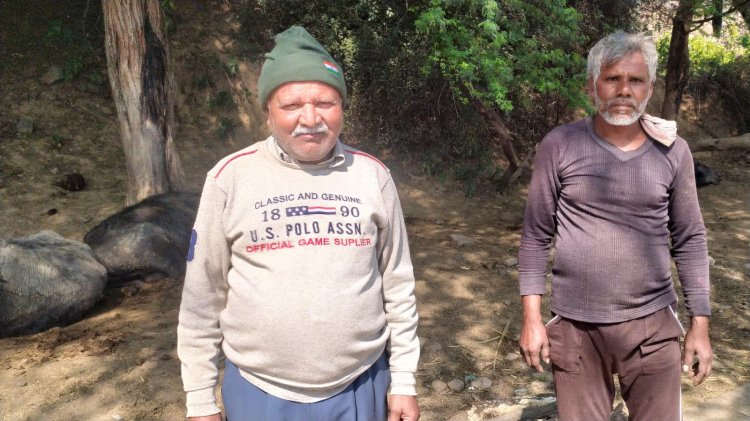
Farmers Suresh Kumar Tamboli and Guddu Tamboli, who have abandoned betel cultivation. Photo: Amarpal Singh Verma
Market access and transportation pose additional challenges. With no nearby wholesale markets, farmers must transport produce to distant cities such as Delhi, Agra, Banaras and Aligarh. Earlier, state-run buses eased this journey, but services were discontinued nearly a decade ago, forcing reliance on costly private transport.
As livelihoods collapsed, migration accelerated. Young people from these villages have moved to Jaipur, Delhi and other cities, working as security guards, drivers, shop assistants and daily wage labourers. Houses stand locked, streets lie deserted and community life has withered. Many children have dropped out of school, and traditional farming knowledge passed down through generations is fading fast.
For the Tamboli community, betel leaf cultivation was more than an occupation—it was an identity. Today, abandoned bamboo structures and empty fields bear silent witness to a tradition on the brink of extinction. Farmers warn that unless betel cultivation is urgently supported through insurance coverage, market access, transportation and climate-resilient practices, this historic agricultural legacy of the Aravalli region may soon be lost forever.