Saffron growers in Pampore, Kashmir, are expecting a substantial recovery in production this year, with output estimated at five to six times last year's level. A fall in night temperatures has created favourable conditions for flowering, although inadequate rainfall has affected the number of flowers. According to Riyaz Ahmad Mir, a saffron grower from Pampore and director of Agro Farmers company, total production in the region could reach 4,000-5,000 kg this year.
Mir's family has been cultivating saffron for nearly 200 years, spanning five generations. Drawing on this experience, he says night temperatures play a more critical role than daytime temperatures in determining the crop's performance. Saffron flowers bloom primarily at night, making cooler nighttime conditions essential for flowering. This year's drop in night temperatures has helped improve the flowering process. However, below-normal rainfall has restricted the number of flowers. Nevertheless, the overall crop is considerably better than last year's.
Four Harvests in 15 Days
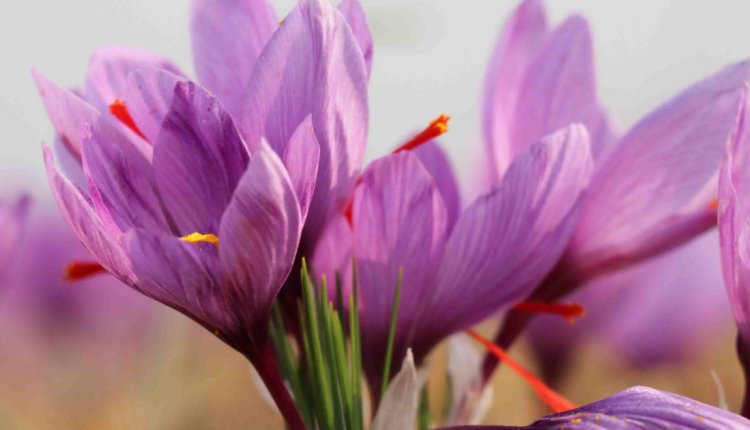
Saffron cultivation has a distinctive harvesting cycle. The main flowering season extends from late October to the first or second week of November, with the entire harvesting period lasting around 15 days. Flowers do not bloom simultaneously across a field; instead, they emerge in successive rounds, allowing farmers to harvest the crop up to four times. Each round of harvesting takes place at an interval of approximately four days.
At the time of the interaction, Mir had completed three rounds of harvesting. The final production estimate can be established only after the red stigmas are separated from the flowers and dried.
According to Mir, one kanal of land can yield an average of around 500 grams of dried saffron. However, actual productivity varies with field conditions, weather and the quality of planting material.
The size and health of saffron corms are particularly important. Large, healthy corms can produce four to six flowers, while smaller ones generally deliver lower yields in the initial years. Typically, a saffron plantation starts giving better returns around three years after the corms are planted.
Saffron corms are planted during August and September and can remain productive for five to seven years. They also multiply underground, producing new corms that can be extracted and planted in other fields. Proper field maintenance after harvesting and timely care of the corms are essential for sustaining productivity. The corms generally remain at a depth of two to three inches in the soil.
Prices Expected to Exceed Rs 3 Lakh per Kg
Despite the improvement in production prospects, better price realisation remains a major concern for saffron growers. Mir expects farmers to receive more than Rs 3 lakh per kg for their produce this year. Saffron sold under the GI-tagged category could potentially command an additional premium of around five per cent.
However, the opportunity to secure a higher price is often constrained by farmers' immediate cash requirements. Many growers need money to meet household expenses, wedding-related costs and other financial commitments. Consequently, rather than waiting for the prescribed GI-tagged marketing process and the possibility of a better price, they often sell their produce to buyers offering immediate payment. This limits their ability to realise the full value of the GI tag.
Shrinking Confidence in Saffron Cultivation
Low production and inadequate returns over the past two to three years have weakened farmers' confidence in saffron cultivation. According to Mir, some growers have even removed saffron corms from their fields and shifted to alternative crops. The improvement in this year's crop, however, is expected to restore some of that confidence.
Around 8,000-9,000 farmers in Pampore are engaged in saffron cultivation, with landholdings varying in size.
Mir identifies two major challenges threatening the future of saffron cultivation in the region. The first is damage to corms caused by rodents and insects in open fields. He believes regular monitoring by the agriculture department and timely support to farmers are necessary to minimise these losses.
The second, and potentially more serious, concern is the growing pressure of residential and commercial construction on saffron-growing land. The conversion of saffron fields into plots for houses and shops is steadily reducing the area under cultivation. Construction activities also raise concerns about pollution and changes in the character of agricultural land.
Pampore's identity is closely linked to its centuries-old saffron-growing tradition. Mir believes that preserving this agricultural heritage requires effective protection of saffron-growing areas, restrictions on unregulated construction and conservation of agricultural land. Without such measures, the long-term sustainability of saffron cultivation in the region could come under increasing pressure.