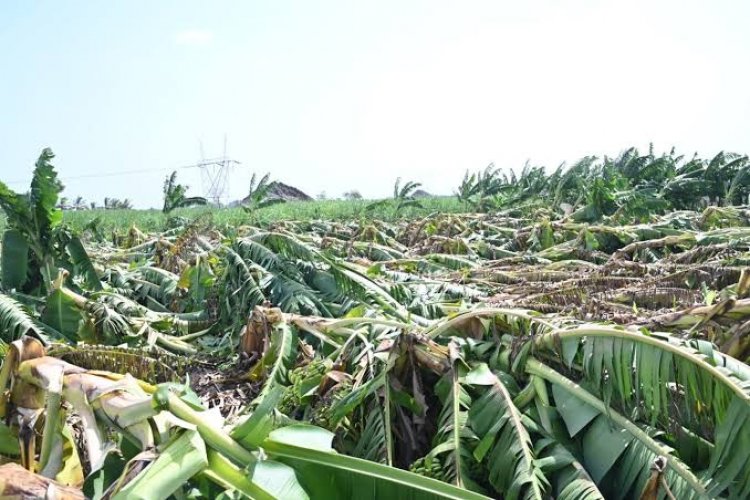
The Maharashtra government has decided to conduct a drone survey to assess the damage caused to banana crops by storms and heavy rains in early June. However, farmers are unhappy that the survey has been ordered nearly three weeks after the damage occurred. They say no farmer can afford to leave fields vacant for so long while waiting for a survey, as fallen banana plants must be cleared and fresh cultivation has to begin immediately.
According to the state Agriculture Department, storms and unseasonal rains during May and June damaged crops over 61,004 hectares, including 18,121 hectares of banana plantations. On Tuesday, June 23, Chief Minister Devendra Fadnavis directed officials from the Agriculture and Disaster Management Departments to conduct a drone-based survey. He said drone technology would provide a more accurate assessment of crop losses and help insurance companies settle compensation claims without difficulty.
The Agriculture Department said adverse weather during the first week of June damaged banana crops across 18,908 hectares in 14 districts. Jalgaon was the worst affected, with 5,471 hectares of banana plantations damaged. Solapur was the second most affected district, where fruit crops spread over 4,110 hectares were destroyed.
India produces about 30 to 33 million tonnes of bananas annually. Maharashtra is the country's largest banana-producing state, accounting for 13-14 percent of total production.
Ganesh Wagh, a farmer from Solapur district, told Rural Voice that he cultivates bananas on five acres. About 2.5 acres of his standing crop were destroyed by rain and strong winds. He said the plants had already started flowering and would have been ready for harvest in about two months. Wagh estimated his direct loss at Rs 9 lakh, but based on the current market price of Rs 30 per kg, he believes the actual loss is close to Rs 20 lakh.
Wagh said that even three weeks after the crop damage, no survey had been conducted in his area. He stressed that the survey should take place immediately because farmers have to remove fallen plants and replant new ones. They cannot wait indefinitely for officials to arrive. He added that the survey would first be carried out in Jalgaon before moving to other districts. At this pace, it could take one-and-a-half to two months before the survey reaches Solapur, and no farmer can afford to leave fields idle for that long.
Another Solapur farmer, Dattatraya Mule Patil, said his own five-acre banana farm suffered limited damage, but nearly 1,000 hectares of banana plantations in the surrounding area were destroyed. With banana prices currently ranging between Rs 25 and Rs 30 per kg, he estimated farmers' losses at Rs 15 lakh to Rs 20 lakh per hectare.
Patil said no official survey had yet been conducted in his area. Some officials had visited and mentioned compensation of Rs 22,500 per hectare, but he said the cost of removing fallen banana plants alone would exceed that amount.
Another Solapur farmer, Suresh Penurkar, who also cultivates bananas on around five acres, said his crop escaped major damage. He noted that banana cultivation is concentrated around Pandharpur and other areas along the Bhima-Sina river in Solapur district. According to estimates, bananas are cultivated on about 7,700 hectares (around 19,000 acres) in the district.
A banana crop takes about 11 months from planting to harvesting. Patil said banana planting takes place throughout the year, but in the Solapur region, most plantations are established during August and September. In Jalgaon, planting is concentrated between December and February, while in Nanded, it mainly takes place during June and July.
Patil said banana farmers enjoyed a good crop last year, with prices rising to Rs 27 per kg. However, just before Diwali, prices crashed to Rs 7-8 per kg. Farmers spend around Rs 4 lakh per hectare from planting to harvest, but at those prices they earned only about Rs 5 lakh per hectare. Prices improved during January and February, but exports were disrupted due to the Iran war, causing prices to fall once again. According to Patil, nearly 70 percent of banana growers in his area have now abandoned banana cultivation because of repeated losses and are shifting to crops such as sugarcane and guava.