Uttarakhand ‘Mahak Kranti Niti’ to Boost Aromatic Farming, Target 22,750 Hectares and 91,000 Farmers
The Uttarakhand government has launched Mahak Kranti Niti, to be implemented by the Centre for Aromatic Plants (CAP), Selaqui, to promote large-scale cultivation of selected aromatic crops. The policy aims to strengthen the entire value chain to enhance farmers' incomes and establish aromatic farming as a sustainable driver of rural economic growth.

 Join the RuralVoice whatsapp group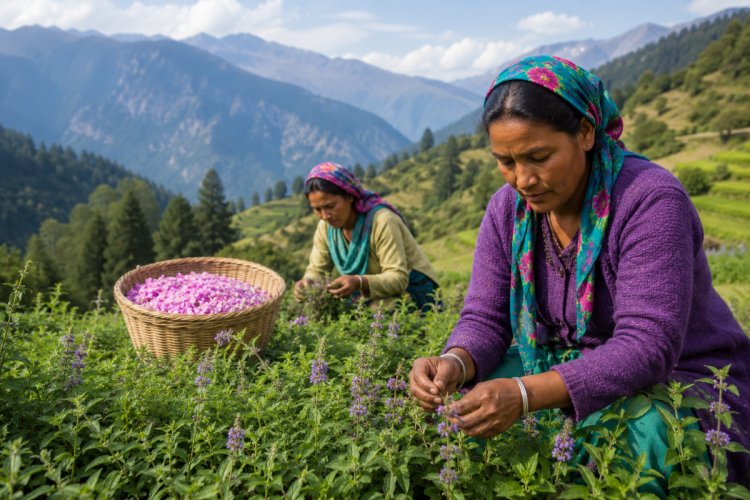
In a major push to diversify agriculture and improve rural livelihoods, the Uttarakhand government has launched the Uttarakhand Mahak Kranti Niti, a comprehensive policy aimed at promoting large-scale cultivation of aromatic crops across the state. The initiative seeks to transform aromatic farming into a sustainable and profitable alternative for farmers while strengthening the entire value chain from cultivation to processing, branding and marketing.
The policy will be implemented by the Centre for Aromatic Plants (CAP), Selaqui (Dehradun) and is designed to address long-standing challenges facing traditional agriculture in the Himalayan state, including crop damage by wild animals, dependence on rainfed farming, steep terrain, soil erosion, and the increasing abandonment of agriculture due to migration.
Focus on high-value aromatic crops
Under the first phase, the government plans to bring approximately 22,750 hectares under aromatic crop cultivation through the development of seven Aroma Valleys and six crop-specific Satellite Centres across Uttarakhand.
The initiative aims to benefit more than 91,000 farmers by promoting high-value aromatic crops and scientific cultivation practices while encouraging bulk production of aromatic raw materials for the essential oils, fragrance, pharmaceutical and cosmetic industries.
The Mahak Kranti Niti offers substantial financial support to farmers, entrepreneurs, cooperatives and self-help groups across the aromatic crop value chain.
Cultivation support
- 80 per cent subsidy on establishment costs for farmers cultivating up to 1 hectare.
- 50 per cent subsidy for farmers cultivating more than 1 hectare.
- Cooperative societies, self-help groups and companies can cultivate up to 30 acres, with a subsidy available for a maximum of 10 acres at the rate of 50 per cent.
- 50 per cent subsidy on nursery establishment costs of up to Rs 30 lakh per hectare.
Processing and value addition
- 80 per cent subsidy on the establishment costs of processing units up to Rs 15 lakh per unit.
- 80 per cent subsidy on packaging and branding expenses up to Rs 25,000.
Aroma Valleys across Uttarakhand
The policy identifies region-specific aromatic crops based on agro-climatic suitability.
|
Aroma Valley |
Districts |
Target Area (Ha) |
|
Damask Rose Valley |
Chamoli, Almora |
2,000 |
|
Timru Valley |
Pithoragarh |
5,150 |
|
Mint Valley |
Udham Singh Nagar, Haridwar |
8,000 |
|
Cinnamon Valley |
Champawat, Nainital |
5,200 |
|
Lemongrass Valley |
Haridwar, Dehradun, Pauri |
2,400 |
|
Total |
22,750 |
The Uttarakhand government will establish six crop-specific Satellite Centres in Champawat (Cinnamon), Pithoragarh (Timru), Uttarkashi (Damask Rose and Timru), Chamoli (Damask Rose), Almora (Damask Rose), and Dehradun (Aromatic Grasses) to provide doorstep support to farmers and entrepreneurs. These centres will function as local hubs for farmer training, hi-tech nurseries supplying quality planting material, processing facilities and marketing support, helping strengthen the aromatic crop value chain across the state.
Expected economic impact
Through the Mahak Kranti Niti, the government aims to significantly expand Uttarakhand's aromatic crop economy over the next decade. The policy targets an increase in the sector's annual turnover from about Rs 100 crore to around Rs 11,700 crore over the next 10–11 years, while benefiting more than 91,000 farmers, generating over 2.2 crore man-days of employment, and promoting entrepreneurship through processing, branding, packaging and value addition.
Environmental and industrial benefits
The initiative is also expected to create employment opportunities for rural youth and help curb migration from the state's hill districts by making farming more remunerative. In addition, aromatic crops can support carbon sequestration, reduce soil erosion and minimise surface runoff, contributing to environmental sustainability. Increased domestic production of crops such as cinnamon and Timru is expected to reduce import dependence and encourage the establishment of more than 450 small-scale processing and distillation units, strengthening Uttarakhand's fragrance and essential oil industry.
Building a sustainable aromatics ecosystem
The Uttarakhand Mahak Kranti Niti integrates scientific research, quality planting material, financial incentives and market support to create a robust ecosystem for aromatic agriculture. By promoting cluster-based cultivation, value addition and farmer participation, the state aims to position itself as a leading hub for aromatic crops while enhancing farmer incomes and supporting sustainable rural development.