
WEF outlines AI roadmap to modernize India's agriculture
To scale AI adoption, the WEF proposes systemic reforms through ecosystems that link governments, start-ups, and research institutions rather than isolated tools or pilots. The report identifies four priority areas — crop planning, soil-health analysis, pest prediction and control, and AI-driven marketplaces — as most relevant to India

 Join the RuralVoice whatsapp group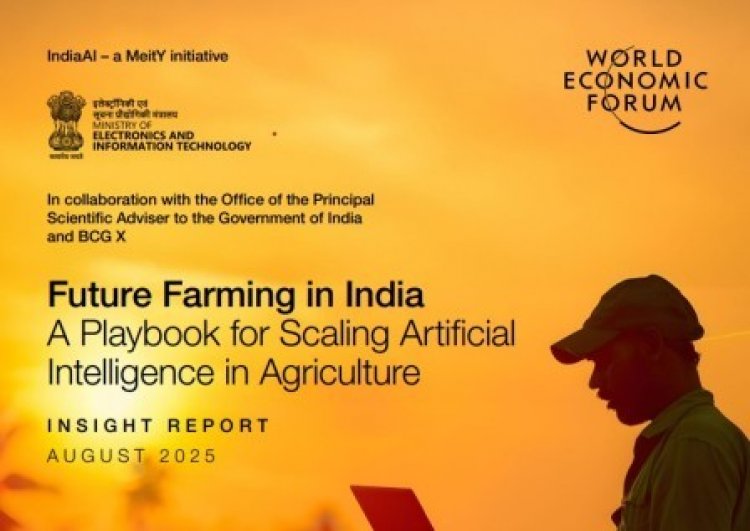
India’s farming sector is poised for a technology overhaul as artificial intelligence (AI) gains traction to boost productivity and resilience, the World Economic Forum (WEF) said in a new report released on Thursday. The report, Future Farming in India: A Playbook for Scaling Artificial Intelligence in Agriculture, developed with the Government of India and BCG X, sets out a practical roadmap for integrating AI across the agriculture value chain. It highlights a three-part strategy — Enable, Create, and Deliver — to build stronger data systems, drive collaboration, and extend digital tools to farmers.
Drawing on case studies such as Telangana’s Saagu Baagu project, which used AI to help 7,000 smallholder chilli farmers raise yields by 21% and cut fertilizer and pesticide use by 9%, the playbook shows how digital technologies can increase incomes and improve sustainability.
Low adoption hinders progress
AI applications could help India’s 150 million farmers counter challenges such as climate change, soil degradation and small landholdings, the report said. Yet fewer than one in five farmers currently use any form of digital technology, constrained by low incomes, weak infrastructure, and lack of finance.
To scale AI adoption, the WEF proposes systemic reforms through ecosystems that link governments, start-ups, and research institutions rather than isolated tools or pilots. The report identifies four priority areas — crop planning, soil-health analysis, pest prediction and control, and AI-driven marketplaces — as most relevant to India.
Building the foundation
Crop planning models using weather data and market trends could help farmers avoid gluts and stabilize prices, according to WEF. Rapid soil-health testing through AI-based spectroscopy offers real-time monitoring, while pest forecasting systems, such as the National Pest Surveillance System launched in 2024, use image recognition to alert farmers to outbreaks.The playbook also highlights smart marketplaces that apply AI for quality assessment and price transparency, helping farmers connect directly with buyers.
Framework for scaling AI
The report introduces the Inclusive Multistakeholder Pathway for Accelerated Convergence of AI Technologies (IMPACT AI) framework. It aligns national efforts such as the IndiaAI Mission, Agri Stack and state-led programs in Telangana and Karnataka to scale AI responsibly and inclusively.
Under the “Enable” pillar, governments are urged to develop AI roadmaps, regulatory sandboxes, and financial incentives. The “Create” pillar focuses on innovation through India’s network of 97 ICAR institutes and 53 agricultural universities. The “Deliver” pillar emphasizes last-mile adoption, including AI tools for 200,000 extension officers and integration with nationwide platforms such as the Kisan Call Centres and ONDC.
A call for collaboration
The WEF calls on governments to establish expert councils on AI in agriculture, on start-ups to co-develop affordable, validated solutions, and on academia to bridge research and practical applications. “India’s readiness to innovate and its expanding agritech ecosystem present a unique opportunity to lead a global shift toward smarter, more sustainable farming,” the report said.With coordinated action, WEF said, AI could help transform smallholder farming into a data-driven and climate-resilient system that strengthens food security and supports national economic growth.