
Sugarcane Crushing Gains Momentum, But Uncertainty Over Sugar MSP and Ethanol Prices
NFCSF has urged the Centre to permit additional sugar exports and correct anomalies in ethanol allocation.

 Join the RuralVoice whatsapp group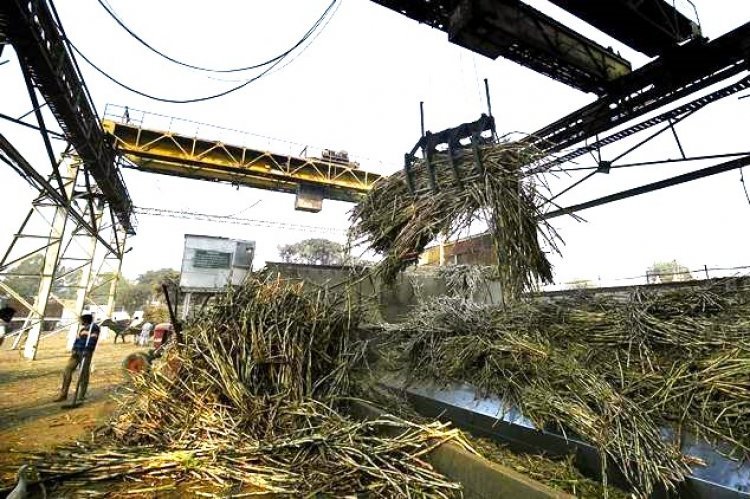
The sugarcane crushing season is progressing in full swing, even as the industry grapples with ambiguity over the long-pending revision of sugar Minimum Selling Price (MSP) and ethanol rates.
According to a pressnote issued by the National Federation of Cooperative Sugar Factories Ltd. (NFCSF), as on 30th November 486 LTs of sugarcane has been crushed (as against last year’s 334 LTs). While 41.35 lakh tons of new sugar has been produced (as against last year’s 27.60 LTs). The average sugar recovery has improved to 8.51%, up from 8.27% last year.
The federation noted that normal monsoon and retreating rains have concluded, and sugarcane cutting operations are currently in full swing, except for some pockets in Maharashtra and Karnataka where farmers’ agitations (“Rasta Roko”) are underway.
Surplus Stock a Concern
NFCSF projects gross sugar production of 350 LTs by the end of the current season (September 2026). With an estimated 35 LTs of sugar likely to be diverted for ethanol production under Cycle-1, net sugar output is expected to stand at 315 LTs.
Major contributors to this output include:
-
Maharashtra: 110 LTs
-
Uttar Pradesh: 105 LTs
-
Karnataka: 55 LTs
-
Gujarat: 8 LTs
Domestic sugar consumption is expected to be 290 LTs, and with an opening stock of 50 LTs, mills may be left holding nearly 75 LTs of surplus sugar, a situation that NFCSF warns is blocking working capital and escalating interest burdens.
To ease the pressure, the federation has urged the Government of India to permit an additional export quota of 10 LTs, over and above the already-approved 15 LTs. The move, NFCSF says, would stabilise domestic prices without impacting global markets significantly, given current low international sugar prices.
Industry Seeks Urgent Revision of Sugar MSP
The sugar industry continues to face uncertainty over the revision of the sugar Minimum Selling Price, which has remained unchanged for six years despite rising input costs.
“There is an urgent need to revise the current MSP to Rs. 41 per kg. It may be noted that revenue share given to farmers in major sugarcane-producing countries such as Brazil and Thailand is around 60–65%, without any minimum guarantee (FRP, whereas in India, it works out to 75-80% even considering sugar MSP Rs. 41 per kg,” said Harshvardhan Patil, President, National Cooperative Sugar Federation.
He also highlighted that, based on the Rangarajan Committee recommendations, Maharashtra and Karnataka have enacted laws mandating mills to share upside revenue with farmers, allocating 75% to farmers and 25% to factories. “This will directly benefit nearly 5 crore small and marginal sugarcane farmers,” Patil added.
Concerns Over Ethanol Allocation
NFCSF also raised concerns regarding the ethanol allocation framework under Cycle-1.
India currently has 513 distilleries with a combined annual capacity of 1953 crore litres, including:
-
281 molasses-based distilleries: 838 crore litres
-
210 grain-based distilleries: 980 crore litres
-
22 dual-feed distilleries: 135 crore litres
Despite the heavy investments in molasses-based distillation capacity, the sugar sector received an allocation of only 288.60 crore litres, while 759.80 crore litres went to grain-based plants.
"This gross anomaly in allocation of Cycle 1 needs to be not only rectified but the long awaited upward revision in Sugar based ethanol prices is the need of the hour, for which we at, NCSF, are continuously following up with the concerned authorities”, said Prakash Naiknavare, Managing Director of National Cooperative Sugar Federation.