
India’s Farmers Are Subsidising America’s China Strategy
The earliest signal came not from customs data but from mandis. Within a week of the announcement, wholesale soybean prices in Indore, Ujjain and Akola fell by between 8 and 11 per cent, while maize prices across feed-linked markets in Karnataka and Andhra Pradesh slipped by 3–5 per cent.

 Join the RuralVoice whatsapp group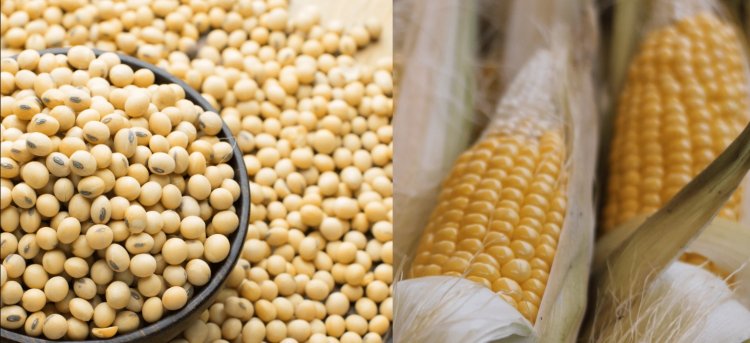
When the interim trade framework between the United States and India was announced in February, the headline figures were designed to convey balance: tariffs on Indian exports to the U.S. would fall to 18 per cent, while India would commit to purchasing up to $500 billion, or roughly ₹41.5 trillion, in American goods over five years. Yet the arithmetic of adjustment embedded in the deal reveals a far more lopsided distribution of risk—one that becomes visible only when national aggregates are broken down into crop prices, per-hectare returns, and household-level income exposure.
The earliest signal came not from customs data but from mandis. Within a week of the announcement, wholesale soybean prices in Indore, Ujjain and Akola fell by between 8 and 11 per cent, while maize prices across feed-linked markets in Karnataka and Andhra Pradesh slipped by 3–5 per cent. These moves occurred in the absence of new imports, underscoring a critical feature of agricultural trade: price formation is forward-looking. Traders reprice crops based on expected landed costs, not realised volumes.
This expectation effect matters because India’s minimum support price system functions unevenly across crops. For soybeans, the MSP for the 2025–26 season stands at ₹5,328 per quintal (about $64), yet average mandi prices in the largest producing state, Madhya Pradesh, were already hovering near ₹4,000 before the trade framework was unveiled. A further ten per cent price compression—well within the range implied by even modest tariff liberalisation—pushes realised prices toward ₹3,600 per quintal, widening the gap between MSP and market price to nearly ₹1,700 per quintal.
For a smallholder cultivating two hectares with average yields of ten quintals per hectare, this translates into a gross revenue shortfall of roughly ₹34,000 per season relative to the MSP benchmark. That figure is not abstract. According to NABARD household surveys, median annual net farm income for small and marginal farmers in central India ranges between ₹90,000 and ₹1.2 lakh, meaning the trade-induced price gap alone can erode 25–35 per cent of yearly farm earnings in a single crop cycle.
Maize, which covers more than 12 million hectares nationwide, presents an even starker illustration of structural vulnerability. The MSP for maize is ₹2,400 per quintal (≈$29), yet market prices in southern India frequently clear at ₹1,700–1,900, reflecting weak procurement and strong integration with global feed markets. A tariff-driven price decline of just five per cent—consistent with observed movements after import policy signals—reduces farm-gate prices by another ₹80–100 per quintal, deepening losses for growers who already operate below official support levels.
When scaled up, the exposure is large. Madhya Pradesh and Maharashtra together account for roughly 10 million hectares of soybean cultivation, while Karnataka, Andhra Pradesh and Telangana contribute nearly 4 million hectares of maize. Even assuming conservative yields, a ₹1,500–₹2,000 per quintal gap versus MSP implies aggregate revenue compression running into ₹30,000–₹40,000 crore ($3.6–4.8 billion) across these states under sustained price pressure—losses concentrated among households least able to hedge, store, or delay sales.
The asymmetry becomes sharper when compared to conditions faced by U.S. farmers. American agriculture receives roughly $42 billion (≈₹3.5 trillion) annually in direct federal support, excluding crop insurance subsidies and ad hoc disaster payments. Spread across fewer than 2 million farms, this equates to average support exceeding $20,000 per farm, with far higher effective protection for large producers. In India, by contrast, even when total farm support exceeds $80 billion (₹6.6 trillion), it is distributed across more than 120 million farmers, yielding a per-farmer buffer that is an order of magnitude smaller—and often unrealised in cash terms.
This imbalance is not incidental; it is instrumental to the broader geopolitical logic underpinning the deal. Washington’s trade strategy has shifted from maximising efficiency to reallocating supply-chain dependence away from China. Manufacturing diversification toward India and Bangladesh is a medium-term project, constrained by infrastructure, labour skilling, and regulatory frictions. Agricultural imports, by contrast, can expand immediately, delivering measurable trade-balance gains and political dividends in U.S. farm states.
Bangladesh’s garment provisions illustrate how deliberately this logic is applied. By granting zero-tariff access to apparel made with U.S. cotton, the agreement effectively redirects raw-material demand away from Indian cotton—previously valued at nearly $3 billion (₹250 billion) annually in exports to Bangladesh—and anchors Dhaka’s manufacturing sector more tightly to American upstream supply. The result is a quiet but consequential rewiring of South Asian value chains: U.S. cotton replaces Indian lint; Bangladeshi factories retain market access; Indian textile hubs absorb the displacement.
Horticulture follows the same pattern at higher margins. In 2024, India imported more than $1.1 billion worth of U.S. tree nuts, already accounting for nearly 70 per cent of its nut imports. A 15–20 per cent expansion in volume—well within historical demand elasticities once tariffs fall—would add $150–200 million in export revenue for American growers. For Indian apple producers in Jammu and Kashmir and Himachal Pradesh, however, even a ten per cent price erosion at the farm gate—triggered by cheaper imported apples gaining shelf space—could wipe out ₹2,000–₹4,000 per tonne in margins, a significant blow in regions where average orchard incomes are under mounting climatic and cost pressures.
Taken together, these figures clarify the underlying dynamic. The trade framework does not merely open markets; it reallocates volatility. Price risk is transferred from a capital-intensive, heavily insured agricultural system to a labour-intensive one where MSP operates more as a benchmark than a guarantee. Manufacturing gains from supply-chain diversification are real but unevenly distributed, while agricultural adjustment is immediate, diffuse, and politically sensitive.
In dollar terms, the agreements appear reciprocal. In rupees and household incomes, they are not. The data suggest that without expanded procurement, price-deficiency payments, or direct income support calibrated to trade exposure, the adjustment burden will continue to fall on millions of small farmers whose margins are already thin.
That is the core contradiction at the heart of the deal: a strategy designed to reduce geopolitical dependence on China is being financed, in part, through the silent repricing of rural livelihoods in South Asia.