
Aravalli 100-metre Definition: Supreme Court Keeps November 20 Directions in Abeyance
The Supreme Court has kept in abeyance its November 20 directions accepting a uniform definition of the Aravalli hills and ranges, including the 100-metre height criterion, and proposed a high-powered expert committee to address critical ambiguities.

 Join the RuralVoice whatsapp group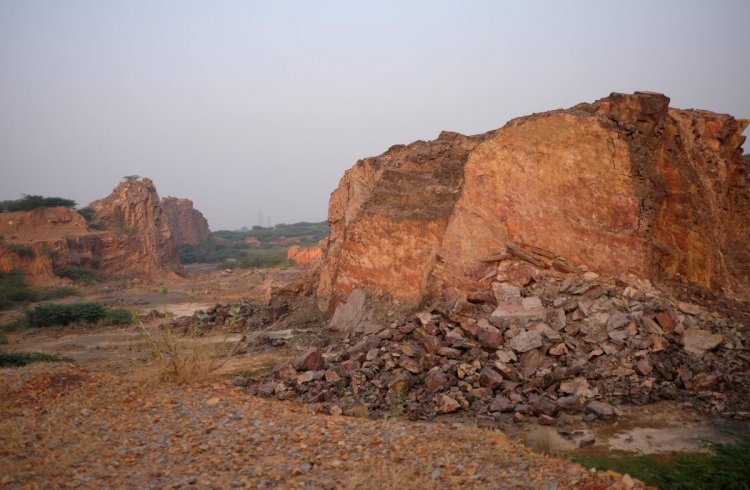
The Supreme Court on Monday kept in abeyance the directions issued in its November 20 verdict that had accepted a uniform definition of the Aravalli hills and ranges, including the controversial 100-metre height criterion.
A vacation bench comprising Chief Justice Surya Kant and Justices J. K. Maheshwari and Augustine George Masih said it would constitute a high-powered expert committee with domain specialists to carry out an exhaustive and holistic examination of the issue.
“We deem it necessary to direct that the recommendations submitted by the committee, together with the findings and directions stipulated by this Court in the judgment of November 20, 2025, be kept in abeyance,” the bench said while hearing a suo motu case titled In Re: Definition of Aravalli Hills and Ranges and Ancillary Issues.
Now the next hearing of this case will be on January 21, 2026.
Court Flags ‘Critical Ambiguities’
Staying its own November 20 order, the three-judge bench said there was a need to resolve “critical ambiguities”, including whether the 100-metre elevation benchmark and the 500-metre gap between hills could potentially strip large portions of the Aravalli range of environmental protection.
The Chief Justice noted that, prima facie, the earlier committee report and the subsequent verdict appeared to have “omitted to expressly clarify certain critical issues”, creating the risk of regulatory gaps that could undermine the ecological integrity of the Aravalli region.
Importantly, the Supreme Court reiterated that, as directed in its order dated May 9, 2024, no permission for mining shall be granted in the Aravalli Hills and Ranges, as defined in the August 25, 2010 report of the Forest Survey of India, without prior approval of the court, until further orders.
Environmentalists Welcome Move
Environmentalists opposing the revised definition welcomed the Supreme Court’s decision to keep the earlier order in abeyance. They said the manner in which mining has continued in the Aravallis reflects administrative and governance failures, and demanded that the proposed expert panel must include independent environmental experts, not just bureaucrats.
The November 20 verdict had accepted a uniform definition recommended by a committee of the Ministry of Environment, Forest and Climate Change (MoEFCC), triggering widespread concern over the potential dilution of protections for the ancient mountain range.
Centre Welcomes Stay; Congress Seeks Minister’s Resignation
Union Environment Minister Bhupender Yadav welcomed the Supreme Court’s decision. In a post on X, he said the government remained committed to the protection and restoration of the Aravalli range. “I welcome the Supreme Court directions introducing a stay on its order concerning the Aravalli range and the formation of a new committee to study the issues. We stand committed to extending all assistance sought from MoEFCC in the protection and restoration of the Aravalli range,” Yadav said.
Commenting on Bhupendra Yadav's post, Congress General Secretary Jairam Ramesh wrote, "Hypocrisy knows no bounds." The Congress Party welcomed the Supreme Court's decision and demanded the resignation of Union Environment Minister Bhupendra Yadav.
Bhupendra Yadav had been defending the central government's stance on the new definition of the Aravalli range and dismissing fears of a threat to the Aravalli range. While protests were taking place in several cities over the 100-meter definition of the Aravalli range, experts say that not only the high hills of the Aravalli range, but also the smaller hills and bushes, are environmentally important. Therefore, conservation of the entire Aravalli range is essential.
Legal and environmental experts view the court’s move as a significant reset in the long-running Aravalli conservation debate, with the proposed expert committee expected to play a crucial role in determining how ecological safeguards are balanced with regulatory clarity in the region.