
Uttar Pradesh Bars New Khandsari Units Within 15 km of Sugar Mills, Policy Changes Hits Small Industries
Key changes introduced to the Uttar Pradesh government’s khandsari licensing policy have made it difficult to set up new khandsari and power crusher units. By increasing the minimum distance from sugar mills, making sugarcane availability a key licensing criterion, and tightening payment and documentation requirements, the policy could significantly constrain the growth of the khandsari industry.

 Join the RuralVoice whatsapp group
The Uttar Pradesh government had announced a Khandsari licensing policy for a five-year period, from the crushing season 2021-22 to 2025-26. The government maintains that the policy was introduced to promote the khandsari industry in the state. However, the crucial point is that several significant changes were made to this policy last year. These changes have tightened regulatory control over the khandsari industry and made the establishment of new khandsari units extremely difficult across most parts of the state.
The amendments introduced through the government order issued on January 21, 2025 make the setting up of new units more difficult rather than encouraging them. The most important change in the policy relates to the distance between sugar mills and khandsari units. For new licenses for power crushers and khandsari units, the radial distance from an existing sugar mill has been increased from 7.5 km to 15 km. This means that no power crusher or new khandsari unit will be granted a license within a 15 km radius of an already established sugar mill.
Interestingly, under the central government’s policy as well, a minimum distance of 15 km is prescribed between two sugar mills. In terms of distance norms, the Uttar Pradesh government has thus placed khandsari units on par with sugar mills.
About a decade ago, when the Uttar Pradesh government implemented an incentive policy for sugar mills, the 15 km distance norm had led to litigation among several sugar industry groups. Most areas with adequate sugarcane availability were already covered by sugar mills. In such a scenario, applying a distance requirement for khandsari units equal to that of sugar mills will make it difficult for these units to find new sugarcane catchment areas.
In addition, the availability of sugarcane over the previous three years has now been made a criterion for granting licenses to khandsari units. There was no such provision in the policy before January 21, 2025.
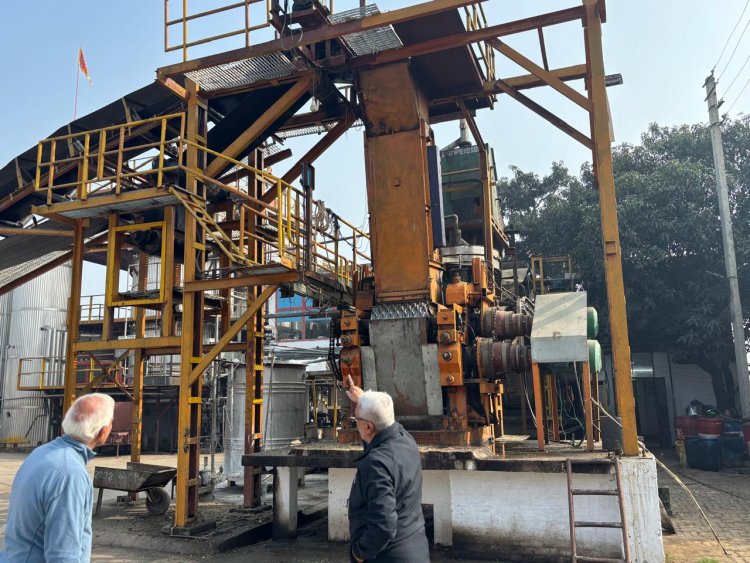
Through several new provisions, the regulatory burden on khandsari units and power crushers has been increased. Earlier, the policy stated that for power crushers with a size of up to 33×46 centimeters, a decision on the license application would be taken within 50 hours of submitting an online application on the department’s website, along with the required documents and a no-objection certificate from the regional pollution control board. The decision was to be taken first at the level of the Assistant Sugar Commissioner and then, within a similar timeframe, at the level of the Sugar Commissioner.
For power crushers larger than 33×46 centimeters, the availability of sugarcane during the previous three crushing seasons was taken as a criterion. This condition has now been extended to all power crushers, including those up to 33×46 centimeters and those with higher capacity. In both cases, the presence of existing khandsari units within a 15 km radius of a sugar mill has also been made a basis for granting new licenses.
Under another condition, licensed khandsari and power crusher units have been mandated to make sugarcane payments to farmers online rather than in cash. In addition, at the time of application, apart from the no-objection certificate from the regional pollution control board, a registration certificate issued by the Excise Commissioner must also be uploaded as a mandatory document. This requirement too was not applicable before January 21, 2025.
As far as the timeline for deciding license applications is concerned, the earlier 50-hour system has been abolished. The new order states that decisions on online applications will be taken at the level of the Sugar Commissioner. In other words, there is now no fixed time limit.
Although the validity of this khandsari policy is only till the current crushing season, from October 2025 to September 2026, the changes made in the final year are quite significant. These amendments, introduced nearly a year ago, will start showing their impact from the current season itself. The new crushing season began in October 2025, and if any new unit is set up, this season would be its first crushing season.
Industry sources say that a large number of khandsari and power crusher-based jaggery units have shut down this year. Due to lower sugarcane availability last year, sugar production in the state had declined. In the current season as well, because of low yield of sugarcane crop, jaggery and khandsari units are purchasing sugarcane at prices equal to or higher than the state-advised price (SAP) of Rs 400 per quintal fixed by the state government for the current crushing season (2025-26). This has led to intense competition over sugarcane and a situation resembling a price war.
Meanwhile, the central government has also amended the Sugar Control Order a few months ago, bringing jaggery, khandsari, shakkar, and boora within the definition of sugar. It has also imposed several conditions on units with a crushing capacity of 500 tonnes per day, including payment of the Fair and Remunerative Price (FRP), similar to sugar mills.
Such provisions will increase the regulatory burden on power crusher and khandsari units and may discourage these industries. Competing with sugar mills under such conditions will become difficult for these units, which could weaken options for sugarcane farmers to secure better prices.
It is surprising that these important changes made nearly a year ago by the Uttar Pradesh government in the khandsari licensing policy have largely gone unnoticed, with very little public discussion. This is despite the fact that the issue is closely linked to a key industry in Uttar Pradesh and to the interests of sugarcane farmers.