
Amid US Section 301 Investigation, India Creates Legal Framework to Ban Forced Labour Imports
India has amended its Foreign Trade Policy to create a legal framework for banning imports made with forced labour, aligning with global trade norms amid a U.S. Section 301 investigation. While no products are immediately prohibited, the move strengthens India's trade compliance and could improve its position in future market-access negotiations.
 Join the RuralVoice whatsapp group
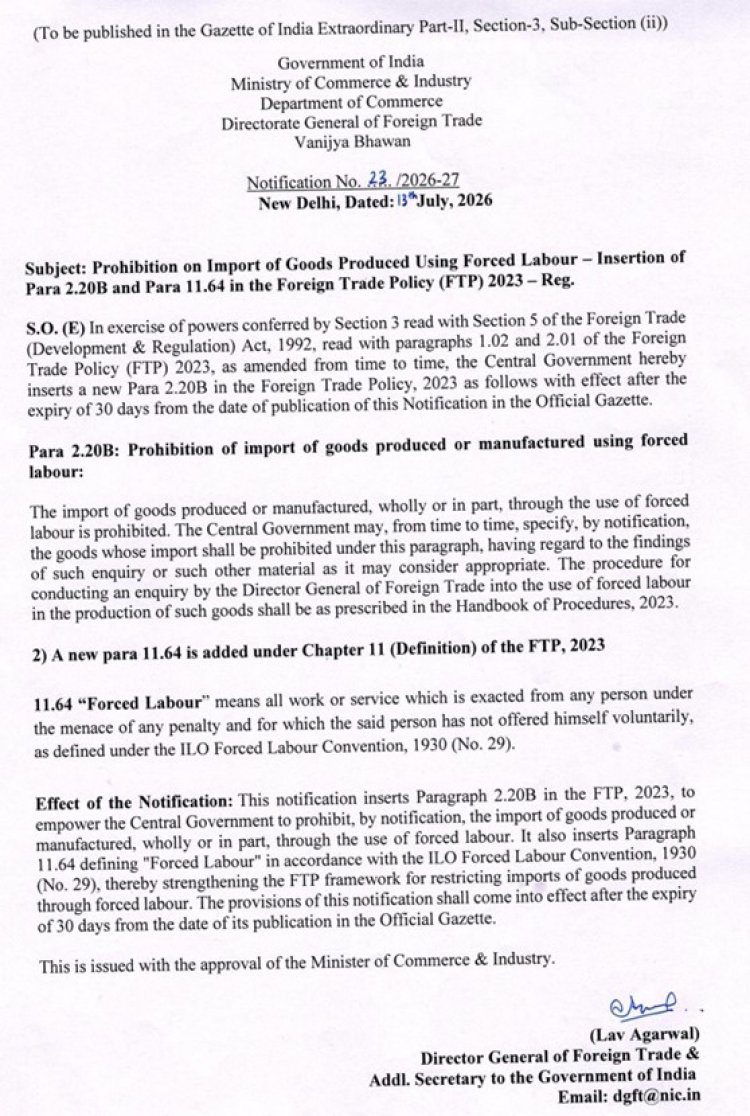
India has moved to ban imports of goods made with forced labour amid a U.S. Section 301 investigation and growing global efforts to keep forced-labor products out of supply chains. DGFT Notification (No. 23/2026-27) issued on July 13 amends the Foreign Trade Policy to prohibit imports of goods produced, wholly or partly, using forced labour. The measure will take effect 30 days after its publication in the Official Gazette.
It does not immediately ban any products or imports from specific countries. Instead, it empowers the government to prohibit identified goods through future notifications following investigations by the Directorate General of Foreign Trade (DGFT). The notification also adopts the International Labour Organization's definition of forced labor as work extracted under the threat of penalty and without voluntary consent.
The order establishes a legal framework rather than an immediate import ban. Its effectiveness will depend on how the government conducts investigations, the evidence required to establish forced labour, and the products it ultimately targets.
The move comes as major economies tighten restrictions on goods linked to forced labour. The U.S. has launched Section 301 investigations covering about 60 economies, including India, and has proposed a 12.5% tariff on imports from India and most other countries under review. The European Union and Pakistan are proposed to face a lower 10% tariff after introducing domestic measures to prohibit imports made with forced labor.
Against this backdrop, India's notification signals that it is strengthening its domestic legal framework in line with international standards, a step that could strengthen its position in future trade negotiations and market-access discussions.
U.S. authorities consider products such as cotton, textiles, solar-panel polysilicon, seafood, metals, batteries and electronics vulnerable to forced-labour risks, particularly when linked to China's Xinjiang region. Yet the U.S. and the EU continue to import many such products from China, underscoring the challenges of enforcing forced-labour rules.
Ajay Srivastava of Global Trade Research Initiative (GTRI) said, “India's notification is a sensible first step, but its credibility will ultimately depend on enforcement. The real challenge is proving that a product is made with forced labour when production spans multiple countries and opaque supply chains.”
“The U.S. and the EU themselves continue to import significant volumes of products from China in sectors where forced-labour concerns have been raised, highlighting the practical and political limits of such measures. For India, the priority should be to build credible traceability and due-diligence systems that protect legitimate trade while ensuring that forced-labour rules do not become arbitrary non-tariff barriers,” he said.