
India’s Egg Production Rises 5.1% to 156.88 Billion, but Output Remains Concentrated in Few States
India’s egg production increased 5.1 percent to 156.88 billion in 2025-26, retaining its position as the world’s second-largest producer. Commercial poultry farms accounted for nearly 85 percent of output, while five states contributed almost two-thirds. However, regional concentration, uneven per capita availability and declining poultry meat production highlight emerging challenges.

 Join the RuralVoice whatsapp group
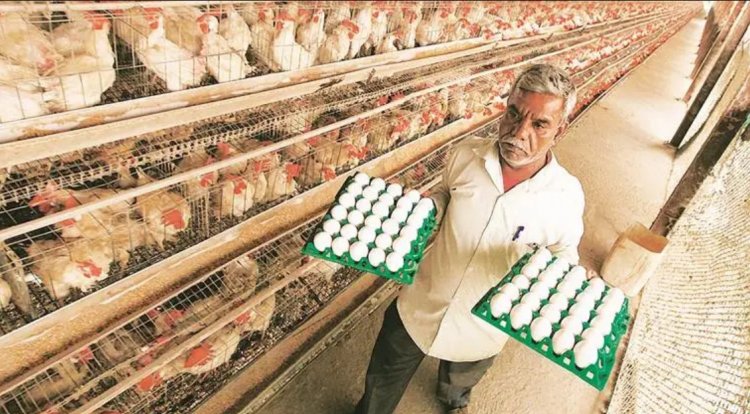
India’s poultry sector continued its expansion in 2025-26, with egg production rising 5.10% to 156.88 billion, compared with 149.27 billion in the previous year. However, the growth story also reveals significant regional concentration, the dominance of commercial poultry farms and considerable differences in egg availability across states. The latest Basic Animal Husbandry Statistics (BAHS) 2026, released by the Department of Animal Husbandry and Dairying, shows that India remains the world's second-largest egg producer after China, according to FAO rankings.
The country's egg production has increased steadily over the past five years, rising from 129.60 billion in 2021-22 to 138.38 billion in 2022-23, 142.77 billion in 2023-24, 149.27 billion in 2024-25 and 156.88 billion in 2025-26. This represents an increase of around 21% over four years. Per capita egg availability has also improved from 95 eggs annually in 2021-22 to 111 eggs in 2025-26.
The increase in production reflects the expanding role of poultry farming in India's food supply and the growing importance of eggs as an affordable source of animal protein. Nevertheless, the national average of 111 eggs per person annually also indicates considerable scope for increasing consumption and improving access, particularly in states with relatively low production.
Commercial farms dominate production
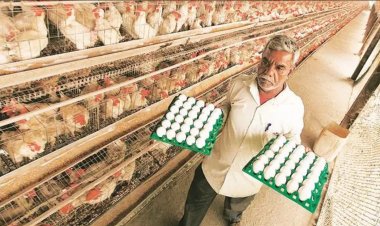
Commercial poultry farms remain the principal drivers of egg production, accounting for 132.87 billion eggs, or 84.70% of total output in 2025-26. Backyard poultry contributed 24.01 billion eggs, representing the remaining 15.30%.
The composition of production also highlights the dominance of improved fowl varieties. Improved fowl accounted for 87.36% of total egg production, while indigenous or desi fowl contributed 11.63%. Desi ducks and improved ducks had marginal shares of 0.82% and 0.19%, respectively.
The predominance of commercial farms indicates the increasing importance of organised poultry production in meeting the country's expanding demand. At the same time, backyard poultry continues to provide an important source of supplementary income and nutrition, particularly for rural households.
The production data also reveal differences in productivity. According to the report, the average annual egg yield of improved fowl in commercial poultry farms increased from 279.95 eggs per layer in 2024-25 to 285.89 eggs in 2025-26. This indicates a gradual improvement in productivity, although performance varies considerably across states.
Five states account for nearly 64% of output
Egg production remains heavily concentrated in southern and eastern India. Andhra Pradesh retained its position as the country's largest egg-producing state, accounting for 17.86% of national production in 2025-26. Tamil Nadu followed with 15.36%, Telangana with 12.99%, West Bengal with 10.59% and Karnataka with 6.95%.
Together, these five states contributed 63.74% of India's total egg production. The concentration is even more pronounced among the top four states, which accounted for 56.79% of national output. The top 10 producing states contributed more than 86%.
Eight major egg-producing states recorded growth rates above the national average of 5.10%. These included Uttar Pradesh, Karnataka, Rajasthan, Punjab, Bihar, Haryana, Odisha and Telangana.
Uttar Pradesh's inclusion among the faster-growing producers is particularly significant, given its relatively modest 4.72% share in national production. Its egg output increased from 6.11 billion in 2024-25 to approximately 7.41 billion in 2025-26, indicating considerable expansion.
Wide differences in per capita availability
Despite rising national production, egg availability remains uneven across the country. Telangana recorded the highest per capita availability at 530 eggs annually in 2025-26, followed by Andhra Pradesh at 523. Haryana and Tamil Nadu reported 312 eggs each, considerably above the national average of 111.
In contrast, several states reported much lower availability. Assam recorded 28 eggs per person annually, Bihar 31, Uttar Pradesh 31 and Jharkhand 24. This disparity highlights the uneven geographical distribution of poultry production and the importance of strengthening local production and distribution networks.
The figures also suggest that higher production does not automatically translate into uniform access across the country. Improving poultry infrastructure, market connectivity and local production capacity could help address these regional imbalances.
Poultry meat production faces a setback
The broader poultry sector presents a mixed picture. While egg production continued to grow, poultry meat production declined marginally by 0.86% in 2025-26. Output stood at 5.13 million tonnes, accounting for 48.27% of India's total meat production of 10.63 million tonnes.
This is significant because poultry is the largest contributor to the country's meat supply, accounting for nearly half of total production. The decline in poultry meat output, even as overall meat production increased by 1.19%, points to differing growth trends within the poultry industry.
Higher production target for 2026-27
The government has set an ambitious egg production target for 2026-27. Andhra Pradesh, Telangana and Tamil Nadu are expected to contribute nearly 57% of the targeted national output of more than 172.1 billion eggs, implying projected growth of 9.67% over 2025-26.
The latest estimates indicate that India's poultry industry has developed considerable production capacity and strengthened its position in the global egg market. However, sustaining higher growth will require greater geographical diversification, improvements in productivity and stronger participation of smaller poultry farmers.
The challenge is not merely to increase production but also to make the sector more geographically balanced, resilient and capable of meeting the country's growing nutritional requirements.