
Scientists Identify Wheat Gene Mutation That Could Boost Yields by Up to 10%
University of Idaho scientists have identified a naturally occurring wheat gene mutation associated with a 5% to 10% yield increase. Linked to later flowering and more spikelets, the mutation can be identified through molecular markers. Researchers have also developed a lower-cost genomic screening method that could accelerate wheat breeding and selection.

 Join the RuralVoice whatsapp group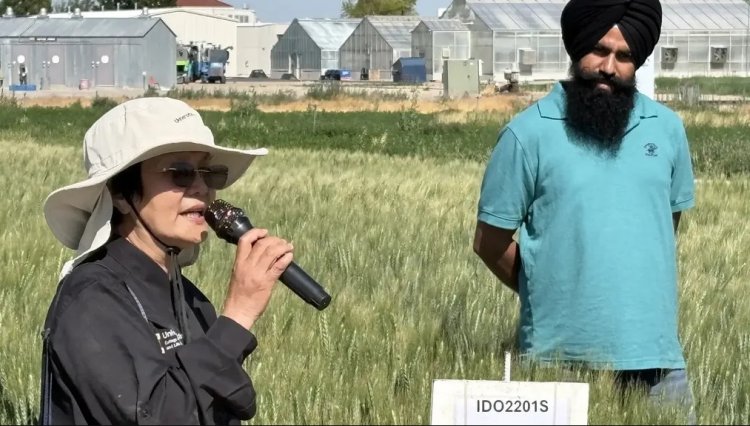
A naturally occurring genetic mutation in wheat could provide breeders with a new way to develop higher-yielding varieties, according to scientists at the University of Idaho (U of I). The mutation has been associated with a 5% to 10% increase in yield and can be identified using molecular markers.
The research was led by wheat breeder Jianli Chen at U of I’s College of Agricultural and Life Sciences, based at the university’s Aberdeen Research and Extension Center. Her team screened wheat germplasm - collections of genetic material - including spring wheat varieties developed by breeders across the Pacific Northwest.
The researchers confirmed the mutation in several high-yielding wheat lines, including UI Gold, a hard white spring wheat variety released by Chen’s programme in 2022, along with several experimental lines.
The genetic change is a nucleotide deletion, in which a small section of DNA is missing. According to the university, the deletion is associated with later flowering and an increase in spikelets - the clusters of flowers that develop into grain along a wheat head. Both traits can contribute to higher grain yields.
Chen and her team have also isolated the locus, or specific position on a chromosome, associated with the beneficial genetic change. This has enabled them to develop molecular markers that can be used to screen wheat lines for the mutation.
“Because we found this gene mutation and developed molecular markers, we can screen lines for it,” Chen said. She expects the marker could eventually be adopted by a number of wheat breeding programmes.
The research was funded through a five-year, $15 million grant from the U.S. Department of Agriculture’s National Institute of Food and Agriculture (USDA-NIFA). Led by the University of California, Davis, the project brought together researchers from 22 institutions across the United States. Chen’s programme received $537,644 in spending authority and built on work from two earlier collaborative USDA-NIFA grants.
Alongside identifying the yield-associated mutation, the researchers worked on improving the speed and affordability of genomic selection, a breeding technique that uses DNA markers to predict which plants are likely to possess desirable traits.
Conventional genomic selection for yield can involve analysing wheat lines using a platform containing about 90,000 single nucleotide polymorphisms (SNPs). SNPs are variations at individual positions in a DNA sequence and can help researchers identify genetic associations with specific traits.
The U of I team found that a platform containing only 4,000 SNPs was as effective as the larger platform in predicting yield and related characteristics. The streamlined approach has reduced testing costs in Chen’s programme by about $60 per sample.
The university said the approach could also reduce the time required to identify promising wheat lines. Rather than waiting several years for field trials to generate yield data, breeders can use genomic-selection models to predict which lines are most likely to perform well.
“Instead of waiting several years to measure grain yield in field trials, wheat breeders can use a genomic-selection model to predict which lines are most likely to be high-yielding,” Chen said.
Chen’s programme plans to test the 4,000-SNP platform for additional traits, including drought tolerance and baking quality. The researchers also expect that identifying specific gene associations could make it easier to develop markers for other important wheat characteristics.
The combination of a specific yield-associated mutation and a lower-cost genomic screening platform could give breeders a more efficient way to identify promising wheat lines and accelerate the development of improved varieties.