
IIT Madras-led Study Reveals Impact of Human Activity on Aerosol and Climate
The implications of this study are profound. With climate models heavily reliant on computer simulations, the established measurements and findings provide empirical data that can help refine these models, thereby reducing uncertainties.

 Join the RuralVoice whatsapp group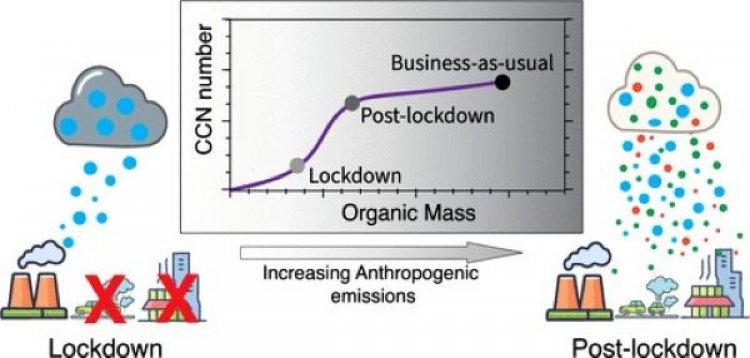
An international study led by the Indian Institute of Technology Madras (IIT Madras) has revealed new insights into how human activities influence aerosols—tiny particles in the air that play a crucial role in cloud formation and climate systems.
This is a critical area of research that continues to generate the largest uncertainties in climate change predictions. The study, conducted between March and July 2020, unveiled the profound influence of human activities on cloud-forming aerosols, also called ‘Cloud Condensation Nuclei’ (CCN), along India’s coastal regions.
The research, published in the American Chemical Society's ES&T Air Journal (https://doi.org/10.1021/acsestair.5c00180), found that coastal India witnessed an 80–250% surge in cloud condensation nuclei (CCN) concentrations following the COVID-19 lockdown as human-caused emissions rebounded. This dramatic rise was attributed to new particle formation (NPF), a process where aerosol particles are formed from gases through complex chemical processes in the atmosphere.
The study was co-authored by Prof. Sachin S. Gunthe, Coordinator, Centre for Atmospheric and Climate Sciences, IIT Madras; Aishwarya Singh, former PhD student at IIT Madras and now post-doctoral researcher at the Max Planck Institute for Chemistry, Germany; Prof. R. Ravikrishna, IIT Madras; and several international collaborators.
Highlighting the importance of such research, Dr. M. Ravichandran, Secretary, Ministry of Earth Sciences, Government of India and a renowned climate scientist who was not part of this research, said, “Aerosol-cloud interactions are intrinsically complicated, and these findings underscore that human activities can dramatically influence underlying processes. This is critical information for negotiating future atmospheric dynamics.”
This research challenges common beliefs about the role of organic aerosols and provides critical data to reduce uncertainties in global climate models. The research also found that anthropogenic organic matter was the dominant factor in the growth of these new particles, challenging the common belief that organic particles inhibit cloud formation. While it is true that organic particles can create surface films that affect cloud droplet formation, this study found that a significant increase in the number of organic particles can promote cloud formation.
Prof. Sachin S. Gunthe said the findings “reveal that anthropogenic emissions strongly influence aerosol behaviour, particularly in how they form clouds. These results challenge existing models and open new avenues for understanding how human activities shape climate patterns.”
Highlighting the importance of the unique “natural experiment” during the lockdown, co-author Aishwarya Singh said, “A cleaner atmosphere can be highly sensitive to new emissions, altering aerosol-cloud interactions significantly. This has a profound impact on climate predictions.”
Prof. R. Ravikrishna, one of the co-authors and a faculty at IIT Madras, remarked, “We cannot predict the future of our climate without rigorously understanding the current state of our environment. Measurements provide an essential context to refine and enhance climate models.”
The researchers emphasize that real-world measurements like these are essential to complement computer-based simulations, helping reduce uncertainties in global climate models. By blending empirical data with advanced modelling, scientists hope to develop more accurate projections for climate change and inform future policy.