
India’s Q1 Oilseed Imports Surpass Last Year’s Full-Year Total, Soybean Accounts for 96%
India’s oilseed imports sharply outpaced exports in Q1 FY2026-27, driven by 550,000 tonnes of soybean imports, largely under zero-duty trade arrangements with least developed countries. Soybean accounted for 96% of import volume. Meanwhile, groundnut and sesame dominated export earnings, highlighting India’s growing import dependence and need for greater value-added exports.

 Join the RuralVoice whatsapp group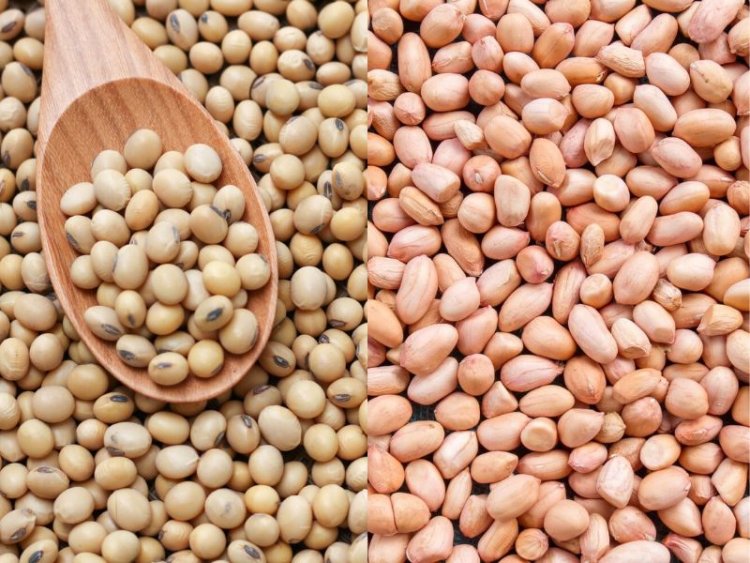
India recorded a significant trade deficit in oilseeds during the first quarter of the 2026-27 financial year (April-June 2026), with total import values outstripping export earnings. According to Directorate General of Foreign Trade (DGFT) data compiled by The Solvent Extractors’ Association of India (SEA), the country imported 580,119 tonnes of oilseeds valued at Rs. 3,146.98 crore, while exports stood at 209,197 tonnes worth Rs. 2,618.68 crore.
The country's oilseed import profile was heavily skewed toward soybean, which comprised 96% of total import volume and 93% of import value. During Q1, India imported 550,000 tonnes of soybean valued at Rs. 2,931 crore.
A substantial portion of these imports originated from Least Developed Countries (LDCs) under the India-Africa Trade Agreement, entering the domestic market at nil duty. Compared to the entire previous financial year (2025-26), when total annual oilseed imports were 481,000 tonnes valued at Rs. 3,130 crore, the first-quarter figures demonstrate a sharp acceleration in import momentum.
Sesame seeds were the second-largest imported commodity at 20,728 tonnes valued at Rs. 189 crore, accounting for 3.57% of total import volume and 6.01% of total import value. Key origin markets included South Korea, Nigeria, Sudan, Brazil, Somalia, the UAE, Vietnam, and Japan. Minor import quantities were recorded for sunflower seeds (3,225.73 tonnes) and mustard seeds (828.70 tonnes).
Groundnut and Sesame Drive Export Revenue
On the export front, groundnut and sesame seeds generated the vast majority of overseas earnings. Groundnut remained India’s primary export driver, with shelled groundnut alone accounting for 133,861 tonnes valued at Rs. 1,550 crore. In FY 2025-26, India exported 663,809 tonnes of groundnut worth Rs. 6,092 crore to destination markets including Indonesia, Vietnam, Malaysia, China, and the Philippines. Industry experts highlight substantial growth potential in transitioning from raw kernel sales toward processed, graded, blanched, and roasted products.
Sesame seed exports totaled 61,248 tonnes during Q1, generating Rs. 945 crore in revenue. Due to its higher unit value, sesame remains a vital contributor to national foreign exchange reserves. Smaller export volumes were recorded for mustard seed (9,067 tonnes valued at Rs. 70.22 crore), linseed (2,647.83 tonnes worth Rs. 30.87 crore), and safflower seed (1,004.91 tonnes worth Rs. 7.45 crore).
The SEA noted that while groundnut and sesame provide a reliable foundation for export revenue, there is an imperative to diversify exports by developing structured overseas markets for secondary oilseeds like mustard and linseed. Concurrently, the strong concentration of zero-duty LDC soybean imports continues to shape India's overall agricultural trade landscape.