
India-UK CETA Takes Effect: Agriculture and Labour-Intensive Exports Poised to Gain, But Market Access Hurdles Persist
The India-UK CETA, effective from July 15, offers new export opportunities for Indian agriculture, processed food, textiles and seafood through tariff reductions. However, compliance with UK standards, Rules of Origin and certification requirements will determine actual gains. The UK secures greater access to India's protected market, making the agreement commercially asymmetric.

 Join the RuralVoice whatsapp group
The India-UK Comprehensive Economic and Trade Agreement (CETA), which came into force on July 15, opens new export opportunities for several Indian sectors, particularly agriculture, processed food, textiles and seafood. However, the agreement's commercial benefits will depend less on tariff reductions and more on exporters' ability to comply with stringent UK quality, food safety and origin requirements. While both countries gain from improved market access, the UK's access to India's high-tariff market appears to be commercially more significant.
Gains for Agriculture and Processed Food Sectors
Agricultural and food products are expected to be among the major beneficiaries of the agreement, although their success will largely depend on compliance with the UK's sanitary and phytosanitary (SPS) regulations.
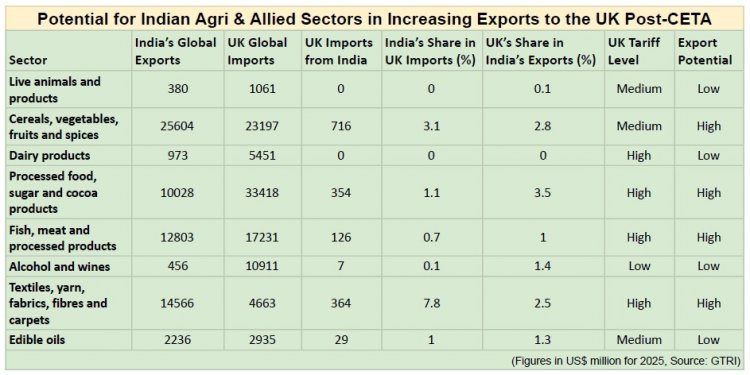
Processed food presents one of the largest untapped opportunities. The UK imports processed food worth over US$33 billion annually, but India currently accounts for only about US$354 million, giving it a market share of just 1.1%. Reduced tariffs could improve the competitiveness of Indian ready-to-eat foods, bakery products, confectionery, sauces and ethnic foods. However, exporters will have to meet strict requirements relating to food safety, labelling and traceability.
India also has scope to expand exports of cereals, fruits, vegetables and spices. Although India exported agricultural products worth US$25.6 billion globally, its share in the UK's US$23.2 billion import market remains only 3.1%. The agreement could improve India's position in selected products, though continued protection of sensitive items and SPS measures are likely to limit gains.
Seafood offers another significant opportunity. India supplied only US$126 million of the UK's US$17.2 billion fish and meat import market despite being a major global seafood exporter. Improved tariff access could enhance competitiveness, but compliance with residue limits, hygiene standards and traceability norms will remain critical.
India has protected several sensitive agricultural products from tariff liberalisation, including dairy products, apples, cheese, oats and selected edible oils, limiting direct competition in these segments.
Tariff Benefits Concentrated in Labour-Intensive Exports
The agreement eliminates UK import duties on almost all Indian exports. However, the widely cited claim of "99% duty-free access" requires careful interpretation because more than half of India's exports to the UK - including petroleum products, pharmaceuticals, cut and polished diamonds and aircraft parts - were already entering the UK duty-free before CETA.
The real commercial gains are concentrated in approximately US$6 billion worth of exports that previously faced tariffs ranging from 4% to 16%.
Garments are expected to benefit significantly as UK tariffs of up to 12% are eliminated immediately. India already supplies over US$1.3 billion worth of garments to the UK, accounting for more than 6% of Britain's apparel imports. Lower tariffs could improve India's competitiveness against countries that already enjoy preferential access.
Textiles, leather products, footwear and carpets are also expected to benefit substantially. Indian footwear and leather products previously attracted duties of up to 16%, making tariff elimination commercially significant for exporters.
UK Gains Larger Access to India's Protected Market
While India secures improved access to the UK market, the UK appears to obtain greater commercial advantages because Indian tariffs have traditionally been much higher.
Around 93% of UK exports currently face moderate or high import duties in India. Under CETA, India will remove tariffs immediately on nearly 64% of UK products, including machinery, electronics, aircraft parts, salmon and lamb. Tariffs on another 26% of products - including chocolates, cosmetics, beverages, auto parts and soft drinks - will be reduced gradually.
The agreement also strengthens legal certainty for UK businesses through commitments covering financial services, digital trade, intellectual property and regulatory transparency. While these measures could improve investor confidence, they also reduce India's policy flexibility in certain areas.
Standards Will Determine Commercial Success
Tariff reductions alone may not guarantee higher exports. Indian exporters must satisfy detailed Rules of Origin, technical standards, certification requirements and food safety regulations before they can claim preferential tariffs. Failure to comply with these conditions would prevent exporters from accessing CETA benefits despite lower duties.
Competition from countries that already enjoy preferential trade arrangements with the UK could also limit India's export gains in several sectors.
Machinery, electronics, fabricated metal products and automobiles illustrate this challenge. Although the UK imports over US$270 billion worth of these products annually, India's market share remains relatively small. Future growth will depend more on technology, certification and integration into global supply chains than on tariff reductions alone.
Services Continue to Drive India's Trade Advantage
India continues to enjoy a trade surplus with the UK in both goods and services, although services contribute the larger share.
Bilateral trade in goods and services is valued at around US$66 billion, with services accounting for nearly two-thirds of total trade. India maintains a strong position in information technology, business services and professional services.
The proposed Double Contributions Convention, once implemented, will allow Indian professionals temporarily working in the UK to avoid paying social security contributions in both countries, reducing employment costs for businesses and workers.
Investment ties also remain strong, with the UK being India's sixth-largest source of foreign investment. More than 1,000 Indian companies operate in the UK, while nearly 800 British firms have operations in India.
Digital Compliance Framework Introduced
To operationalise CETA, the Directorate General of Foreign Trade (DGFT) and the Central Board of Indirect Taxes and Customs (CBIC) have introduced new digital procedures.
Indian exporters seeking preferential market access must obtain electronic Certificates of Origin through the DGFT's Trade Connect portal using either self-certification or authorised certification agencies.
For imports from the UK, Indian importers will require an authenticated Origin Declaration and a Unique Reference Number (URN) generated through CBIC's digital verification system before claiming concessional customs duty.
Both exporters and importers will need to maintain detailed origin documentation, production records and supporting evidence for customs verification.
Ajay Srivastava of think tank Global Trade Research Initiative (GTRI) says that India-UK CETA creates meaningful opportunities for labour-intensive manufacturing, agriculture and processed food exports while strengthening bilateral investment and services trade. However, the agreement is unlikely to produce automatic export growth. Real gains will depend on exporters' ability to meet stringent regulatory requirements, improve product quality and integrate into global supply chains. Although India secures improved market access in several sectors, the UK's preferential access to India's relatively protected market gives it a stronger commercial advantage in goods trade.
Special Package Reaches Deputy High Commission
On this occasion, a special package of select British goods arrived at the British Deputy High Commission in Mumbai this morning (15 July) aboard a British Airways flight. The package contained goods from the UK benefitting from reduced tariffs, including cosmetics, food products, and alcoholic beverages.
Unveiling the package Harjinder Kang, UK Trade Commissioner for South Asia and British Deputy High Commissioner for Western India, said: “This is a watershed moment for the UK-India partnership. As the landmark trade deal comes into force, what better than having select British products arriving in one of the very first UK flights into India this morning - with thanks to support from British Airways. Our landmark trade deal is designed to benefit businesses and consumers from day one with cheaper, quicker and easier trade. We are all excited to take full advantage of it.”