
U.S. Replaces Temporary Section 122 Tariffs with 10% Forced-Labour Duties on India
The U.S. replaces Section 122 tariffs with permanent Section 301 forced-labour duties. India secures a lower 10% tariff rate after banning forced-labour imports. Read the breakdown of exempted goods and export impacts.

 Join the RuralVoice whatsapp group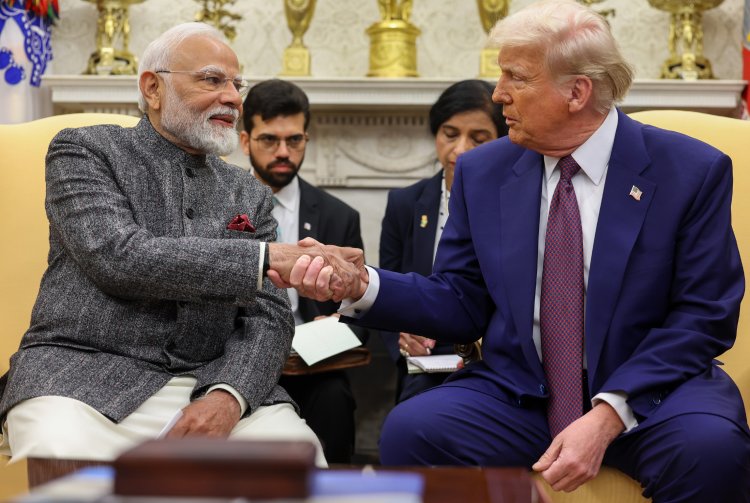
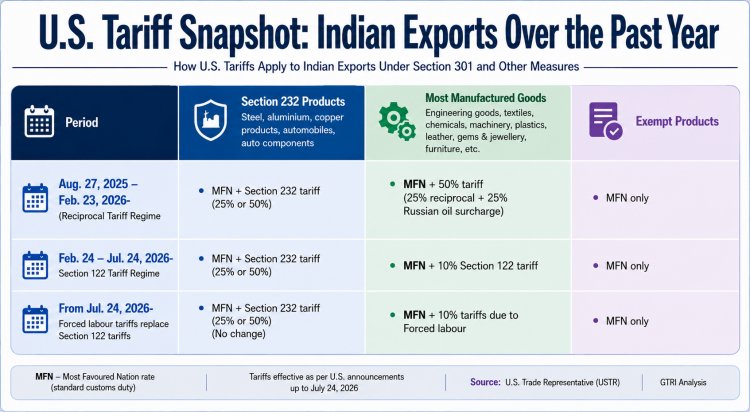
The United States has reduced the Section 301 forced-labour tariff on Indian exports to 10% from 12.5%, after taking note of India's decision to ban imports of goods made with forced labour. Announcing the final results of the investigation on July 23, U.S. Trade Representative Jamieson Greer said the new tariffs would take effect on July 24, 2026, replacing the temporary 10% global tariffs imposed under Section 122 that expired the same day.
The USTR concluded that 60 economies had failed to adequately prohibit or enforce restrictions on goods produced using forced labour. 17 economies, including India, Canada, the United Kingdom, Bangladesh and Pakistan, will face a 10% tariff, while the remaining 43 economies will be subject to a 12.5% tariff. Goods loaded before July 24 and entered into the United States by July 28 are exempt under a transition provision.
Some Agri Inputs Exempted From Tariffs
The new tariffs exempt raw materials and agricultural inputs that the United States cannot produce in sufficient quantities, products whose taxation could cause inflation or supply disruptions, selected industrial inputs including certain plastic resins, medical supplies and metal products, goods already subject to Section 232 tariffs, and informational or humanitarian items such as books, personal baggage and donations. The new tariffs also exempt goods covered by U.S. free trade agreements such as USMCA and certain CAFTA-DR products.
For the European Union, Japan, Korea, Taiwan and Switzerland, the Section 301 duty is applied on a net-of-MFN basis, ensuring the combined tariff reaches the prescribed level rather than stacking the full Section 301 duty on top of existing MFN tariffs. For example, if an EU product already pays a 3% standard MFN duty, the Section 301 tariff tops it up by 7% so that the combined duty ceiling reaches 10%, rather than stacking a full 10% on top of the existing rate.
India Secures Lower Tariff Rate
India secured the lower 10% tariff, down from the 12.5% rate proposed in the USTR's draft, after introducing measures to prohibit imports made with forced labour. On June 14, 2026, India amended its Foreign Trade Policy to ban the import of goods produced using forced or compulsory labour. The USTR considered this a policy improvement, placing India in the lower-tariff category alongside 16 other economies.
U.S. tariffs on Indian exports now fall into three broad categories:
• First, products covered by Section 232 - including steel, aluminium, copper, auto components and certain derivative products, accounting for about 8% of India's exports - face 25% or 50% tariffs in addition to the normal U.S. MFN duty.
• Second, a limited set of exempted products continues to pay only the normal MFN tariff.
• Third, the remaining about 70% of India's exports - including engineering goods, textiles and garments, chemicals, machinery, plastics, leather products, gems and jewellery, furniture and most other manufactured goods - are subject to the 10% Section 301 forced-labour tariff in addition to the applicable MFN duty.
Think tank Global Trade Research Initiative (GTRI) commented, “The 10% U.S. tariff on Indian exports under the forced-labour investigation lacks a credible factual basis. The United States has not produced evidence that India imports goods made with forced labour. In response to U.S. concerns, India has already amended its Foreign Trade Policy to ban the import of goods produced using forced or compulsory labour.”
According to GTRI, Indian law also prohibits forced labour in domestic production through constitutional guarantees and labour statutes. The tariff therefore appears to serve primarily as a mechanism to preserve the Trump administration's tariff wall after the expiry of the temporary Section 122 tariffs, rather than as a targeted response to a proven forced-labour problem involving India.
India has not received the textile and apparel tariff-rate quota (TRQ) exemption under the new U.S. Section 301 forced-labour tariff. The exemption applies to specified volumes of textile and apparel exports from Bangladesh, Cambodia, Indonesia, and Malaysia that use U.S. origin cotton and fiber. These qualifying exports are exempt from the new Section 301 duties.