
Parliamentary Committee Says Solar Schemes Are Bypassing Farmers, Warns of Systemic Failures
A parliamentary committee has warned that India’s flagship solar programmes — PM-KUSUM and PM Surya Ghar — are failing to effectively reach farmers. Despite ambitious targets, installations remain far behind schedule due to financing delays, vendor failures, and weak state-level implementation. Farmers face long waits, excessive paperwork and unreliable support, raising concerns that the solar transition is bypassing those it aims to empower.

 Join the RuralVoice whatsapp group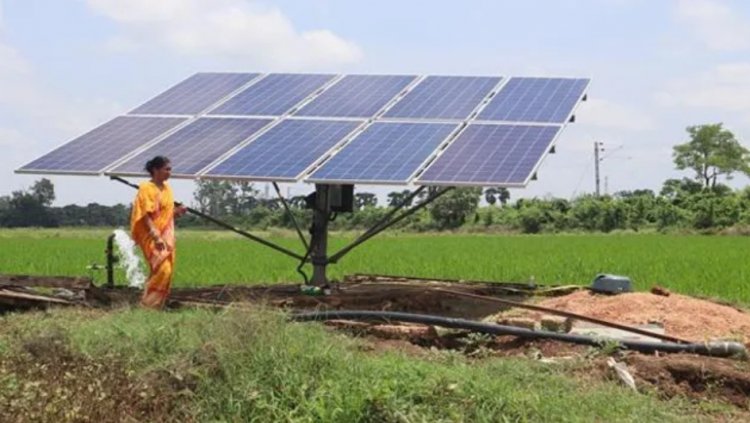
For nearly two years, Ramesh Chaudhary, a marginal farmer from western Madhya Pradesh, has carried around a neat folder of application papers — bank forms, identity documents, quotations from empanelled vendors — believing the PM-KUSUM scheme would finally allow him to replace his ageing diesel pump with a solar one. “They told me it would take three months,” he said. “It’s been nearly two years.” His experience mirrors the frustrations of thousands of farmers across drought-prone districts from Marathwada to Saurashtra, who once saw solar pumps as a lifeline to stable irrigation but now find themselves caught in long queues, financing delays and poor vendor support.
A parliamentary committee, in a sharply worded review, has now echoed these concerns, warning that India’s flagship solar schemes for farmers — PM-KUSUM and the PM Surya Ghar: Muft Bijli Yojana — are struggling to reach their intended beneficiaries. The Committee on Estimates said that while targets have expanded rapidly, on-the-ground progress remains “well below expectations,” leaving farmers to navigate procedural bottlenecks and unreliable service systems that undermine the promise of clean, affordable irrigation.
Launched in 2019, PM-KUSUM was designed to reduce dependence on diesel and erratic grid power and give farmers greater energy autonomy through standalone solar pumps, solarisation of existing grid-connected pumps, and the installation of small solar plants on their land. Yet progress has stalled at multiple levels.
As of July 2025, only 8.5 lakh standalone pumps had been installed against a sanctioned 12.7 lakh, while grid-connected pump solarisation had reached just 6.5 lakh installations out of more than 36 lakh allocated. The most transformative component — allowing farmers to host 500 kW to 2 MW solar plants on their land and earn income through long-term power purchase agreements — has delivered only 641 MW of the targeted 10,000 MW. For many farmers, these numbers translate into months of waiting, multiple visits to banks and district offices, and an uneasy feeling that the scheme is running ahead on paper, not fields.
The committee identified financing as the core obstacle. Even after all components were brought under the Agriculture Infrastructure Fund, banks have sanctioned far fewer loans than the programme requires. By February 2025, banks had received 1,254 loan applications and sanctioned 922, but disbursed only 891. The remaining cases have either been rejected or remain stuck in procedural loops, often because banks ask for collateral or documentation beyond what the scheme mandates. Farmers repeatedly told state officials that vendors demand upfront payments before installation, creating additional burdens and undermining the subsidised credit architecture.
Vendor performance has become another point of stress. Several states acknowledged that vendors have not established the required district-level service centres or maintained consistent after-sales support, leaving farmers stranded when their newly installed pumps malfunction. In regions where irrigation windows are narrow and rainfall uncertain, a pump that stalls for weeks can trigger crop losses. “A solar pump that refuses to start in the sowing season is worse than having no pump at all,” the report noted, underscoring the erosion of trust among early adopters.
Differences in state implementation add another layer of inequality. Maharashtra, Gujarat and Rajasthan account for the bulk of installations, driven largely by feeder-level solarisation, while states such as Bihar, Andhra Pradesh, Chhattisgarh and West Bengal remain far behind. Feeder-level solarisation, though financially attractive for distribution companies, offers fewer direct gains for farmers compared to individual pump solarisation, which allows them to generate surplus power and earn income. Farmers in several states expressed concern that the growing preference for feeder-level models sidelines them in a programme that was originally conceived as farmer-centric.
Component A, intended to provide farmers with a new revenue stream by leasing or utilising their land for solar plants, has barely moved. The committee attributed this to delays in land verification, difficulties in arranging equity, and slow signing of power purchase agreements by distribution companies. It described this as “the single most underutilised opportunity for augmenting farmer income.”
While the Ministry of New and Renewable Energy has highlighted diesel savings of 340 million litres and an annual reduction of 40 million tonnes of CO₂ through existing installations, the committee said the potential impact is far greater if structural issues are resolved. For now, farmers continue to face delayed installations, unclear timelines, inconsistent vendor support and slow energisation of systems even after they are set up.
For farmers like Chaudhary, the frustration is personal. “I thought solar would free me,” he said. “Diesel is too costly and electricity is unreliable. But now I’m stuck between banks, vendors and paperwork.” The committee’s concluding message seemed to reflect that sentiment: farmers, it said, “are not passive beneficiaries — they must be central actors.” Unless financing is streamlined, vendor accountability strengthened and lagging states pushed harder, India’s solar transition risks leaving behind the very cultivators it claims to empower.