
USTR Leaves New Delhi Without Trade Deal Breakthrough as India Reassesses BTA
India-U.S. trade negotiations remain unresolved after USTR Jamieson Greer's visit to New Delhi failed to produce a breakthrough. Analysts say India is reassessing the proposed Bilateral Trade Agreement following changes to the U.S. reciprocal tariff regime. Both countries, however, maintain that negotiations are progressing toward a balanced and commercially meaningful agreement.

 Join the RuralVoice whatsapp group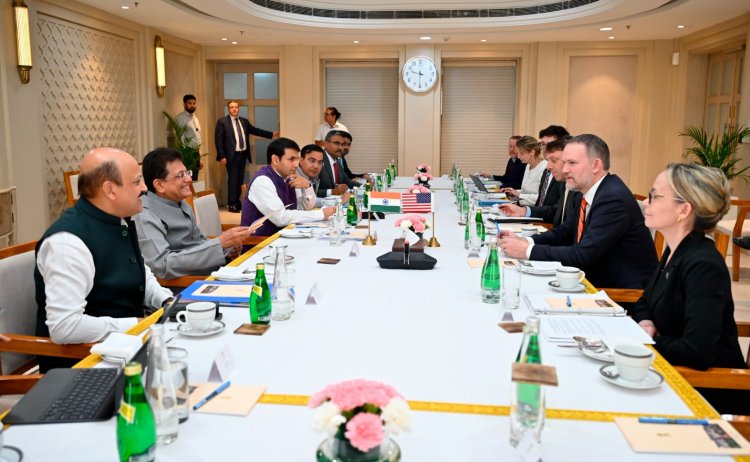
The proposed India-U.S. Bilateral Trade Agreement (BTA) appears to have hit a fresh roadblock after U.S. Trade Representative (USTR) Jamieson Greer's visit to New Delhi on June 23-24 ended without a breakthrough. While both sides reported progress in negotiations, the absence of a concrete outcome has raised questions about the future of the deal, particularly after changes in the U.S. tariff framework altered the basis of the original understanding reached earlier this year.
The failure of USTR Jamieson Greer's June 23-24 visit to produce any breakthrough suggests that New Delhi is reassessing the logic of the proposed India-U.S. Bilateral Trade Agreement.
When U.S. Ambassador Sergio Gor declared on May 30 that the deal was "99% ready," expectations were high. Yet the BTA negotiations remain stuck because the foundation of the original bargain as defined in India-US Joint Statement dated Feb 7 has collapsed.
Ministry of Commerce & Industry, in its statement said, "Both sides noted substantial progress by negotiating teams in recent months and welcomed the momentum from successive technical and ministerial-level engagements. Discussions focused on pathways to conclude an interim agreement as an important milestone toward a comprehensive BTA. Both sides reaffirmed their commitment to an agreement that is balanced, commercially meaningful, and delivers tangible benefits for businesses, farmers, workers, and consumers in both countries.
"Recognizing the growing significance of the India–U.S. economic partnership amid evolving global trade dynamics, both sides reiterated their shared goal of expanding bilateral trade, fostering innovation, and building resilient, trusted supply chains.
"The two sides expressed confidence that ongoing negotiations will further deepen economic ties and strengthen the India-U.S. Comprehensive Global Strategic Partnership."
Under the February 7, 2026 framework, Washington offered to reduce reciprocal tariffs on Indian exports from 25% to 18% in exchange for far-reaching Indian concessions on agriculture, energy, defense, aircraft, digital services and advanced technologies. But the U.S. Supreme Court's February 20 ruling invalidated the reciprocal tariff regime, eliminating the only American concession. Washington now is effectively asking India to negotiate on the basis of benefits it can no longer legally deliver.
Ajay Srivastava from think tank Global Trade Research Initiative (GTRI), said, "From India's perspective, the proposed BTA increasingly resembles a one-way market-access agreement rather than a balanced trade pact. New Delhi would undertake permanent commitments while receiving little certainty in return. Even a signed agreement would offer no protection against future U.S. trade actions, as Washington has repeatedly launched Section 301 investigations and imposed trade restrictions on countries with which it already has trade agreements."
The emerging message is clear: the BTA looks like less as a vehicle for mutual economic gains and more as a mechanism to secure preferential access for American exports and strategic interests. In these circumstances, India realizes that delaying - or even abandoning - a rushed BTA may be the more prudent course than locking India into obligations whose costs could far exceed any temporary tariff relief offered by Washington.