
Carbon Markets for Indian Agriculture: Opportunities for Farmers and the Rural Economy
Carbon markets can support India’s agricultural transition by financing regenerative farming practices that reduce greenhouse-gas emissions, improve soil health and strengthen climate resilience. Carbon project developers, FPOs and research institutions can help smallholders access this opportunity, but credible verification, scientific validation and transparent benefit-sharing are essential to ensure meaningful farmer incomes.


 Join the RuralVoice whatsapp group
India’s agricultural sector faces two interconnected challenges: securing food supplies for a growing population while reducing greenhouse-gas emissions and restoring soil and water resources. The United Nations projects a population peak of approximately 1.7 billion in the early 2060s, yet warming, rainfall variability, groundwater depletion and deteriorating soil health threaten sustained productivity. India’s First Biennial Transparency Report (BTR), its official climate report to the United Nations, quantifies the sector’s emissions and vulnerability. Agriculture employed 46.1% of the workforce but contributed 16.6% of gross value added in 2023–24; more than 86% of operational holdings are small and marginal. The transition must therefore protect food security and rural incomes while supporting households with limited capacity to finance change or absorb production losses.
The BTR’s crop-loss estimates demonstrate this exposure. The March–April 2022 heatwave caused an estimated wheat production loss of 4.5 million tonnes; heavy rainfall and wind during the same months in 2023 caused a further loss of 1.5 million tonnes. Extreme rainfall during soybean pod maturation was associated with losses of 9.5–30.75% in affected years. These findings support integrating mitigation, adaptation and soil restoration.
Carbon markets offer a potential financing pathway for this transition. Carbon Project Developers (Carbon companies/Ag tech companies) can support locally appropriate regenerative practices that reduce emissions, improve soil health and strengthen resilience, with potential yield benefits over time. Independently verified emission reductions or carbon removals can generate carbon credits whose revenues provide supplementary farmer income and help sustain adoption, provided benefit-sharing arrangements are transparent.
The Emissions Profile Identifies Mitigation Priorities
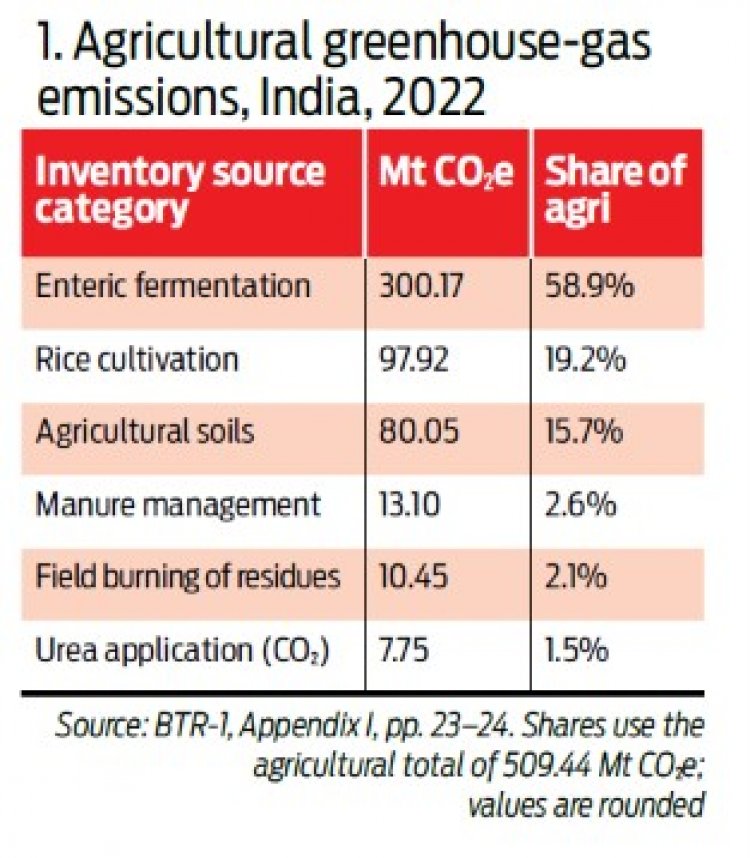
The BTR reports agricultural emissions of 509.44 million tonnes of CO₂-equivalent (Mt CO₂e) in 2022, approximately 15% of national emissions excluding land use, land-use change and forestry (Table 1). Irrigated rice contributed 71.45 Mt CO₂e, compared with 21.57 Mt from rainfed and 4.90 Mt from deep-water rice. Prolonged flooding supports methane-producing microorganisms, increasing methane emissions, and thus compelling to make water management a priority. Agricultural-soil emissions also identify nitrogen management as a substantial opportunity.
From Agronomic Practice To A Verified Climate Outcome
For a smallholder farmer, changing agricultural management involves immediate costs, while benefits may emerge over several seasons. This transition is particularly consequential in India, where approximately 86% of operational holdings are smaller than two hectares. Carbon project developers can help bridge this gap by providing technical support, connecting Farmer producer organizations and technical advisory organizations, aggregating farms and linking regenerative practices to carbon finance. Where these practices deliver additional, independently verified emission reductions or carbon removals, credit sales can generate supplementary income alongside potential savings in irrigation, fertilizer and other inputs. Transparent revenue-sharing arrangements are essential to translate project-level carbon revenues into meaningful farmer benefits.
The pathway from practice adoption to income begins with measurable changes in field processes. Practices promoted within regenerative-agriculture programmes—including alternate wetting and drying (AWD), direct-seeded rice, reduced tillage, residue retention and diversified rotations—alter soil aeration, nutrient cycling and carbon inputs. Their effects, however, are not uniformly beneficial across all greenhouse gases.
Nitrogen management therefore deserves explicit attention in carbon-project design. Legume rotations and green manures can supply biologically fixed nitrogen; cover crops can retain residual nutrients; and composts or organo-mineral fertilizers can partially replace mineral fertilizers. These interventions should be supported by nutrient budgets that account for all nitrogen sources and crop demand. Supplementing rather than substituting synthetic fertilizer may increase nitrogen surplus, while readily decomposable organic amendments can stimulate methane production in flooded rice. Crediting must consequently reflect the net system-level outcome, not merely the adoption of practice.
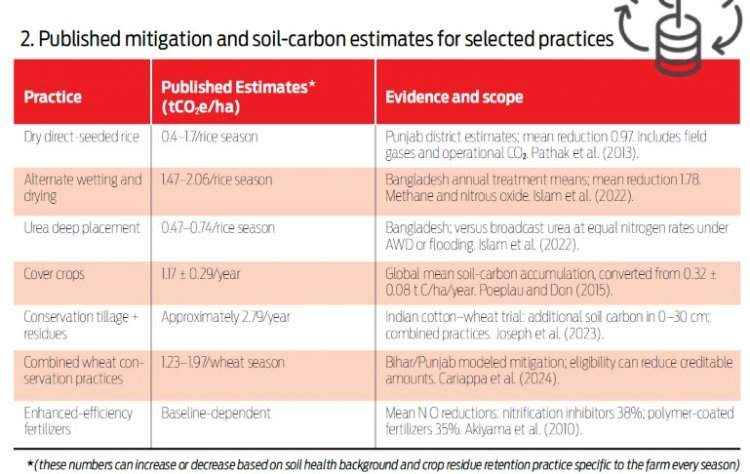
Published studies illustrate the scale of mitigation that improved agronomic management can deliver. The published data provided in Table 1 provides an evidence base for project development. By supporting adoption, aggregating smallholder farms and verifying net mitigation, carbon project developers can convert eligible outcomes into carbon finance, creating supplementary farmer income alongside potential savings in water and fertilizer expenditure. To convert these priorities into finance, developers establish baselines, demonstrate additionality, quantify emissions or carbon-stock changes, and address uncertainty, leakage and relevant reversal risks through independent validation and verification. Each issued credit represents one tonne of CO₂-equivalent reduced or removed. Farmer payments depend on issuance, financing or carbon credit sales, project costs and contractual revenue allocation.
Practices must be assessed as interacting systems, i.e., soil-plant-climate systems. In a three-year Bangladesh rice experiment, alternate wetting and drying (AWD) reduced methane by 28% and combined methane–nitrous oxide global-warming potential by 27%, without significant yield loss, despite a 73% increase in nitrous oxide. Urea deep placement (UDP) practice increased yield by 21% and nitrogen recovery efficiency by 58% relative to broadcast urea. These findings support coordinated water and nitrogen management, with validation under Indian conditions.
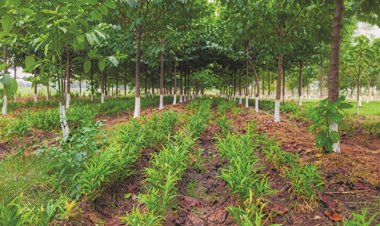
Reduced tillage, residue retention, diversified rotations and cover crops can contribute through soil-carbon accumulation and resource conservation. Soil-carbon claims require repeated measurements or calibrated models supported by measurements, as specified by the methodology. Benefits depend on soil, climate, baseline management and implementation.
These estimates are not guaranteed credit yields and should not be added directly: practices interact and accounting boundaries differ. Soil-carbon accumulation is only one component of net mitigation; issuance requires applicable eligibility tests, verification and deductions.
Fertilizer Efficiency Can Expand The Mitigation Portfolio
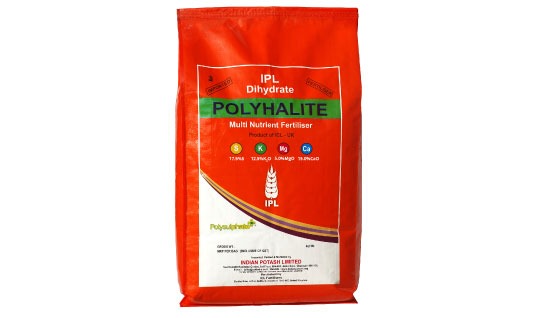
Beyond rice-water management, carbon project developers should emphasize fertilizer reduction and nitrogen-use efficiency through dedicated eligible projects or existing regenerative programmes. UDP places urea briquettes in the root zone; fertilizer deep placement (FDP) extends the principle to suitable formulations. In a separate two-season Bangladesh study, UDP used 78 rather than 104 kg N/ha—a 25% reduction—while increasing yield by 28% and nitrogen recovery efficiency by 167%.
Enhanced-efficiency fertilizers offer complementary options. A synthesis of 182 studies reported average reductions of 49% in nitrous oxide with nitrification inhibitors and 51% in ammonia with urease inhibitors. These responses require local validation; ammonia is not itself a greenhouse gas. Legumes, green manures, composts and organo-mineral fertilizers can partially substitute synthetic nitrogen, but nutrient budgets must account for all inputs. Excess nitrogen can increase emissions, while readily decomposable organic matter can stimulate methane in flooded rice.
Scientific organizations can help translate these options into credible projects. The International Fertilizer Development Center (IFDC), working with Indian research institutions and developers, can support agronomic trials, nutrient budgets, CH₄ and N₂O measurements, formulative novel combinations of organi-mineral fertlizers, developing locally calibrated models for offering specific nutrient management advisory and farmer trainings. The objective is to identify feasible reductions in synthetic fertilizer demand or nitrogen losses while maintaining yields and soil fertility, then credit the verified net climate benefit.
Indian Projects Demonstrate Different Routes To Carbon Finance
Emerging projects illustrate the distinction between issuance, payment and future demand. Grow Indigo’s Aadi project reported VM0042 issuance and September 2026 payments to more than 2,500 farmers, averaging `11,478 per recipient; these were programme payments, not annual income guarantees. Sow & Reap reported 37,405 Gold Standard credits from AWD-based rice, while Mitti Labs announced a Google purchase agreement for one million rice-methane credits by 2030. Varaha’s Google agreement concerns biochar removals; Mati Carbon reports enhanced-weathering issuance through Isometric and Puro.earth. These approaches are examples for different carbon incentives, and each developer uses different accounting methods (MRVs) and cannot be compared as equivalent farmer-income outcomes.
The Road Ahead: Delivering Value To Farmers
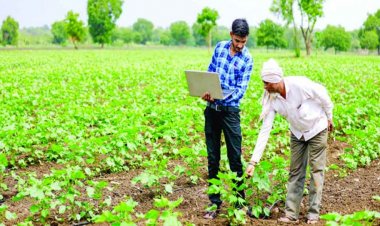
Farmer producer organizations and cooperatives can aggregate farms for training, awareness and for sharing farm machinery required for implementing new practices, share monitoring costs and negotiate contracts with carbon project developers. Farmers need clear and transparent terms on revenue shares, payment timing, commitments and data rights. Meticulous recording of irrigation, fertilizer types and doses, organic inputs and yields from farmers can support verification efforts of the project developers. Developers should also provide agronomic advisory and training, transparent calculations and timely payments, using remote sensing and calibrated models alongside targeted field measurements.
Long-term buyer commitments can support earlier farmer payments and build confidence in Carbon Markets for the farmers. Public investment in Indian field trials, emission factors and data systems can improve accounting and reduce uncertainties. Clear rules on benefit sharing and any required authorizations would strengthen confidence, while project design must prevent double counting.
Conclusion
Carbon finance can complement input savings and improved productivity when projects combine sound agronomy with credible accounting. Its contribution to the rural economy depends on whether verified environmental value reaches farmers through fair contracts, technical support and sustained improvements in farm management.
(Padma Shanthi Jagadabhi is Senior Soil Health Specialist, International Fertilizer Development Center. Yashpal Singh Saharawat is Global Director, International Fertilizer Development Center.)