Cheap Edible Oil Imports: A Setback for Farmers Ahead of Kharif Harvest and Rabi Sowing
The Centre’s decision to cut import duties on major edible oils could help moderate prices ahead of the festive season, but it comes just as kharif oilseed arrivals are picking up and farmers prepare for rabi sowing. The move raises concerns about farm-gate prices and India’s efforts to reduce its dependence on edible oil imports.

 Join the RuralVoice whatsapp group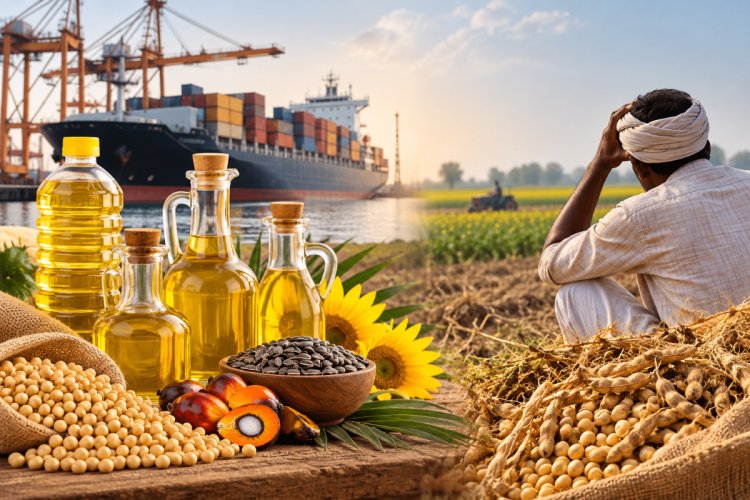
The Basic Customs Duty (BCD) on crude sunflower oil has been reduced from 10% to nil, while the BCD on crude soybean oil and crude palm oil has been reduced from 10% to 5%. The government has simultaneously reduced the applicable BCD on the respective refined edible oils while maintaining an import duty differential of 19.25% between crude and refined edible oils.
The Solvent Extractors’ Association of India (SEA), an industry body, views the government’s decision as a timely and balanced intervention, particularly in the context of the significant rise in domestic edible oil prices over the past year and the approaching festive season.
Timing Matters for Oilseed Farmers
The duty cuts come just as arrivals of kharif oilseeds are set to increase. Early soybean harvesting has already begun in some areas, while groundnut is also expected to enter the market soon. Making imported edible oils cheaper at this stage could put additional pressure on domestic oilseed prices.
Mustard farmers could also face a setback, particularly those who have been holding stocks in anticipation of better prices during the festive season. The price outlook before the rabi sowing season is particularly important because farmers use prevailing market prices as one of the signals when deciding which crops to plant.
Madhya Pradesh farmer leader Kedar Sirohi told Rural Voice that the government had increased import duties on edible oils last year following protests by farmers, but had now sharply reduced duties just before the arrival of the new crop in mandis.
“This is a major blow to farmers’ interests,” Sirohi said, arguing that farmers were already struggling to receive remunerative prices, while lower import duties would make the Indian market more accessible to global traders.
Soybean farmers have also faced weather-related crop damage in major producing areas this year. According to Sirohi, the resulting impact on production could have supported soybean prices in mandis. However, lower import duties on edible oils could put downward pressure on domestic prices.
Soybean prices in Madhya Pradesh mandis are currently around Rs. 5,000 per quintal, while the Centre has fixed the Minimum Support Price (MSP) for soybean at Rs. 5,708 per quintal for the 2026-27 marketing season.
Rising Dependence on Imported Edible Oils
India meets nearly two-thirds of its edible oil requirement through imports, primarily palm oil, soybean oil and sunflower oil. Major suppliers include Malaysia, Indonesia, Argentina, Russia and Ukraine.
The country’s efforts to reduce this import dependence could face another setback this year. During the first 10 months of the 2025-26 oil year, from November to August, India’s edible oil imports rose by around 4.6% year on year, mainly due to higher imports of palm and soybean oil.
According to SEA data, India imported 13.62 million tonnes of edible oils during November-August 2025-26, compared with 13.02 million tonnes during the corresponding period of the previous oil year.
Imports of palm oil, including crude palm oil and RBD palmolein, rose to 6.53 million tonnes during the period, from 6.14 million tonnes a year earlier. Soybean oil imports increased from 4.46 million tonnes to 4.56 million tonnes, while sunflower oil imports rose from 2.40 million tonnes to 2.51 million tonnes.
The increase is therefore not limited to palm oil. Imports of both soybean and sunflower oil have also risen.
Soybean Oil Imports Could Hit a Record
India’s soybean oil imports could reach a record 5.8-6.0 million tonnes during the 2025-26 oil year. Disruptions to sunflower oil supplies following the Russia-Ukraine war, along with tighter availability of palm oil, have made soybean oil relatively more attractive to Indian buyers.
In Indonesia, rising palm oil consumption for biodiesel production has reduced availability for exports, putting upward pressure on international palm oil prices. Soybean oil, meanwhile, has remained relatively competitive.
As a result, India’s total edible oil imports could rise to a record 16.5 million tonnes in 2025-26.
The challenge for Indian oilseed farmers is therefore no longer limited to palm oil imports. Palm oil’s share of total edible oil imports is expected to remain below 50% for the second consecutive year, while soft oils such as soybean and sunflower oil could account for around 52-53%.
Oilseed Acreage Has Failed to Expand
The government has been promoting domestic oilseed production through programmes such as the National Mission on Edible Oils (NMEO), with the broader objective of reducing India’s dependence on imports.
However, oilseed acreage has not increased during the current kharif season. The area under oilseeds has reached around 19.4 million hectares, broadly similar to last year and below the normal kharif oilseed area of around 20 million hectares.
Soybean, India’s largest oilseed crop by acreage, illustrates the challenge. While soybean oil imports have reached record levels, the area under soybean cultivation has declined from the normal area of around 12.8 million hectares to about 12.2 million hectares this season.
The bigger question is: how can India achieve self-sufficiency in edible oils while continuing to encourage cheaper imports of edible oils?