
EU Delays Mercosur Trade Deal Amid Fiery Farmer Protests in Brussels
Thousands of farmers stormed Brussels in a fiery protest against the EU–Mercosur trade deal and subsidy reforms, forcing EU leaders to delay the agreement amid deep political divisions.

 Join the RuralVoice whatsapp group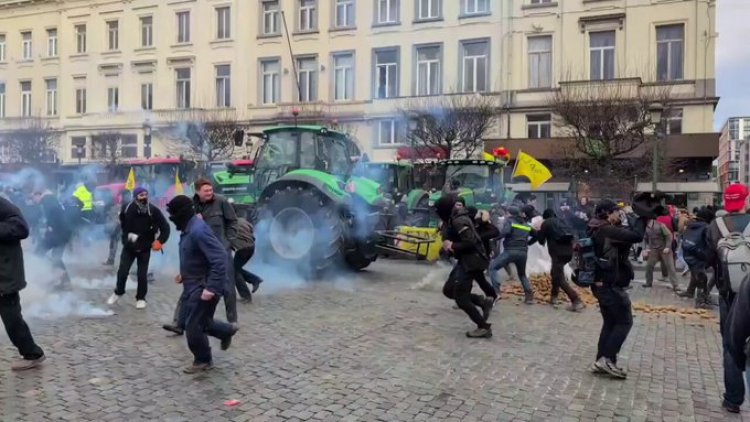
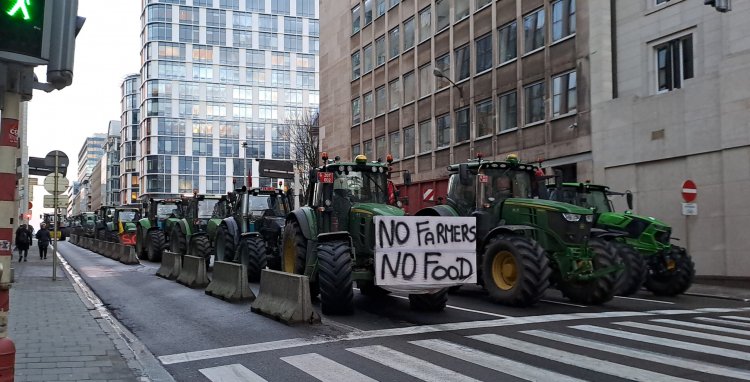
The European Union has postponed the signing of a major free-trade agreement with the South American Mercosur bloc after thousands of farmers descended on the Belgian capital, paralyzing the city with tractors and clashing with riot police.
The decision to delay the deal came late Thursday, after European Commission President Ursula von der Leyen informed EU leaders that a “qualified majority” of member states could not be reached. The postponement marks a significant victory for agricultural unions and a setback for proponents who viewed the pact as a strategic counterweight to Chinese and American trade influence.
Chaos in the European Quarter
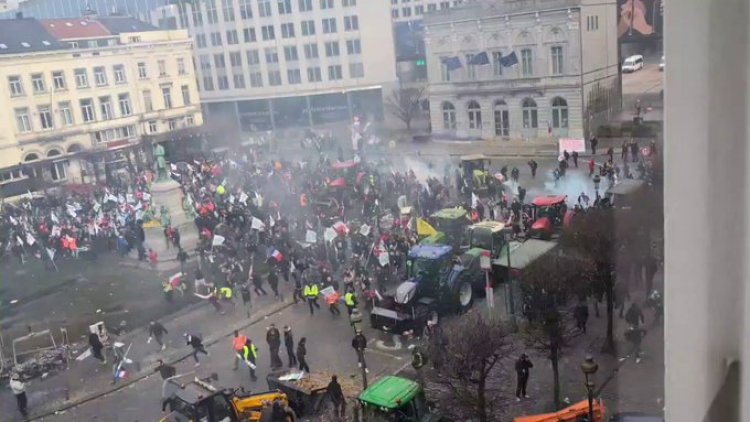
Chaos erupted in the heart of Europe’s political district on Thursday as thousands of farmers blocked streets with tractors and confronted riot police in a fiery protest against the EU’s prospective Mercosur agreement and proposed reforms to agricultural subsidies.
The demonstrations, which drew an estimated 7,000 to 10,000 protesters from across the 27-nation bloc, turned violent near the European Parliament. Farmers hurled potatoes, eggs, and fireworks at police, lit bonfires with tires and hay, and burned a symbolic coffin labeled “Agriculture.” Riot police responded with tear gas and water cannons, filling the air with black smoke as tensions boiled over.
EU–Mercosur Trade Deal and Subsidies
The EU–Mercosur agreement, under negotiation for more than 25 years, would create the world’s largest free-trade area, covering nearly 780 million people and eliminating tariffs on billions of euros worth of goods. Supporters, including Germany and Spain, argue it would boost EU exports of machinery, vehicles, and wines while securing geopolitical advantages amid global trade tensions.
Farmers also protested against European Commission plans to overhaul the Common Agricultural Policy (CAP), the bloc’s massive farm subsidy system. Groups like Belgium’s Walloon Agricultural Federation denounced proposed cuts of up to 20 percent, calling them “totally unacceptable,” especially alongside increased import competition from Mercosur nations.
Temporary Relief for Protesters
The protests coincided with an EU leaders’ summit, where the deal’s fate was discussed. In a dramatic shift, the European Commission announced a delay in signing the agreement—originally scheduled for this weekend in Brazil—pushing it to January amid opposition from France and Italy.
French President Emmanuel Macron insisted the agreement lacked sufficient safeguards, while Italian Prime Minister Giorgia Meloni demanded stronger protections for farmers.
The delay offers temporary relief to protesters but underscores deep divisions within the EU. Farmers warn that without robust import controls and maintained subsidies, the deal could devastate rural livelihoods and undermine Europe’s high standards.
As black smoke lingered over Brussels on Thursday evening, the protests highlighted rising rural discontent, with unions vowing further action if demands are ignored. The postponed Mercosur deal now faces an uncertain path in the new year.
A Continent Divided
While Germany and Spain remain strong proponents of the deal to boost exports, a powerful coalition led by France and Italy successfully blocked its signing this week.
Macron argued that “fundamental changes” are still required, while Meloni described a weekend signing as “premature,” calling for stronger reciprocal guarantees for European producers.
European Commission officials expressed confidence that a breakthrough could still be reached in January, but Thursday’s scenes in Brussels suggest that any final agreement will face a winter of intense domestic resistance.