
Simultaneous Global Droughts Threaten to Triple Wheat Prices in a 3°C Warmer World
A study in Earth’s Future warns that a 3°C increase in global temperatures relative to mid-20th-century baselines could triple average global wheat prices compared to 2010. Synchronized severe water scarcity across major breadbaskets accounts for 74% of annual wheat price fluctuations, severely threatening global food security.

 Join the RuralVoice whatsapp group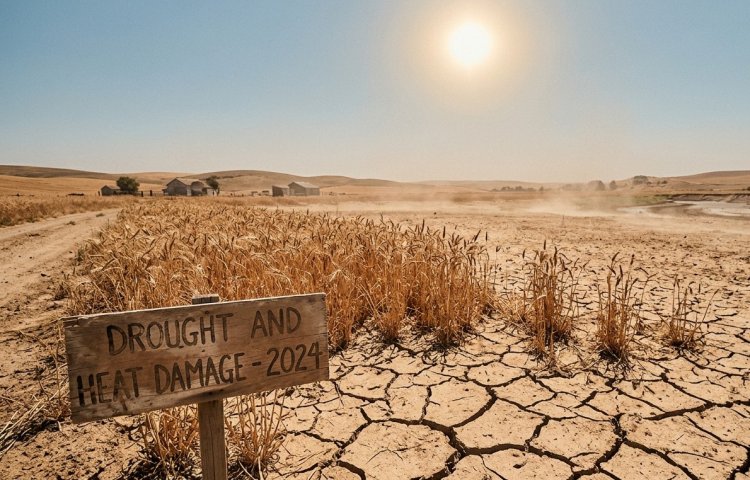
Widespread, simultaneous water shortages across the world’s main agricultural regions could triple global wheat prices if global mean temperatures rise by 3°C above mid-20th-century levels, according to a major study published in the journal Earth’s Future.
The peer-reviewed study, titled “Climate-Induced Severe Water Scarcity Events as Harbingers of Global Wheat Price,” reveals a strong direct relationship between the geographic extent of severe drought during critical growing periods and global commodity price spikes.
Led by Professor Miroslav Trnka of the Global Change Research Institute (CzechGlobe) at the Czech Academy of Sciences, alongside international researchers including Professor Jørgen E. Olesen from Aarhus University, the study warns that climate change is shifting drought from a series of manageable local agricultural crises into a systemic, global market threat.
Key Findings & Projections
Threefold Price Hike: Under a 3°C warming scenario relative to 19511980 baseline temperatures, global wheat prices are projected to average approximately USD 364 per metric ton - roughly three times the inflation-adjusted global wheat price recorded in 2010.
Moderate Warming Impact: Even under a lower warming threshold of 2°C, the estimated average price of wheat rises to USD 273 per ton.
Drought as the Main Price Driver: The researchers developed an indicator called Severe Water Scarcity (SWS), which isolates moisture deficits during the key four-month window prior to crop harvests. The extent of SWS alone explained roughly 74 percent of annual fluctuations in global wheat prices between 2000 and 2021.
Synchronized Crop Failures: While localized droughts are historically buffered by global grain reserves and international trade, simultaneous drought events across multiple major breadbaskets overwhelm market buffers, triggering severe price surges.
Wheat Stands Out Among Major Staples
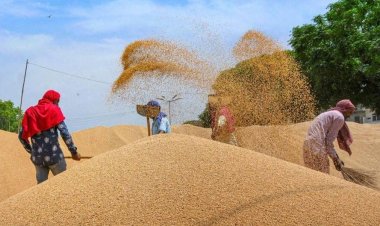
The research team analyzed three global staple crops - wheat, maize, and rice - and found that wheat displayed an unusually strong vulnerability to global market shocks driven by severe water scarcity.
While maize prices showed a notably weaker correlation with synchronized drought coverage, rice prices demonstrated no comparable statistical relationship. Researchers attribute this difference to wheat's unique geographic footprint, high trade volume relative to total production, and dependence on rainfall during sensitive physiological stages such as flowering and grain filling.
Historically, severe water scarcity affected an average of 5% of global wheat-growing areas in any given year. However, during major shock years - such as 2000, 2010, 2012, and 2020 - that figure surpassed 15%. Simulations using 31 global climate models (CMIP5 and CMIP6) indicate that as global temperatures rise, these widespread events will transition from statistical anomalies to recurring occurrences.
Systemic Risks and Policy Implications
The authors emphasize that drought does not operate in a vacuum. Energy prices, fertilizer costs, currency fluctuations, grain storage inventories, and geopolitical disruptions - such as trade restrictions or war - also dictate final consumer costs. However, severe water scarcity provides a distinct, predictable climate-driven baseline that will increasingly dictate food affordability.
"Wheat is one of the world's most important food crops, which means climate-related production problems can quickly have global consequences," noted co-author Jørgen E. Olesen. "This study shows that we need to view drought as an international challenge rather than a series of isolated local events."
Because low-income households spend a disproportionate percentage of their earnings on basic staples, sharp price surges carry significant humanitarian and economic risks.
To address these compounding risks, the authors call for a multi-pronged strategy to build global agricultural resilience. This includes accelerating the breeding of heat- and drought-tolerant crop varieties, modernizing irrigation systems to enhance soil moisture retention across vulnerable croplands, and strengthening international coordination around strategic grain reserves and trade agreements to prevent market panics during concurrent climate shocks.