
ISMA’s Estimate Misses the Mark: Sugar Output Drops by 4.5 Million Tonnes
India’s gross sugar output for the current sugar season (2024–25) is estimated at 295 lakh tonnes — significantly lower than the Indian Sugar and Bio-energy Manufacturers Association’s initial estimate of 333 lakh tonnes released in July 2024.

 Join the RuralVoice whatsapp group
Despite modern technologies like satellites, remote sensing and AI, accurate estimation of crop production remains a challenge. Even the Indian Sugar and Bio-Energy Manufacturers Association (ISMA), the premier body of the private sugar industry in the country, has failed to accurately estimate sugar production in the country.
In July last year, ISMA had forecasted gross sugar production of 333.10 lakh tonnes (before diversion for ethanol production) for the 2024–25 sugar season (Oct.-Sep.). However, the actual production is likely to be 38 lakh tonnes (11.41%) lower than the first preliminary estimate by ISMA and 45 lakh tonnes (13.2%) less than the gross sugar production of 340 lakh tonnes in Sugar Season 2023-24.
After accounting for the diversion of 34 lakh tonnes of sugar for ethanol, the net sugar production in 2024–25 is estimated to reach at 261 lakh tonnes — about 18% lower than the previous year’s net output of 319 lakh tonnes. Such a substantial gap between initial estimates and actual output is a cause for concern, as both industry strategies and government policies heavily rely on these forecasts.
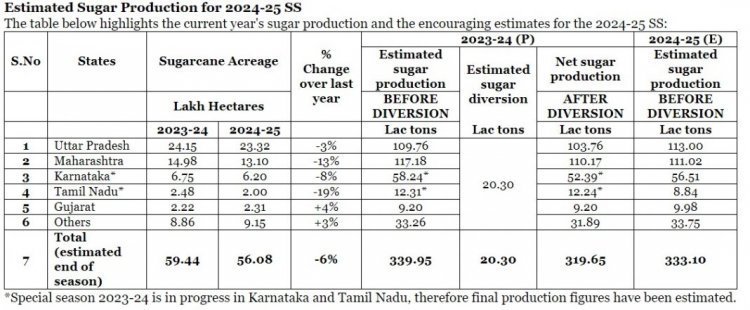
First preliminary estimate for 2024-25 released by ISMA on 30 July 2024
ISMA President Gautam Goel said in a press conference on Thursday that last year sugarcane crop was unexpectedly affected due to the outbreak of red rot in Uttar Pradesh and the unfavourable weather conditions in Maharashtra and Karnataka. This has affected the sugar production. However, he expressed optimism for the coming season (2025-26), in view of the good monsoon and the better crop conditions this year.
Forecasting Challenges
Forecasting challenges are not limited to the sugar sector alone. Similar doubts have been raised over government estimates of record wheat production. Despite high projections, the government had to halt wheat exports and impose stock limits to control domestic price — highlighting the gap between estimates and ground realities.
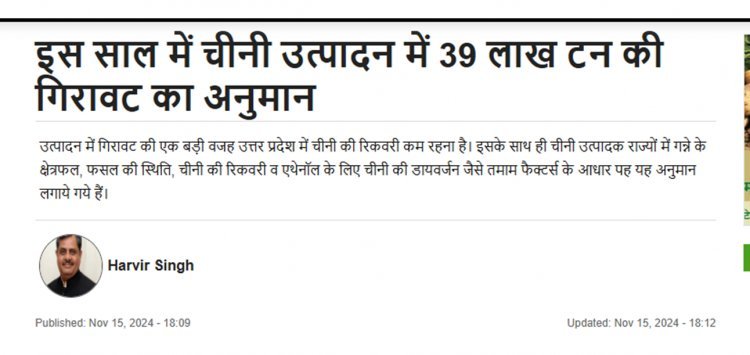
Notably, Rural Voice had reported in November last year the likely decline in sugar production due to crop diseases, weather anomalies, and lower sugar recovery. The big question remains: why did key institutions, including government bodies and ISMA, fail to anticipate this?
Sugar Output to Rebound in Next Season
On Thursday, ISMA released the first preliminary estimates for the upcoming sugar season 2025-26, projecting gross sugar production to increase by 18 per cent to 349 lakh tonnes. In view of this expected increase, ISMA has urged the government to "timely" allow the export of 20 lakh tonnes of sugar and diversion of 50 lakh tonnes of sugar for ethanol production.
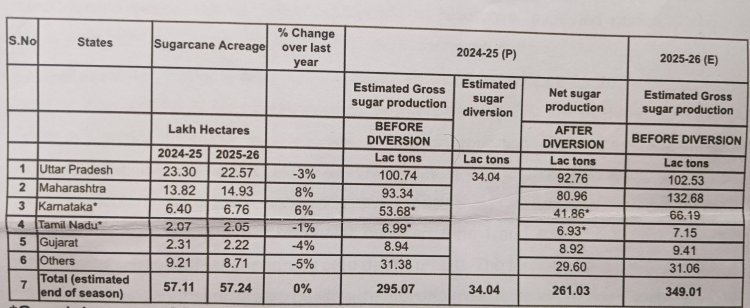
ISMA's first preliminary estimate for the upcoming season 2025-26 released on 31 July 2025
ISMA Director General Deepak Ballani noted that the current season will end with a closing stock of 52 lakh tonnes of sugar, ensuring the next season’s domestic consumption demand of 284 lakh tonnes will be comfortably met. He said that if the government does not take timely decisions regarding sugar exports and increasing ethanol prices, the sugar industry could face challenges. ISMA has also reiterated its demand for raising the Minimum Selling Price (MSP) of sugar.
State-Wise Production Estimates
-
Maharashtra: Sugarcane acreage has increased by 8% to 14.93 lakh hectares. With favourable rains and good crop conditions, production is expected to jump by 42% to 132.68 lakh tonnes.
-
Karnataka: Sugarcane area has grown by 6%, with production likely to rise 23% to 66.19 lakh tonnes.
-
Uttar Pradesh: Sugarcane acreage has declined by 3% to 22.57 lakh hectares, but better crop conditions than last year may push sugar output slightly up to 102.53 lakh tonnes, from last year’s 100.74 lakh tonnes.
ISMA emphasized that the crop is still in its early stages, and several factors could impact the final yield and recovery. A revised estimate will be released in September.