
Monsoon Advances into Uttar Pradesh and Uttarakhand, but India Records Driest June Since 2014
After nearly three weeks of slow progress, the southwest monsoon has advanced into parts of Uttar Pradesh and most of Uttarakhand. However, India recorded its driest June since 2014, with rainfall nearly 40 percent below normal, delaying kharif sowing by 23 percent.

 Join the RuralVoice whatsapp group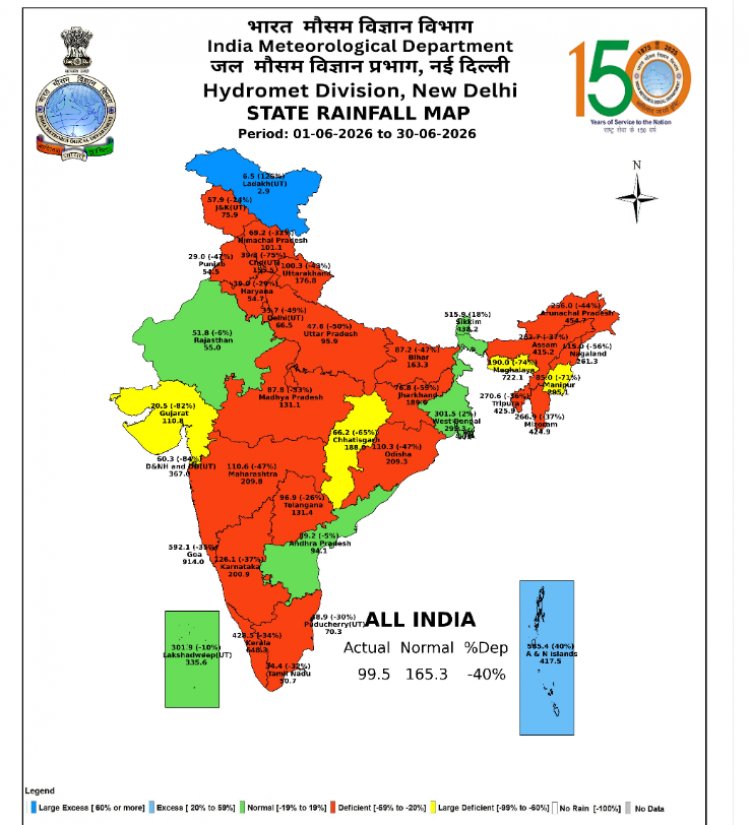
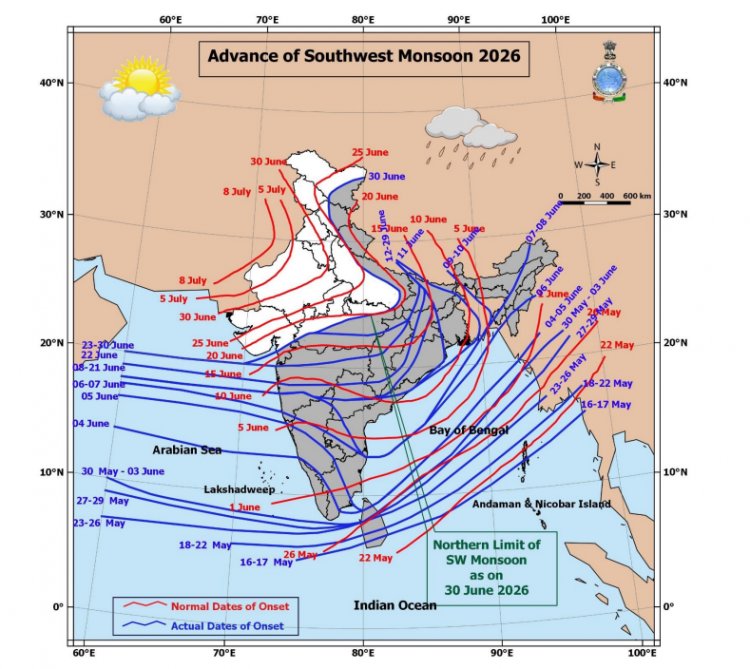
After nearly three weeks of sluggish progress, the southwest monsoon has finally advanced into Uttar Pradesh and Uttarakhand, bringing relief to farmers waiting to begin kharif sowing. According to the India Meteorological Department (IMD), on 30 June the monsoon advanced into more parts of Madhya Pradesh, the remaining areas of Chhattisgarh, Jharkhand and Bihar, parts of Uttar Pradesh, most parts of Uttarakhand, and some regions of Himachal Pradesh and Ladakh. However, despite this progress, June ended as the driest since 2014, with rainfall 39.8 percent below the long-period average.
The IMD has forecast the formation of a low-pressure area over the northwest Bay of Bengal around 3 July 2026, which is expected to revive monsoon activity over central India during the week. Meteorologists believe the system will help strengthen the southwest monsoon after an extended period of weak advancement across the northern and central parts of the country.
Conditions are likely to remain favourable over the next two to three days for the monsoon to advance further into the remaining parts of Gujarat, Madhya Pradesh, Uttar Pradesh, Uttarakhand, Himachal Pradesh and Ladakh, most parts of Jammu & Kashmir, Haryana, Delhi and Punjab, as well as some areas of Rajasthan.
The IMD has also issued a warning of isolated very heavy rainfall over Konkan during 2–4 July, the Ghat areas of Madhya Maharashtra during 2–3 July, and South Gujarat during 3–4 July.
June Turns Exceptionally Dry
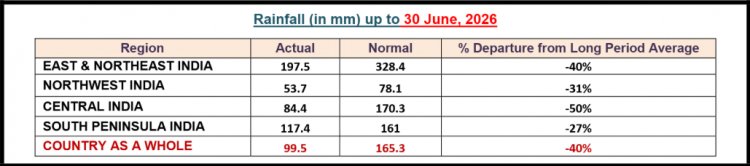
India received only 99.5 mm of rainfall during June 2026, compared with the long-period average (1971–2020) of 165.3 mm, resulting in a 39.8 percent rainfall deficit. This is the lowest June rainfall recorded since 2014, when the country received 92.1 mm of rain during another El Niño year.
According to the IMD, nearly 70 percent of India's 741 districts recorded below-normal rainfall between 1 June and 29 June. Meteorologists attribute the widespread rainfall deficit primarily to El Niño, which has weakened the monsoon circulation and delayed its northward advance.
Historical rainfall records show that the driest June in the past century was recorded in 2009, when India received only 87.5 mm of rainfall. June 2026 now ranks among the driest Junes on record, underlining the severity of the current monsoon slowdown.
Regionally, between June 1 and 20, Central India received 50 percent less rainfall than normal. Eastern and Northeastern India received 40 percent less rainfall, and Northwest India received 31 percent less rainfall. Southern India also received 27 percent less rainfall than normal. Among states, Gujarat received 82 percent less rainfall, Meghalaya 74 percent less, and Chhattisgarh 65 percent less rainfall.
Kharif Sowing Down 23 Percent
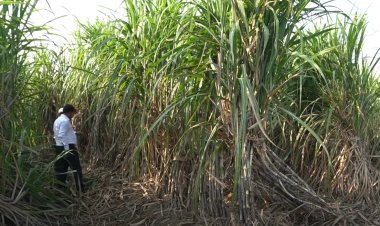
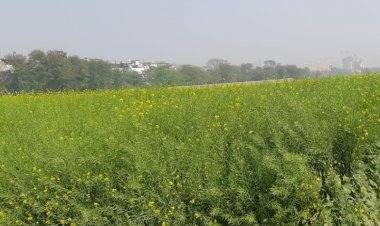
The delayed arrival and sluggish progress of the southwest monsoon have significantly affected the sowing of kharif crops. As of 25 June, the total kharif sown area stood at 18.272 million hectares, compared with 23.646 million hectares during the corresponding period last year, reflecting a 23 percent decline.
Sowing has remained below last year's levels across all major kharif crops, including paddy, pulses, oilseeds, coarse cereals and cotton. With the IMD forecasting a revival in monsoon activity during the first week of July, the coming days will be crucial for accelerating sowing operations and narrowing the gap in crop coverage.