
NREGA Sangharsh Morcha Slams Proposed Bill to Repeal MGNREGA, Calls It 'Rollback of Workers' Rights'
Terming the proposed law “not a reform but a rollback,” the NREGA Sangharsh Morcha said the bill dismantles hard-won democratic and constitutional guarantees achieved through decades of struggle.
 Join the RuralVoice whatsapp group
The NREGA Sangharsh Morcha (NSM), a collective of workers' and civil society groups, has issued a strong condemnation of the proposed Viksit Bharat – Guarantee for Rozgar and Ajeevika Mission (Gramin) Bill, 2025 (VB-G RAM G), which is set to replace the landmark Mahatma Gandhi National Rural Employment Guarantee Act (MGNREGA), 2005.
In a press release, the Morcha said the bill was introduced without any consultation with workers or their organisations and represents a fundamental shift from a rights-based law that provides an enforceable entitlement into a budget-constrained scheme without any accountability of the Union Government.
Excessive Discretionary Power for the Centre:
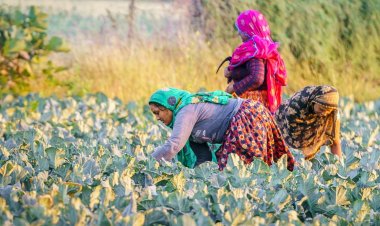
The Morcha highlighted that MGNREGA provides a universal, demand-driven right to work, obligating the state to provide employment within 15 days of demand or pay unemployment allowance. In contrast, the new bill allows the Union government to notify only selected rural areas for coverage. Workers in areas not notified by the Centre would have no legal right to employment, effectively reducing universally guaranteed employment.
From Demand-driven to Supply-based:
Another major concern raised is the shift in funding pattern. Under MGNREGA, funding follows demand, with the Union government bearing 100 percent of labour wages. The proposed bill, however, empowers the Centre to determine state-wise “normative allocations” in advance. Any expenditure beyond this allocation would have to be borne by state governments.
According to the Morcha, this change would cap employment days based on budgetary ceilings rather than workers’ demand, fundamentally altering the logic of the programme and increasing the likelihood of unmet demand for work.
Increased financial burden on states:
The proposed cost-sharing formula has also drawn sharp criticism. Under MGNREGA, the Union Government is responsible for 100% labour wages and 75% of the material wages. In practice, this translates to a 90:10 cost share between the Centre and the States. The new bill proposes a 60:40 ratio for most states, retaining 90:10 only for northeastern and Himalayan states.
Workers’ groups argue that this clause not only puts a massive burden on states, but also disproportionately impacts poorer and high migrant-sending states which are more in need of rural employment. The increased financial burden will lead to states resorting to fiscal conservatives and not registering workers’ demand for work.
Bottom-up to Top-Down:
The Morcha warned that the bill undermines the 73rd Constitutional Amendment, which mandates decentralised planning through Gram Sabhas. Under MGNREGA, local bodies decide the nature of works based on community needs. The proposed legislation replaces this with a centrally designed “National Rural Infrastructure Stack”, which would guide planning and prioritisation from the top down.
“This Bill violates the spirit of the Constitution, undermines the 73rd Constitutional Amendment, and strikes at the core of social and economic justice by shifting power away from workers, Gram Sabhas, and States into the hands of the Union Government,” the statement said.
Technocratic Monitoring and Surveillance:
The bill also proposes to introduce a framework rooted in top-down, technology-driven surveillance by mandating the use of biometric authentication, geospatial technology and geo-referencing of works. Workers’ organisations cautioned that similar technology-driven systems under MGNREGA—such as Aadhaar-based payments and digital attendance—have already led to large-scale exclusions.
They argued that biometric authentication is fraught with problems, particularly for agricultural and manual labourers, as evidenced by numerous studies and ground reports.
Year-round Right to work to Blackout Periods:
Another controversial provision allows states to notify up to 60 days in a year as “blackout periods” during peak agricultural seasons when no work would be provided under the scheme. According to the Morcha, this effectively deprives workers, especially women workers, of the right to demand work for at least two months annually, eroding the guarantee of year-round employment.
Call for withdrawal of the bill
Terming the proposed law “not a reform but a rollback,” the NREGA Sangharsh Morcha said the bill dismantles hard-won democratic and constitutional guarantees achieved through decades of struggle. It accused the Union government of converting a historic rights-based legislation into a centrally controlled, budget-capped and surveillance-heavy scheme.
The Morcha has unequivocally rejected the VB-G RAM G Bill, 2025, and demanded its immediate withdrawal. It called on political parties, civil society groups and democratic institutions to oppose the proposed changes and defend MGNREGA as a cornerstone of livelihood security and social justice for millions of rural workers across India.