
Talks on US Tariffs Begin Again, Will Tariffs Upend Indian Agriculture?
With US tariffs threatening their key markets, Indian farmers face falling prices and job losses. The crisis tests whether India's "self-reliance" can survive against global economic pressures

 Join the RuralVoice whatsapp group
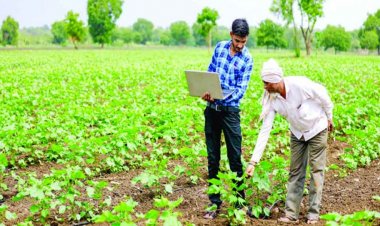
Rising US tariffs threaten India’s farm exports, exposing the fragility of its agricultural surplus and rural livelihood security. Six months after President Donald Trump launched his “Fair and Reciprocal” tariff plan, Indian policymakers’ worst fears are materializing. With tariffs on Indian farm products climbing as high as 50 percent, exports of shrimp, rice, fruits, and processed foods — staples of India’s $3.4 billion agricultural surplus with the United States — are suddenly at risk. For India’s farmers, who make up more than 40 percent of the workforce, the consequences could ripple from seafood hubs to rice belts, triggering falling prices, lost income, and job cuts.
“India’s agri-exports to the US may come down sharply, and the trade surplus could be wiped out,” warns a policy brief from the Indian Council for Research on International Economic Relations (ICRIER).
The Shrinking US Market
For years, Indian farm products entered the US under relatively low tariffs. Shrimp — India’s largest export to America — faced none. Rice, honey, and plant extracts paid minimal rates.
Now the reciprocal tariff strategy has shifted that calculus. Vietnam and Thailand, with lower barriers and trade pacts, are poised to seize India’s share in seafood and rice. Even Bangladesh, a shrimp competitor, could benefit from India’s loss of competitiveness.
Political Standoff
The clash is not only about economics but also politics. US officials have long demanded that India lower barriers on dairy, poultry, and genetically modified crops — sectors New Delhi protects fiercely.
India’s dairy rules, for instance, ban imports from cattle fed with animal-derived feed, a red line for American exporters.
Conceding would be politically problematic for Prime Minister Narendra Modi, whose government has built its rural base on promises of farm protection. Officials are signaling relief packages for shrimp and rice exporters while doubling down on self-reliance.
Macroeconomic Stakes
Nearly $48 billion of exports could be hit by Trump’s escalation. Economists estimate a drag of 0.2 to 0.5 percent on GDP growth. A weaker rupee and higher borrowing costs could deepen the strain. For agriculture, the risks are immediate. Oversupply at home could push down farmgate prices for rice, cotton, and nuts, squeezing incomes in a sector already strained by debt and climate shocks.
A Moment of Reckoning
India’s model of protecting farmers through high tariffs — averaging 39 percent in agriculture compared to America’s 5 percent — has left it vulnerable. “India cannot insulate itself indefinitely with tariffs,” the ICRIER report notes, urging a pivot to productivity-driven competitiveness. That would require shifts: lowering duties on processed foods and dairy, investing in agricultural R&D (less than 0.5 percent of agri-GDP), and building supply chains to meet stricter standards abroad. India is also under pressure to diversify markets. Trade officials are prioritizing negotiations with the European Union, Britain, and African nations to reduce reliance on the United States.
The Bigger Picture
The tariff fight underscores a larger tension in India’s strategy: can it protect small farmers yet project itself as an export powerhouse? For now, political winds in New Delhi favor defiance. But without reforms, India risks being edged out by nimbler competitors.
For Trump, the tariffs are part of an “America First” push to shrink the US trade deficit, which stood at $918 billion last year, with India accounting for $45.7 billion. For Modi, they have become a test of whether “Atmanirbhar Bharat” can withstand global pressures.
The coming months will reveal whether India’s farm economy can adapt — or whether Washington’s tariffs will force a deeper reckoning.
(Writer is former Resident Editor-East, Press Trust of India. Views expressed are personal)