
Monsoon Recovery Masks Regional Divide as Nearly Half of India Remains Rainfall Deficient
Despite a strong revival in the first week of July after a 40 per cent rainfall deficit in June, India's southwest monsoon continues to show sharp regional and temporal imbalances.

 Join the RuralVoice whatsapp group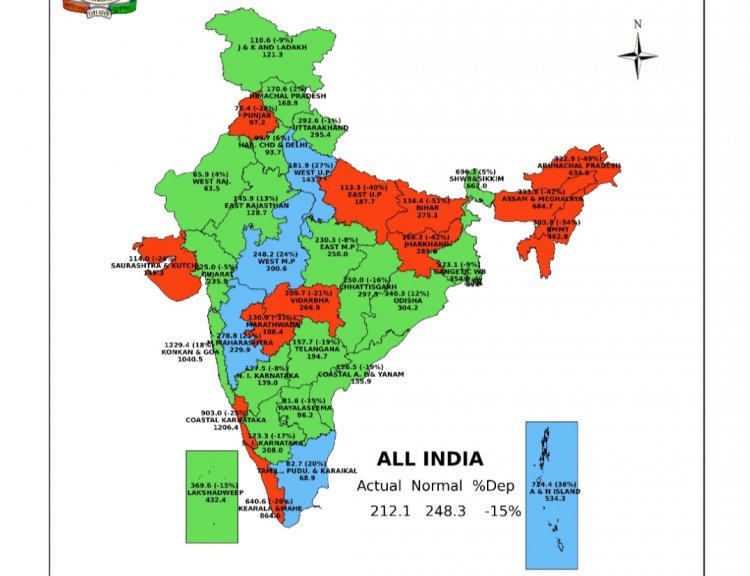
India's southwest monsoon has become fully active, but its progress continues to be marked by sharp temporal and regional imbalances. After nearly 40 per cent below-normal rainfall in June, the monsoon staged a strong comeback during the first week of July. However, large parts of the country continue to face rainfall deficits, while the India Meteorological Department (IMD) has warned that rainfall activity is likely to weaken again over central and southern India in the coming days.
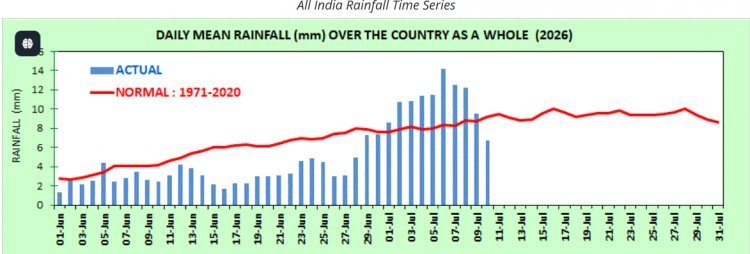
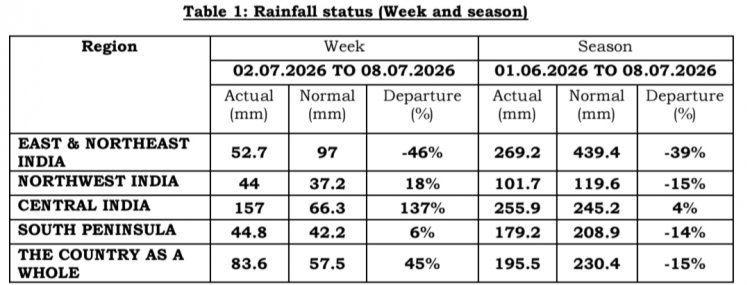
According to the IMD, the country received 83.6 mm of rainfall between July 2 and 8, which was 45 per cent above the normal 57.5 mm for the period. Despite this recovery, cumulative rainfall from June 1 to July 10 remained 15 per cent below the long-period average (LPA). Daily rainfall across the country remained above normal between July 1 and 9, helping narrow the nationwide deficit after the exceptionally dry June.
Dry Spell Likely Across Central and Southern India
The next phase of the monsoon could pose fresh challenges for central and southern peninsular India. The IMD has forecast a significant decline in rainfall activity over these regions during the next six to seven days.
Most parts of Delhi, Haryana, Punjab, Rajasthan, Gujarat, Maharashtra, Madhya Pradesh, Chhattisgarh and Telangana are expected to experience predominantly dry weather over the next five to seven days, which could result in a noticeable decline in rainfall across much of the country.
As the monsoon trough shifts northwards, rainfall activity is expected to intensify over Uttarakhand, Himachal Pradesh, Bihar, West Bengal, Sikkim and the northeastern states. The IMD has forecast heavy to very heavy rainfall in these regions during the next five to seven days.
Meteorologists note that such a shift in rainfall distribution by the second week of July comes relatively early, following nearly ten days of active monsoon conditions across several parts of the country.
Nearly Half the Country Still Facing Rainfall Deficit
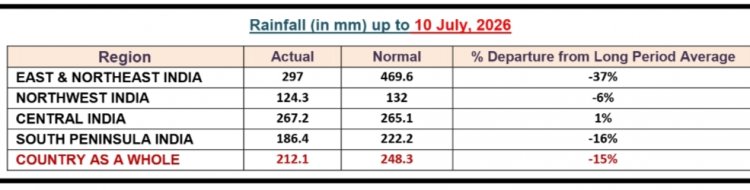
IMD data show that India received 212.7 mm of rainfall between June 1 and July 10, compared with the normal 248.3 mm, leaving the country with a 15 per cent rainfall deficit. Although July's active monsoon has improved the overall national picture, rainfall distribution remains highly uneven.
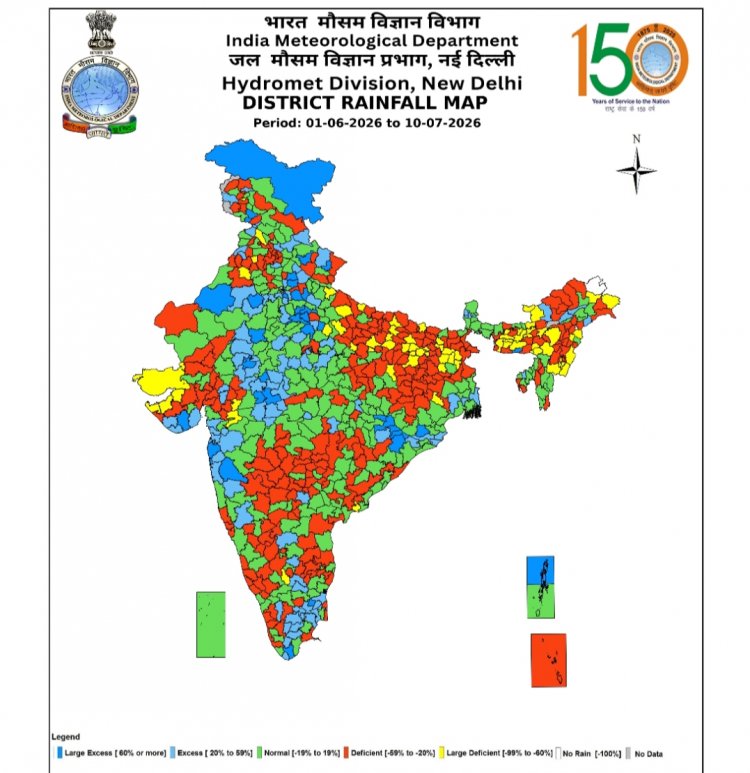
Out of 741 districts, 282 continue to report deficient rainfall, while 73 districts fall under the large deficient category. Together, 355 districts—covering nearly 48 per cent of the country's geographical area—remain rainfall deficient. Around 100 of these districts are heavily dependent on rainfall for irrigation, raising concerns for kharif crop growth.
Eastern and Northeastern India Continue to Lag
The regional disparity remains striking. Between June 1 and July 10, East and Northeast India recorded a 37 per cent rainfall deficit, the highest among all regions. Northwest India received 6 per cent below-normal rainfall, while Central India recorded 1 per cent above-normal rainfall. South Peninsular India remained 16 per cent below normal.
Several states and Union Territories, including Punjab, Bihar, Jharkhand, Kerala and Assam, continue to remain in the deficient rainfall category.
The imbalance was equally evident during the first week of July. Between July 2 and 8, Central India received 137 per cent above-normal rainfall, while Northwest India recorded 18 per cent above normal and South Peninsular India 6 per cent above normal. In contrast, East and Northeast India received 46 per cent below-normal rainfall during the same period, highlighting the persistent weakness of the monsoon in that region.
Monsoon Marked by Dual Imbalance
So far this season, the southwest monsoon has displayed a dual imbalance—both in timing and spatial distribution. After an exceptionally dry June, rainfall surged abruptly in early July. At the same time, while parts of central and western India have experienced excess rainfall, eastern and northeastern regions continue to grapple with severe deficits.
The coming weeks will be crucial for kharif crops, reservoir storage and the rural economy, as rainfall during July and August will determine whether the early-season deficit can be fully offset.
Weak El Niño Conditions Under Watch
Weather scientists are also closely monitoring evolving ocean-atmosphere conditions. According to the IMD, weak El Niño conditions persist over the equatorial Pacific Ocean and are expected to strengthen during the remainder of the monsoon season. Meanwhile, the Indian Ocean Dipole (IOD) remains neutral, offering neither favourable nor adverse support to the monsoon at present.