
How India-first Google AI models are driving local impact and going global
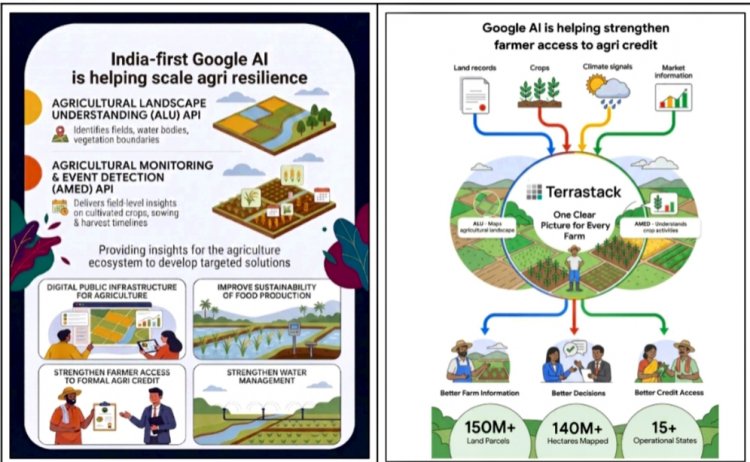
Google DeepMind’s India-first AI models, Agricultural Landscape Understanding (ALU) and Agricultural Monitoring & Event Detection (AMED), are helping strengthen agricultural resilience in India while driving impact globally.

 Join the RuralVoice whatsapp group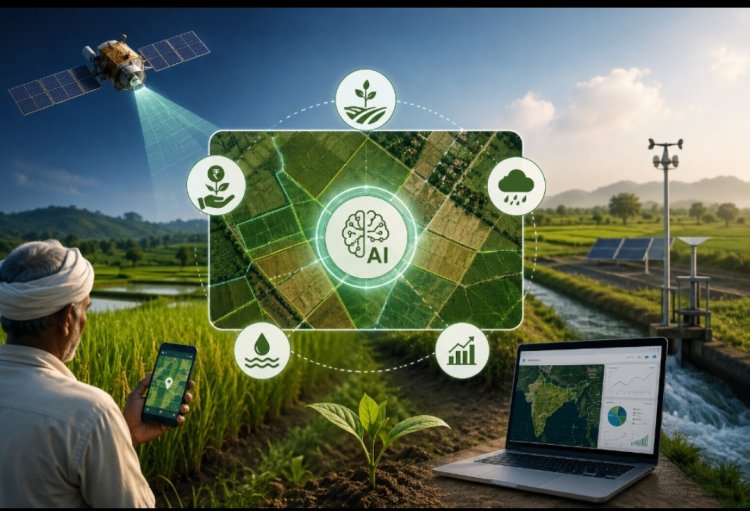
As the global agriculture and food system faces growing pressure from climate change, resource constraints and rising food demand, artificial intelligence is emerging as a key tool for improving farm-level intelligence and strengthening agricultural resilience.
Google DeepMind said two of its India-first AI models — Agricultural Landscape Understanding (ALU) and Agricultural Monitoring & Event Detection (AMED) — are now being used across a growing range of agricultural applications in India and other countries.
The models use satellite imagery to map agricultural field boundaries and monitor farming activity. Originally developed to support India’s agriculture ecosystem, their outputs have now been shared with trusted testers in 11 countries across Asia-Pacific and Africa. The data is also available to the wider ecosystem through APIs and Google Earth, where the ALU data layer has emerged as one of the platform's most popular layers globally.
From field mapping to sustainable farming
The AI models are being used by organisations working on sustainable agriculture, financial services, government platforms and water management.
CarbonFarm, for instance, is using Google's ALU API along with Gemini to generate automated field-level insights, particularly for delineating agricultural fields. The technology is being deployed in programmes aimed at reducing the environmental impact of rice cultivation.
The company has set a target of supporting 2 million hectares of low-carbon rice cultivation by 2030.
According to CarbonFarm Chief Operating Officer Aparna Raturi, one of the biggest challenges in scaling sustainable rice cultivation has been measuring and verifying environmental outcomes at the farm level.
By mapping individual fields through ALU, using satellite-based verification of farming practices and providing farmers with real-time feedback through Gemini, the company is seeking to measure adoption of improved practices, water outcomes and reductions in methane emissions.
Improving access to agricultural credit
Spatial intelligence company Terrastack is using the ALU and AMED APIs to build a platform that has mapped more than 140 million hectares of farmland.
The platform reduces the dependence on physical field visits and aims to help lenders, insurers, governments and agribusinesses make faster and more informed decisions.
Aaryan Dangi, Co-founder and CEO of Terrastack, said that more than 100 million farming households remain underserved because of the lack of reliable farm-level information.
He said the AI models are helping transform fragmented data on land, crops and farm income into actionable intelligence, creating a digital foundation that could expand farmers' access to financial and other agricultural services.
Supporting Telangana's digital agriculture platform
In Telangana, the state's ADEX platform is integrating ALU and AMED as part of efforts to build a digital infrastructure for agricultural innovation.
The platform is designed to support more than 5 million farmers in the state and is being used for capabilities such as field boundary delineation, crop stress analysis, early-warning systems and hyperlocal agricultural advisories.
One such initiative is a pilot of the Krishivaas application, which provides information on crop stress, crop-specific weather patterns and localised pest outbreaks.
The Information Technology, Electronics and Communications Department of the Telangana government said the integration of these datasets is helping create a shared platform that government departments, universities, startups and other partners can build upon.
AI for water management in Karnataka
The Karnataka Water Resources Department is also using the models alongside local weather data, remote sensing information and other datasets to strengthen water management across the state's 2.6 million hectares of irrigated area.
The Advanced Centre for Integrated Water Resources Management said that integrating ALU and AMED with the Karnataka Water Resources Information System, field observations and community participation has improved access to timely and more precise crop intelligence.
The data is expected to help identify areas where water productivity can be improved and support more informed decisions on sustainable management of water resources across river basins.
Going global through FAO
The technology is also being extended to global agricultural data systems.
The UN Food and Agriculture Organization's new geoAI4stats initiative plans to integrate ALU and AMED into FAO's global CROPGRIDS data repository. The initiative has received support from Google.org under the AI Collaborative: Food Security programme.
The project aims to strengthen the availability of timely and granular agricultural data for countries, supporting agricultural planning, sustainability initiatives and food security interventions.
Francesco Tubiello, FAO Senior Statistician and geoAI4stats Project Lead, said the initiative combines AI, geospatial intelligence and statistical systems to improve agricultural decision-making.
He said stronger agricultural data could help countries develop better insights for planning and sustainability while accelerating the transformation of agri-food systems.
India-first models with wider ambitions
Alok Talekar, Lead, Agriculture and Sustainability Research at Google DeepMind and head of the AnthroKrishi team, said the growing use of the models across applications such as agricultural credit, crop advisories and policy decision-making validates the approach of developing targeted AI solutions for agriculture.
“Our AnthroKrishi team has been dedicated to supporting targeted agricultural solutions that both increase farm productivity and reduce climate impact,” Talekar said.
“The growing application of our India-first AI models' APIs to impact-focused solutions — ranging from farmer credit, to crop advisory and policy decision-making — across both the Indian and global ecosystem encourages us in our approach.”