
Carbon Is A New Crop, And The Harvest Has Begun
India’s smallholder farmers have begun receiving carbon credit payments for adopting regenerative agricultural practices, marking a breakthrough in farm-based carbon markets. The initiative offers additional income, incentivises sustainable cultivation and creates new opportunities for farmers to benefit from climate-friendly agriculture.

 Join the RuralVoice whatsapp group
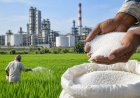
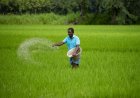
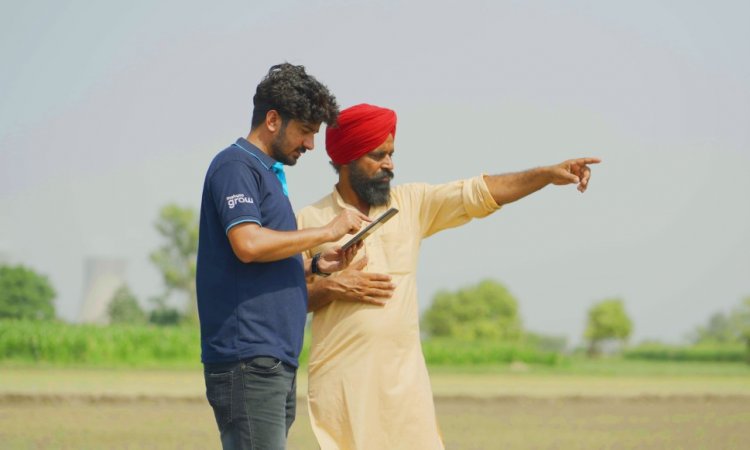
In 2019, a few thousand farmers in Punjab and Haryana agreed to try something their neighbours were wary of. Instead of transplanting paddy into flooded fields, they sowed the rice seed directly. After the rice harvest, instead of burning the straw, they left it in the field and sowed wheat with no tillage or reduced tillage. Most did it for good farming reasons: less water, less labour, and one less battle with the rice straw every October. Last month, these farmers started receiving the carbon credit payment for those practices. Most payments were between `3,000 and `15,000. The payments come from our Aadi project (VCS 2590), and they are the first soil organic carbon credit payments to smallholder farmers in India.
The science was never really the problem. Scientists have known for decades that flooded paddy emits methane, and that reduced tillage and keeping crop residue on the field increases soil organic carbon and hence improves soil health. However, anyone who has spent time in villages over the last few years knows how often farmers have heard the words “carbon credit” and never seen anything come of it. These farmers are being paid, years later, for work they did in their fields. That is why we see this as a turning point.
In our experience, carbon money reaches a farmer only when three things are in place. The farmer has to change how the land is managed. Someone has to prove that change, for each field enrolled in the carbon program. And there has to be a buyer willing to trust and pay for the carbon credits. Changing agricultural practice takes real effort, but it can be done. In Aadi, farmers made the switch with our Kisan Advisors providing the guidance on scientifically-grounded regenerative agriculture practices. What we lacked was a way to prove the carbon benefit on a small farm at a cost that makes sense. That piece now works, and what we have to fix next is the time it takes to complete the process.
What Exactly Is A Carbon Credit?
A carbon credit is one tonne of carbon dioxide equivalent kept out of the atmosphere (avoidance) or drawn back into the soil (removal), certified by an independent auditor. From an agriculture perspective, three greenhouse gases matter most: methane (largely from rice), nitrous oxide (largely from synthetic fertilizers), and carbon dioxide (from soil respiration, energy, and also sequestration of carbon in the soil). All these emissions are converted into the amount of carbon dioxide that would cause the same warming (CO2 equivalent or CO2e). A farmer can hold a quintal of wheat in his hand. He cannot hold a tonne of carbon. We were asking people to believe in something invisible, on the promise of money that would arrive years later, and belief like that had to be earned. Each carbon credit has its own serial number on a public registry, so anyone can look it up. It shows which project it came from and which years. And, a credit can be used only once. When a company buys and claims it, the credit is retired and cannot be sold again.
There is also a second, faster route. Through ClearHarvest, our sustainable sourcing programme, companies that buy the farmer's crop pay a premium for the lower emissions in their own supply chain. The farmer gets this money when the crop is sold, instead of waiting years for a credit to be issued. The same reduction counts only once, i.e. either as a carbon credit or towards a company's supply chain.
On a farm, credits may come from two different things. The first is avoiding emission. For example, if the farmer sows rice directly, or lets the field dry out between irrigations, less methane is emitted. Using less diesel or less urea also reduces emissions. The second is carbon removed from the air and stored in the soil. Plants take carbon from the air as they grow. When roots and straw stay in the field, and the soil is not disturbed frequently, more of that carbon stays in the ground.
Avoidance and removals have different risk profiles. Methane that was never released is permanent, whereas soil carbon can be lost again if the farmer goes back to heavy ploughing or burning. That is why soil carbon projects have a long duration and ask for a long commitment from the participating farmers.
Why It Took So Long
People have talked about paying farmers for carbon since the Kyoto Protocol. The Clean Development Mechanism, which brought carbon money to Indian wind energy farms and factories in the 2000s, did almost nothing for smallholder farmers. In the last few years, several carbon programs signed up farmers with talk of future income, and many of those farmers are still waiting to hear back.
Looking Back, Three Things Held It Up
The first was the size of each farm. Measuring one factory chimney is simple. However, proving what happened on thousands of small plots, each farmed a little differently every season, was slow and expensive. Moreover, one acre in one year produces only a small carbon benefit. Unless thousands of farmers come together, measuring and checking it costs more than what it is worth.
The second was time. Soil carbon builds up slowly, and a project has to record several seasons, get through an independent audit, and then get through the registry’s review. For Aadi, the first round of credits covered 2019 to 2022, and those credits were issued only in January 2026. Carbon is a slow crop. The quiet value of a first payment is that it makes every payment after it believable.
The third was confidence in the market itself. For a long time, buyers were unsure whether carbon from smallholder farms could be measured well enough to stand up to scrutiny.
Wider questions about credit quality in the voluntary market only added to that caution. Aadi was a first of its kind, as no VM0042 project anywhere had issued credits from smallholder farms before, so there was no earlier example that buyers, auditors or farmers could point to. Someone had to go all the way from the field to a payment first, and in India that turned out to be Aadi.
What Is Different Now
Several things have come together over the last few years.
- The rules have caught up with small farms. Verra’s VM0042 methodology, and Gold Standard’s rules for rice methane, let a developer group thousands of small farms into one project. New farmers and new districts can keep being added over time, without starting from scratch.
- Measurement has become cheaper and better. Satellite images now show us, plot by plot, when a field was sown, whether it was flooded, whether it was tilled and whether the straw was burnt. Soil samples and crop models estimate the change in soil carbon and emissions. Our field staff help the farmers log their agronomy data in our monitoring system every season.
- Credits are issued only after the work is done and checked. What farmers are paid for is carbon that has already been measured and audited.
- The farmer’s share is transparently communicated before they enroll in the program. In Aadi, 75% of net carbon revenue goes to farmers.
- There are also new kinds of buyers. Until recently, credits were bought mostly by companies offsetting their own emissions. Now food, textile and beverage companies want to cut emissions within their own supply chains, on the farms that grow their raw material.
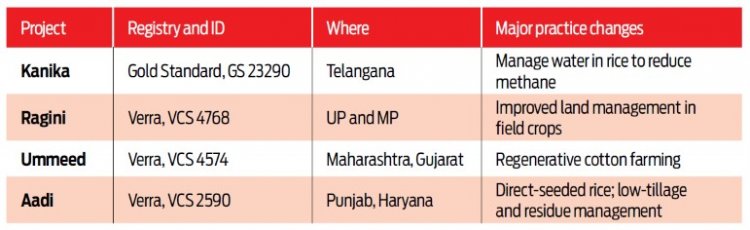
At Grow Indigo, all of this now shows up in four registered projects under two standards, across seven states.
What We Have Learnt Along The Way
The first lesson is that carbon money arrives years after the work is done, and that creates a real challenge. On paper, direct-seeded rice uses less water and needs no transplanting labour, and reduced tillage saves diesel and gets wheat into the ground sooner. In practice, very few farmers make the switch on their own. The first seasons may bring new weed problems, uncertain yields, unfamiliar machines, and the worry of being the only one in the village doing things differently. The carbon programme is what changes that. Because the
credits will come later, we can invest from the first season in Kisan Advisors, training and field support. Farmers get the assurance that sticking with the new practice will earn them an income on top of the farming benefits. So when we talk to farmers, we talk about both, the farming benefits they can expect once the practice settles in, and the carbon income that makes the early risk worth taking.
Second, methane from rice is quicker to quantify and is more certain than soil carbon. A tonne of methane that was never released cannot be undone later. Soil carbon, on the other hand, takes years to build and has to be protected. This is a big part of why our newest project, Kanika in Telangana, is built around methane from rice. India grows rice on more than 40 million hectares, so the room to grow here is very large.
Third, the payments have made carbon feel real to farmers. Many farmers had been told about carbon before and seen nothing. Once money reached people they knew, the question we heard changed from whether this was real to how to join.
Finally, the same practice can help farmers in more than one market. In Punjab, our ClearHarvest wheat programme was independently assessed under the SAI Platform’s Farm Sustainability Assessment. 82.5% of farms scored at Gold level and the rest at Silver. Food companies increasingly want to source grain grown this way, so a change in practice can bring carbon income and also better access to buyers for the crop.
What Comes Next
Carbon credits are not going to replace crop income or MSP. For most smallholder farmers, carbon will be an extra payment for a better way of farming. Still, for the first time in India, the climate benefit of what a farmer does in the field has been measured, verified and paid for.
Whether these payments become regular depends on a few things. The wait has to come down from years to a season or two, and registered projects, digital field records and regular monitoring now make that possible. Buyers also have to be willing to pay fair prices for high-quality farm credits. The science and the registries are ready, so demand will set the pace from here. I would like to see more Indian companies among those buyers.
Farmers, too, should ask hard questions before they sign anything. What share of the carbon money comes to me, and what is written in the participation agreement, and how will I know the credits were actually issued?
Aadi means “beginning”. With Ummeed, Ragini and Kanika now registered, cotton farmers in Maharashtra and Gujarat, farmers in Uttar Pradesh and Madhya Pradesh, and paddy growers in Telangana can follow the same path. Our job over the next few years is to make sure they do not have to wait seven years for it.
(Writer is Chief Operating Officer, Carbon, Grow Indigo)