
Government Tightens Sugar Stock Rules as Prices Stay Elevated, Orders Strict Compliance from Mills
The Centre has intensified efforts to keep sugar prices under control ahead of the festive season, tightening stock and dealer compliance rules while holding consultations with the sugar industry. Ex-mill sugar prices in Uttar Pradesh and Maharashtra are currently around Rs 4,800 per quintal, while uncertainty over the new crushing season and ethanol diversion continues.

 Join the RuralVoice whatsapp group
The Centre has stepped up its efforts to contain sugar prices amid concerns over elevated ex-mill rates and uncertainty over sugar availability during the upcoming festive season. The latest move comes days after a high-level meeting between the Food Ministry, officials from major sugar-producing states and representatives of the sugar industry, where the government pressed mills to ensure that sugar prices remain at reasonable levels.
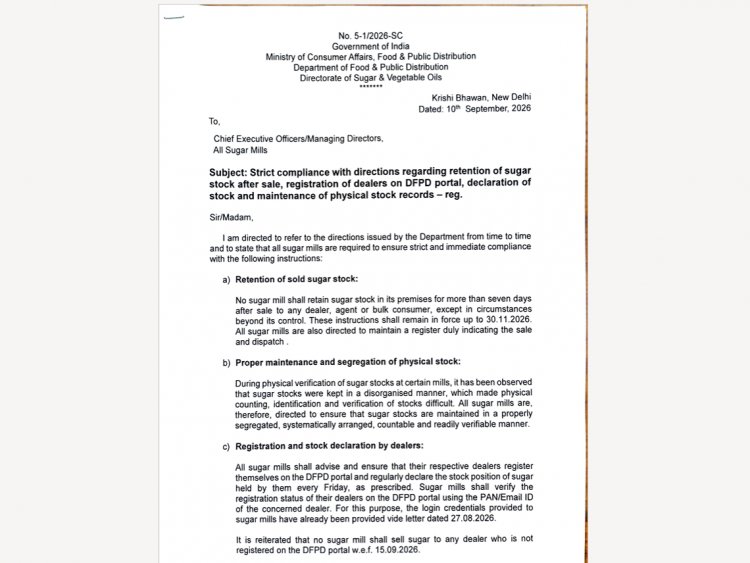
The government has now issued fresh directions to all sugar mills, tightening monitoring of sugar stocks, dealer registration and dispatches. In a letter dated September 10, 2026, the Directorate of Sugar & Vegetable Oils under the Department of Food & Public Distribution directed mills to strictly comply with the prescribed stock-related norms.
The government has been concerned over the unexpected rise in sugar prices after production estimates for the 2025-26 crushing season did not materialise as initially expected. Despite measures such as changes in the monthly sugar release quota, new sales norms and inspections of traders, prices have again moved up.
After these measures, ex-mill sugar prices had fallen to around Rs 4,250-4,300 per quintal, but subsequently recovered. On Thursday, prices in both major sugar-producing states, Uttar Pradesh and Maharashtra, were around Rs 4,800 per quintal.
Price Gap Between UP-Maharashtra
According to senior industry sources, the widening gap between sugar prices in Uttar Pradesh and Maharashtra was one of the key reasons behind the recent meeting with the industry.
Normally, the price difference between the two states remains around Rs 200 per quintal. However, the gap had recently widened to as much as Rs 700 per quintal, with ex-mill prices touching around Rs 5,100 per quintal in Uttar Pradesh, compared with about Rs 4,400 per quintal in Maharashtra.
The sharp divergence ahead of the festive season heightened concerns within the Food Ministry and prompted discussions with the industry.
The meeting was attended by the president, vice-president and director general of the Indian Sugar & Bio-energy Manufacturers Association (ISMA), the chairman and managing director of the National Federation of Cooperative Sugar Factories (NFCSF), and the sugar commissioners of Uttar Pradesh, Maharashtra and Karnataka, along with senior officials of the Food Ministry. The Karnataka Sugar Commissioner participated online.
During the meeting, Uttar Pradesh Sugar Commissioner also highlighted the difference between the ex-mill prices of cooperative and private sugar mills in the state. The industry was urged to remain sensitive to the government's concerns over sugar prices.
Industry Comfortable with Current Prices
A senior sugar industry official told Rural Voice that the industry is currently comfortable with prevailing prices as they allow mills to cover their costs and earn some margin.
According to the official, ex-mill sugar prices in Uttar Pradesh and Maharashtra are now around Rs 4,800 per quintal, with prices in the two states broadly converging.
The official said inspections by government authorities have reduced considerably, bringing greater stability to the market. The earlier inspections had created uncertainty among traders, contributing to the decline in prices to around Rs 4,300 per quintal.
The subsequent recovery, the official said, reflects market conditions and is considered reasonable by the industry.
Government Tightens Stock Monitoring
The latest government directive makes it clear that mills will face closer scrutiny of their physical stocks and sales.
Under the September 10 order, no sugar mill can retain sugar sold to a dealer, agent or bulk consumer on its premises for more than seven days after the sale, except in circumstances beyond its control. The direction will remain in force until November 30, 2026. Mills have also been asked to maintain proper records of sales and dispatches.
The government has also directed mills to keep physical sugar stocks properly segregated and systematically arranged so that they can be counted, identified and verified easily. The move follows observations during physical verification that stocks at some mills were being maintained in a disorganised manner.
Dealers Must Register on DFPD Portal
The government has further tightened the monitoring of sugar dealers. Mills have been instructed to ensure that their dealers register themselves on the Department of Food & Public Distribution (DFPD) portal and declare their sugar stocks every Friday.
Mills must verify the registration status of dealers using their PAN or email ID. More importantly, the government has reiterated that mills will not be permitted to sell sugar to dealers who are not registered on the DFPD portal from September 15, 2026.
The directive also requires mills to ensure that information submitted through the P-II return is accurate, complete and reconciled with their actual physical stocks and statutory records. Non-compliant mills may face denial of sugar release quota for the following fortnight, apart from other action under applicable provisions.
Mills have also been asked to submit details of opening stock, production, dispatches, releases and closing stock for the first fortnight of September by September 18, 2026.
The government has warned that discrepancies, suppression or misreporting of stocks, unauthorised retention of sold sugar, sales to unregistered dealers or failure to submit information within the prescribed deadline may invite action under the Sugar (Control) Order, 2025, read with the Essential Commodities Act, 1955.
Uncertainty Over October 15 Crushing
Meanwhile, there is some uncertainty over the start of the 2026-27 crushing season.
In Maharashtra, approval has reportedly been given for mills to commence crushing from October 15. However, industry sources believe that several mills may actually begin operations only after Dussehra on October 20, while some may wait until after Diwali.
The government has been encouraging mills to start crushing from October 15 to increase sugar availability in the market.
Ethanol Diversion Under Watch
The government's repeated interventions and meetings with the industry indicate that it is unwilling to take a risk of a sharp increase in sugar prices during the festive season.
At the same time, prospects for a significant improvement in sugarcane availability in the next season remain limited. During the 2025-26 season, sugar production stood at around 27.9 million tonnes, while about 3 million tonnes of sugar was diverted for ethanol production.
Whether the government will remain equally supportive of sugar diversion for ethanol in the 2026-27 season is difficult to predict at this stage. A clearer picture of sugar production is expected only by January.
Retail sugar prices are currently around Rs 62-65 per kg, keeping the issue firmly on the government's radar. With the festive season approaching and production prospects for the new season still uncertain, further consultations between the government and the sugar industry on prices, stocks and ethanol diversion are likely.