
Activists Allege ICAR and Agriculture Ministry of Rigging Results to Promote Genome-Edited Rice Varieties
Citing ICAR’s official trial data, the Coalition for a GM-Free India alleged that results for two genome-edited rice varieties — Pusa DST-1 and DRR Dhan 100 (Kamala) — have been rigged and hyped to manufacture false claims of success.

 Join the RuralVoice whatsapp group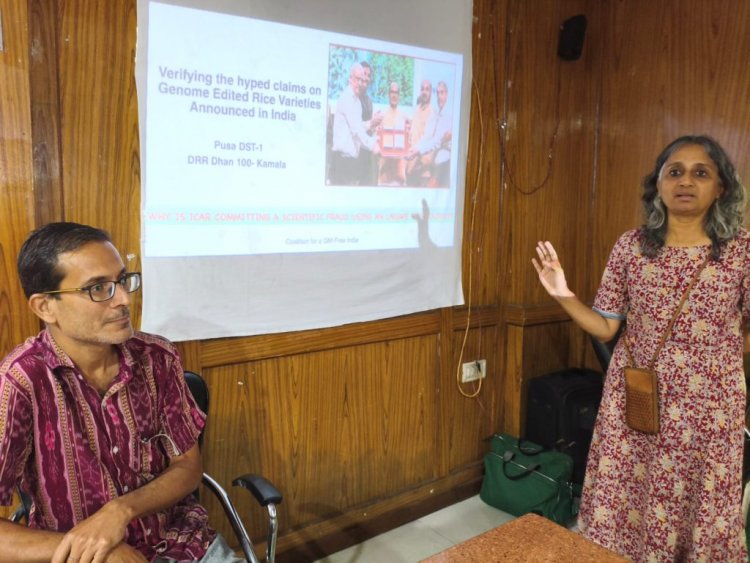
The Coalition for a GM-Free India accused Indian Council of Agricultural Research (ICAR) and the Ministry of Agriculture of rigging results to promote genome-edited rice varieties. Citing ICAR’s official trial data, the Coalition alleged that results for two genome-edited rice varieties — Pusa DST-1 and DRR Dhan 100 (Kamala) — have been rigged and hyped to manufacture false claims of success.
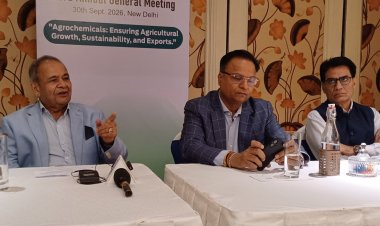
In a press conference held on Thursday in New Delhi, the Coalition presented data extracted from the Annual Progress Reports (2023 and 2024) of ICAR’s All India Coordinated Research Project on Rice (AICRPR), available in the public domain. The findings claim the pattern of scientific manipulation, where ICAR’s conclusions directly contradict its own data. The Coalition for a GM-Free India called it a “scientific fraud” in the name of genome-edited rice.
In this regard, the Coalition wrote a letter to Union Agriculture Minister Shivraj Singh Chouhan, demanding that an independent investigation be instituted immediately to verify the claims and testing, and that all claims made so far be withdrawn pending the inquiry.
The Coalition warned that this hasty promotion of untested, underperforming and unsafe varieties — camouflaged in hype around a so-called global breakthrough — is nothing but an attempt to bypass public resistance to risky gene technologies in India’s food systems. The switch to genome editing, that too by compromising on regulatory requirements, is in itself an admission of the failure of GM crops. Meanwhile, Gene Editing is genetic engineering too, technically and by legal definitions.
Hype Vs. Evidence
On May 4, 2025, Union Agriculture Minister Shivraj Singh Chauhan “announced” two genome-edited rice varieties as a global first — Pusa DST-1 (IET 32043) and DRR Dhan 100 ‘Kamala’ (IET 32072). Pusa DST-1 was claimed to outperform its non-GM parent MTU-1010 (Cotton Dora Sannalu) under saline and alkaline soils, while Kamala, derived from BPT 5204 (Samba Mahsuri), was declared to yield 17% higher, mature 20 days earlier, and use nitrogen more efficiently.
Coalition’s findings claim that behind the orchestrated hype lies a shocking absence of real data. The claims are not supported by evidence, and in fact, the reports themselves disprove them. Public money being spent on such dubious technologies becomes a matter of public accountability.
Question on Scientific Integrity
The Coalition said that the manipulations are not minor errors but a dangerous pattern of bad science, repeated over time to justify controversial technologies. Contradictions exist even in basic parameters — like panicle density (per Sq/M), days taken for 50% flowering, and grain quality — all altered to suit the narrative.
For instance, on DFF (Days for 50% Flowering), the annual reports of AICRPR do not contain any data to show a difference of 20 days between Kamala and parent. Overall mean DFF for Kamala is 101 days and for BPT 5204 it is 104 days. In five zones, Kamala’s DFF is less by 2 to 7 days, and in two zones, it is more by 8 to 9 days. Against this backdrop, it is not clear how conclusions were drawn with bombastic claims made on not just early maturity, but lower usage of water and fertiliser etc.!
“If the technology being used is truly safe, precise and effective, there should be no hesitation in putting out all data and conducting proper testing, as is done for all GMOs,” said Soumik Banerjee, independent researcher.
“Doing bad science in agriculture, that too from the public sector, has a direct bearing on the lives and livelihoods of millions of farmers,” said Kavitha Kuruganti, activist and Coalition member. “It is not to be taken lightly — this becomes a matter of fundamental human rights. How can the jumla culture be allowed to enter the scientific arena at all? It is up to India’s upright scientists to call out this fraud and ensure that our scientific establishment does not bring shame on itself.”
Coalition’s Demands
The Coalition for a GM-Free India demanded to Immediate withdrawal of all promotional claims about genome-edited rice varieties and an independent, transparent scientific review of ICAR’s AICRPR trial data and methodology. A moratorium on genome-edited crop releases until credible biosafety regulations and independent oversight mechanisms are in place. All genome editing to be brought under stringent regulations, and all reports related to the R&D of these varieties to be placed in the public domain.